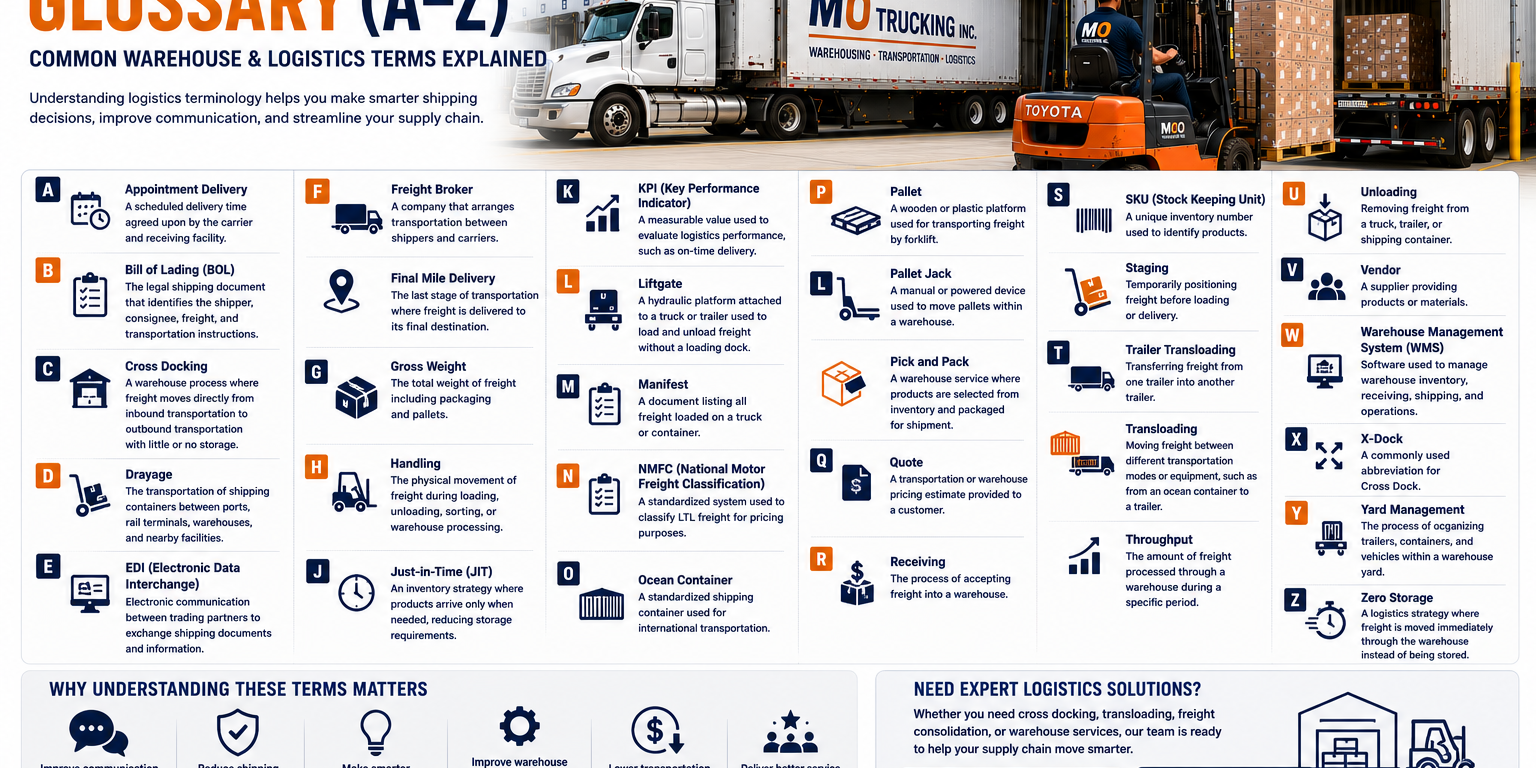
Cross Docking Glossary (A–Z): Common Warehouse & Logistics Terms Explained
Whether you’re an importer, manufacturer, retailer, freight broker, or logistics professional, understanding common warehouse terminology can help you make better transportation decisions and improve communication throughout the supply chain.
If you’re researching a Cross Dock Warehouse New York, this glossary explains many of the most common terms used in cross docking, transloading, freight handling, warehousing, and transportation.
A
Appointment Delivery
A scheduled delivery time agreed upon by the carrier and receiving facility.
Asset-Based Carrier
A transportation company that owns and operates its own trucks, trailers, drivers, and equipment.
B
Bill of Lading (BOL)
The legal shipping document that identifies the shipper, consignee, freight, and transportation instructions.
Backhaul
A return shipment that helps eliminate empty miles after a delivery.
C
Carrier
A company responsible for transporting freight.
Consolidation
Combining multiple shipments into one outbound shipment to reduce transportation costs.
Cross Docking
A warehouse process where freight moves directly from inbound transportation to outbound transportation with little or no long-term storage.
Cube Utilization
The percentage of trailer space being used during transportation.
D
Distribution
The movement of products from warehouses to customers.
Dock Door
A loading bay where trucks are loaded or unloaded.
Detention
Additional charges when a truck is delayed beyond the free loading or unloading time.
Drayage
The transportation of shipping containers between ports, rail terminals, warehouses, and nearby facilities.
E
EDI (Electronic Data Interchange)
Electronic communication between trading partners to exchange shipping documents and information.
F
Final Mile Delivery
The last stage of transportation where freight is delivered to its final destination.
Floor Loaded Container
A shipping container where products are loaded directly on the floor instead of on pallets.
Freight Broker
A company that arranges transportation between shippers and carriers.
Freight Consolidation
Combining freight from multiple suppliers into one outbound shipment.
G
Gaylord
A large corrugated bulk container commonly used for loose products and recyclable materials.
Gross Weight
The total weight of freight including packaging and pallets.
H
Handling
The physical movement of freight during loading, unloading, sorting, or warehouse processing.
Hub
A central warehouse or transportation facility where freight is transferred before continuing to its destination.
I
Products entering the United States from another country.
Inventory
Products stored inside a warehouse before distribution.
J
Just-in-Time (JIT)
An inventory strategy where products arrive only when needed, reducing storage requirements.
K
KPI (Key Performance Indicator)
A measurable value used to evaluate logistics performance, such as on-time delivery or warehouse throughput.
L
Liftgate
A hydraulic platform attached to a truck or trailer used to load and unload freight without a loading dock.
LTL (Less Than Truckload)
Freight shipments that do not require a full trailer.
M
Manifest
A document listing all freight loaded on a truck or container.
Material Handling
The movement, storage, protection, and control of products throughout the warehouse.
N
NMFC (National Motor Freight Classification)
A standardized system used to classify LTL freight for pricing purposes.
O
Ocean Container
A standardized shipping container used for international transportation.
Outbound Freight
Freight leaving the warehouse for delivery.
P
Pallet
A wooden or plastic platform used for transporting freight by forklift.
Pallet Jack
A manual or powered device used to move pallets within a warehouse.
Pick and Pack
A warehouse service where products are selected from inventory and packaged for shipment.
Q
Quote
A transportation or warehouse pricing estimate provided to a customer.
R
Receiving
The process of accepting freight into a warehouse.
Reload
Moving freight from one trailer or container into another.
S
SKU (Stock Keeping Unit)
A unique inventory number used to identify products.
Staging
Temporarily positioning freight before loading or delivery.
Supply Chain
The complete network involved in producing, transporting, storing, and delivering products.
T
Transferring freight from one trailer into another trailer.
Transloading
Moving freight between different transportation modes or equipment, such as from an ocean container to a trailer.
Throughput
The amount of freight processed through a warehouse during a specific period.
U
Unloading
Removing freight from a truck, trailer, or shipping container.
V
Vendor
A supplier providing products or materials.
W
Warehouse Management System (WMS)
Software used to manage warehouse inventory, receiving, shipping, and operations.
Warehouse Distribution
The process of receiving, sorting, storing when necessary, and shipping products to customers.
X
X-Dock
A commonly used abbreviation for Cross Dock.
Y
Yard Management
The process of organizing trailers, containers, and vehicles within a warehouse yard.
Z
Zero Storage
A logistics strategy where freight is moved immediately through the warehouse instead of being stored.
Why Understanding Warehouse Terms Matters
Knowing common logistics terminology helps businesses:
- Improve communication with carriers
- Reduce shipping mistakes
- Better understand freight quotes
- Improve warehouse efficiency
- Make smarter transportation decisions
- Select the right logistics services
Whether you’re shipping one pallet or multiple truckloads every week, understanding these terms makes working with warehouse and transportation providers much easier.
Frequently Asked Questions
Why is it important to understand logistics terminology?
Understanding logistics terminology helps businesses communicate more effectively with carriers, warehouses, freight brokers, and customers while reducing confusion during the shipping process.
What is the most important warehouse term to know?
Cross docking is one of the most valuable concepts because it helps businesses reduce storage, improve delivery speed, and lower transportation costs.
Is transloading the same as cross docking?
No. Cross docking focuses on quickly moving freight through a warehouse, while transloading transfers freight between different types of transportation or equipment.
What does LTL mean?
LTL stands for Less Than Truckload and refers to shipments that share trailer space with freight from other customers.
What is a dock door?
A dock door is a loading position where trucks and trailers are loaded or unloaded at a warehouse.
Final Thoughts
The logistics industry uses hundreds of specialized terms, but understanding the fundamentals can make managing freight much easier. Whether you’re arranging transportation, importing products, or coordinating warehouse operations, knowing these common warehouse and shipping terms will help you make informed decisions and communicate more effectively with your logistics partners.
As your business grows, having a solid understanding of cross docking, freight handling, transportation, and warehouse terminology will help you build a more efficient and reliable supply chain.
Need Expert Warehouse & Logistics Support?
If you’re looking for cross docking, transloading, freight consolidation, or warehouse services, Request a Free Quote and our logistics specialists will develop the right solution for your freight.
Have questions about warehouse operations or transportation? Contact Our Warehouse Team today. We’re ready to help keep your supply chain moving efficiently.