
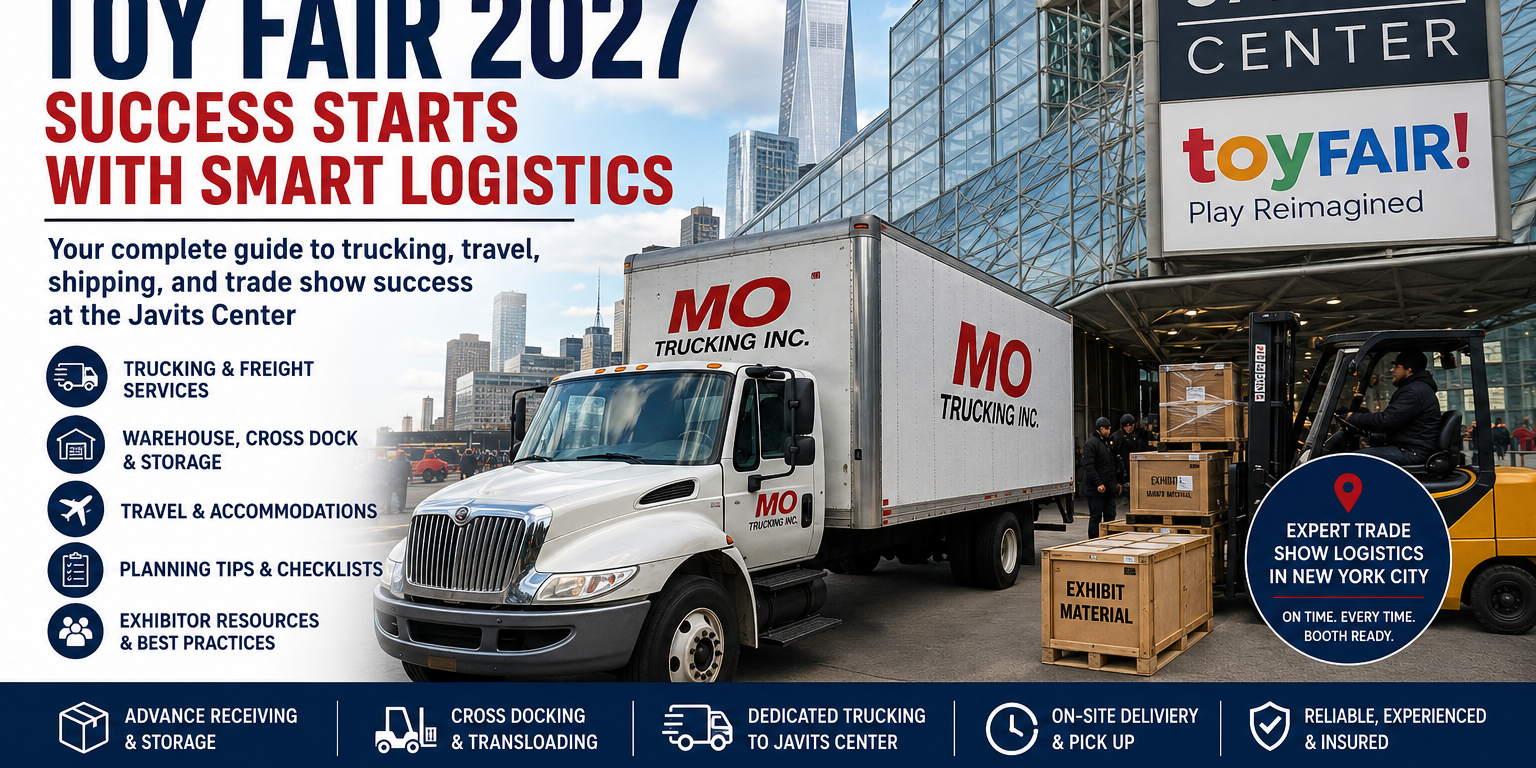
The Ultimate Guide to Toy Fair 2027 in New York City
Travel, Trucking, Hotels, Freight, Booth Setup, Networking & Everything You Need for a Successful Trade Show
Toy Fair New York is more than a few days of walking through aisles filled with new products. For manufacturers, distributors, inventors, retailers, licensors, sales representatives, importers, and other toy-industry professionals, it can be one of the most important business events of the year.
Toy Fair 2027 will take place February 20–23, 2027 at the Jacob K. Javits Convention Center in New York City. The Toy Association describes it as the largest trade-only toy and play industry event in the Western Hemisphere, bringing together buyers, manufacturers, licensors, inventors, media professionals, retailers, and other industry decision-makers.
But having a successful Toy Fair starts long before the doors open.
Your products have to arrive.
Your booth has to be ready.
Your employees have to get to New York.
Your hotel rooms need to be booked.
Meetings should already be scheduled.
Samples need to be organized.
Your freight needs a plan for both move-in and move-out.
And once the show begins, every hour matters.
This Ultimate Guide to Toy Fair 2027 covers the entire process—from trucking and trade show freight to airline travel, hotels, transportation around Manhattan, booth planning, networking, sales strategy, lead generation, meals, winter weather, move-out, and post-show follow-up.
Toy Fair 2027 Quick Facts
Dates: February 20–23, 2027
Location: Jacob K. Javits Convention Center, New York City
Show Hours:
- Saturday, February 20: 10:00 AM–6:00 PM
- Sunday, February 21: 9:00 AM–6:00 PM
- Monday, February 22: 9:00 AM–6:00 PM
- Tuesday, February 23: 9:00 AM–4:00 PM
Toy Fair is a trade-only event and is not open to the general public. The official FAQ also notes that badges cover all four show days and are not mailed in advance; badge pickup takes place at designated locations at the Javits Center.
Exhibitor applications for 2027 are already open, while attendee registration is scheduled to open in fall 2026.
- Start Planning for Toy Fair Months in Advance
One of the biggest mistakes a company can make is treating Toy Fair like an ordinary four-day business trip.
It isn’t.
For an exhibitor, Toy Fair is a logistics project, marketing campaign, sales event, product launch, transportation operation, and corporate travel program happening simultaneously.
Ideally, create one master Toy Fair plan containing:
- Booth information
- Exhibitor deadlines
- Product list
- Freight requirements
- Shipping dates
- Trucking company contacts
- Advance warehouse information
- Hotel confirmations
- Flight information
- Employee schedules
- Buyer meetings
- Press meetings
- Dinner reservations
- Sample inventory
- Marketing materials
- Equipment orders
- Lead-capture procedures
- Emergency contacts
- Move-out instructions
- Return freight arrangements
The Toy Association is providing a series of Exhibitor Academy sessions throughout the 2027 planning cycle covering areas including shipping products, booth setup, move-in and move-out, hotels, staff registration, PR, online profiles and final pre-show preparation.
Take advantage of them.
- Trade Show Trucking: One of the Most Important Parts of Toy Fair
You can have the greatest booth design in the building, but it doesn’t matter much if your display or merchandise isn’t there when setup begins.
Trade show trucking should be planned early.
Shipping freight to a major Manhattan convention center is different from delivering a normal commercial shipment.
You have:
- Show deadlines
- Target move-in schedules
- Marshaling requirements
- Dock appointments
- General service contractors
- Union freight handling
- Limited delivery windows
- Manhattan traffic
- Potential detention
- Special labeling requirements
- Move-out congestion
Toy Fair’s 2027 exhibitor resources specifically include Shipping & Move-In Logistics, and an Exhibitor Academy session scheduled for December is dedicated to the target move-in schedule, booth setup timing, breakdown logistics and the differences between shipping to an advance warehouse and shipping directly to the show site.
Do not wait until February to develop your freight strategy.
- Understand the Difference Between Your Trucking Company and Show-Site Freight Handling
This distinction is extremely important.
Your trucking company transports your freight to the designated delivery point.
Once freight reaches the convention center’s controlled freight environment, the event’s general service contractor and Javits Center freight handlers become involved.
According to Javits Center policies, its freight handlers are responsible for loading and unloading trucks and moving exhibitor freight between the loading area and exhibit booths. Freight handlers work under the direction of the show’s general service contractor.
That means exhibitors should not assume their outside trucking company can simply drive into the building, unload pallets and carry them directly to the booth.
Trade show logistics do not work like ordinary dock delivery.
- Direct-to-Show Shipping vs. Advance Warehouse Shipping
Exhibitors may eventually have multiple freight options listed in the Toy Fair Exhibitor Kit.
Two common trade show strategies are:
Advance Warehouse
Freight is shipped to a designated warehouse before the show.
The show contractor receives it, stores it according to the program rules and eventually transports it to your booth during move-in.
This can offer additional schedule flexibility.
Direct-to-Show
Your carrier holds the freight until the show’s assigned receiving date and delivers according to the official move-in instructions.
This can eliminate one storage step but requires very careful scheduling.
For 2027, exhibitors should wait for the official Toy Fair Exhibitor Kit and target move-in instructions before finalizing their shipping method. The Toy Association says additional Shipping & Move-In resources are being released during the 2027 planning cycle.
- Javits Center Truck Deliveries Require Planning
The Javits Center has extensive trade show freight infrastructure, including a dedicated multi-level truck marshaling facility.
Its policies state that event-related deliveries must be received by the event’s General Service Contractor, and drivers are required to check in before accessing the facility. Javits also states that it does not accept advance event deliveries directly before the contracted move-in period.
That makes communication between your:
Exhibitor → Trucking Company → General Service Contractor → Javits Logistics Team
extremely important.
Provide your carrier with complete information well ahead of delivery.
Your trucking instructions should eventually include:
- Exhibiting company
- Toy Fair 2027
- Booth number
- Number of pallets
- Number of cartons
- Total shipment weight
- PRO or tracking number
- Delivery date
- Target move-in date
- Delivery address specified by the show
- Contractor information
- Marshaling instructions
- Appointment number
- On-site contact
- Cell phone numbers
- Special handling instructions
Print several copies of your Bill of Lading and shipping documentation.
- Why a Local New York Trucking Partner Can Be Valuable
Companies located outside the New York metropolitan area often underestimate how complicated a Manhattan trade show delivery can become.
A local trucking company can be particularly valuable when you need flexibility.
For example, your freight may arrive in New York earlier than expected.
Instead of keeping a long-distance tractor-trailer waiting, an exhibitor may be able to arrange:
Long-distance carrier → Local warehouse → Cross-dock/storage → Local dedicated delivery → Javits receiving
This strategy can provide more control over the final leg of the shipment.
It can also help companies dealing with:
- Appointment changes
- Missed delivery windows
- Consolidated shipments
- Multiple vendors
- Late-arriving promotional materials
- Emergency replacement merchandise
- Pallet breakdowns
- Storage
- Cross-docking
- Straight-truck deliveries
- Tractor-trailer deliveries
- Liftgate requirements outside the show
- Post-show freight
- Toy Fair Trucking Services from MO Trucking Inc.
For companies exhibiting at Toy Fair 2027, MO Trucking Inc. can serve as a New York-area transportation resource for freight moving through the metropolitan region.
Depending on the shipment and official Toy Fair receiving requirements, services can include:
Local Trucking
Transportation throughout the New York metropolitan area.
Dedicated Trucking
Dedicated trucks for time-sensitive merchandise, displays, samples and exhibit materials.
Straight Trucks
Useful for smaller exhibit shipments or local transfers where a tractor-trailer is unnecessary.
Tractor-Trailer Service
For larger booth shipments, palletized product and full truckload movements.
Cross-Docking
Freight arriving on one trailer can be unloaded, reorganized and transferred onto a local delivery vehicle.
Short-Term Storage
Particularly useful when freight arrives before its approved trade show delivery window.
Emergency Transportation
If displays, samples or marketing materials are delayed, having a local trucking contact can sometimes be the difference between an empty booth and a successful opening day.
Post-Show Transportation
The logistics job does not end Tuesday afternoon.
Your booth, samples, displays and unsold merchandise still have to go somewhere.
Planning outbound transportation before Toy Fair begins is just as important as planning inbound transportation.
- Build Extra Time Into Your Freight Schedule
Do not schedule trade show freight based on the assumption that everything will happen perfectly.
February weather can affect transportation throughout the Northeast and Midwest.
A shipment traveling from Chicago, Detroit, Boston, Toronto, Pennsylvania or New England could encounter weather hundreds of miles before reaching Manhattan.
Your schedule should account for:
- Snow
- Ice
- Traffic
- Mechanical problems
- Loading delays
- Appointment delays
- Driver hours
- Road closures
- Missed connections
- Warehouse congestion
When the entire show depends on a shipment, early is generally better than barely on time.
- Never Send Freight to the Javits Center Without Instructions
This deserves its own section.
Do not simply address several pallets to:
Toy Fair – Javits Center – New York
and expect everything to work itself out.
Javits policies specify that it does not accept advance event deliveries directly and that event freight is handled through the event’s General Service Contractor.
Always follow the official 2027 Toy Fair Exhibitor Kit once your shipment instructions are issued.
- Hand-Carrying Products Is More Restricted Than You May Expect
Companies sometimes think they can avoid freight arrangements by loading products into an SUV or rental van and carrying everything inside.
There are strict limitations.
Javits Center’s current hand-carry policy restricts vehicle sizes, establishes designated access points and time periods, limits the equipment exhibitors can use and prohibits freight companies or outside contractors from using hand-carry procedures as a substitute for official freight handling.
For qualifying exhibitor hand-carry operations, merchandise generally needs to be manageable by company employees using permitted small carts and designated access areas.
If you have pallets, crates, large displays or commercial freight, plan on using the proper freight system.
- Do Not Forget About Move-Out
Move-out often creates more problems than move-in.
Everyone wants to leave at once.
Toy Fair 2027 ends at 4:00 PM on Tuesday, February 23.
That does not mean your freight will be sitting on a truck at 4:10 PM.
After the show closes:
- Booths begin breaking down.
- Empty containers may need to be returned.
- Products are repacked.
- Shipping paperwork is prepared.
- Freight is moved from booths.
- Trucks are staged.
- Shipments are loaded.
- Carriers depart.
Have your outbound plan ready before opening day.
Know:
- Where the freight is going
- Which carrier is picking it up
- Who is preparing the Bill of Lading
- Who has authority to release the shipment
- Whether freight is returning to your warehouse
- Whether it needs temporary storage
- Whether multiple shipments need to be separated
- Who is staying until freight is officially turned over
Never assume the person managing your booth Monday morning will automatically know what needs to happen Tuesday evening.
- Traveling to New York for Toy Fair 2027
If your team is flying into New York, your three primary airport choices are:
John F. Kennedy International Airport – JFK
JFK is a major choice for international travelers and offers connections to Manhattan using AirTrain together with the subway or Long Island Rail Road.
The airport’s current transportation information says AirTrain connects JFK with Jamaica and Howard Beach, providing access to LIRR and NYC subway service.
LaGuardia Airport – LGA
LaGuardia is geographically closer to Midtown Manhattan and can be especially convenient for many domestic flights.
Newark Liberty International Airport – EWR
Newark is across the Hudson River in New Jersey and provides rail connections toward Manhattan through NJ Transit/Amtrak connections from the airport rail station.
There is no universally “best” airport.
Compare:
- Airfare
- Nonstop availability
- Arrival time
- Departure time
- Checked baggage
- Airline reliability
- Ground transportation
- Your hotel location
A nonstop arriving at Newark may be better than a cheaper connecting itinerary into JFK.
Similarly, a flight arriving at LaGuardia during peak traffic may take longer than expected to reach Midtown.
- When Should You Arrive?
Exhibitors
Do not fly into New York the morning the trade show starts.
Your team needs time to:
- Check into the hotel
- Retrieve badges
- Inspect the booth
- Organize merchandise
- Test electronics
- Review meetings
- Fix problems
Employees responsible for setup may need to arrive several days before opening depending on the official move-in schedule.
Attendees
Arriving Friday for a Saturday opening is generally far more comfortable than taking an early Saturday flight and hoping everything runs perfectly.
Remember: February is winter travel season in New York.
Build flexibility into flights.
- Flying Home
Another common mistake is booking an early Tuesday flight because the traveler thinks, “The show ends Tuesday.”
Toy Fair remains open until 4:00 PM Tuesday.
If you’re an exhibitor, move-out continues afterward.
Avoid scheduling travel that forces your key employees to abandon your booth before the show officially ends.
For many exhibitors, departing Wednesday may be the more practical option.
- Where Should You Stay?
The most convenient strategy is generally staying in or near:
- Hudson Yards
- Midtown West
- Hell’s Kitchen
- Times Square
- Penn Station
- Garment District
The Javits Center is located on Manhattan’s West Side near Hudson Yards.
The Toy Association has an official Toy Fair hotel program through onPeak, which it identifies as the show’s exclusive housing partner. The Association specifically warns exhibitors and attendees about unauthorized companies impersonating the show and offering fraudulent hotel deals.
When evaluating hotels, compare more than room price.
Consider:
- Walking distance to Javits
- Subway access
- Breakfast options
- Meeting areas
- Late-night dining nearby
- Early check-in
- Luggage storage
- Wi-Fi
- Fitness center
- Business center
- Room size
- Cancellation policy
Saving $40 per night may not be worthwhile if six employees spend $30 each way on transportation every day.
- Staying Within Walking Distance Can Be Worth It
Trade show days are long.
You may leave your hotel at 7:00 AM and not return until 10:00 PM.
A hotel within walking distance can make it easier to:
- Return for forgotten materials
- Change clothes before dinner
- Drop off samples
- Avoid rush-hour traffic
- Attend early meetings
- Stay later at the booth
- Give employees more rest
For larger teams, calculate the total cost of transportation, not just the hotel rate.
- Getting to the Javits Center
One of the easiest subway options is the 7 train to 34 St–Hudson Yards, the closest subway station to the Javits Center. Toy Fair’s FAQ also identifies the M12, M34 and M42 as nearby bus routes.
Other options include:
- Walking
- Taxi
- Rideshare
- Private car
- Company transportation
Traffic around major convention events can become heavy.
A hotel that appears ten minutes away by car may take substantially longer during morning congestion.
- Prepare for February Weather
New York in February can be cold, wet, windy or snowy.
Travel with:
- Warm coat
- Gloves
- Comfortable waterproof shoes
- Umbrella
- Extra socks
- Layers
- Portable charger
- Small travel umbrella
- Backup travel day when possible
Trade show professionals spend much more time walking than they expect.
Comfortable shoes may be one of the most important items you pack.
- What to Pack for Toy Fair
Personal Items
- Business clothing
- Comfortable shoes
- Extra pair of shoes
- Winter coat
- Umbrella
- Chargers
- Portable power bank
- Medication
- Toiletries
- Business cards
- ID
- Travel documents
Booth Items
- Product samples
- Catalogs
- Price sheets
- Order forms
- Pens
- Tape
- Scissors
- Zip ties
- Velcro
- Markers
- Extension cables where permitted
- Chargers
- Backup tablet
- Cleaning wipes
- Small first-aid kit
- Snacks
- Water
- Staff schedule
- Buyer meeting calendar
Keep critical items with you whenever practical.
Do not place the only copy of your presentation, buyer list or sales materials inside checked luggage.
- Internet and Technology
The Javits Center offers wireless internet, but exhibitors using bandwidth-intensive applications should evaluate available paid connectivity options rather than assuming complimentary Wi-Fi will handle everything. Toy Fair’s FAQ describes the complimentary network as intended for lighter business uses such as browsing and email.
If your booth relies on:
- Streaming video
- Cloud demonstrations
- Interactive displays
- Video conferencing
- Live ordering systems
test your connectivity solution before show day.
Also have a backup.
Download important product information locally onto your devices.
- Build a Booth That Explains Your Brand in Five Seconds
People walking through Toy Fair are overwhelmed with visual information.
Your booth should immediately communicate:
- Who are you?
- What do you sell?
- Why should I stop?
Avoid filling every square inch with text.
Make hero products visible.
Create clear demonstrations.
Use strong signage.
Give visitors a reason to enter.
The Toy Association is again emphasizing visual merchandising for 2027 and is offering Exhibit Design Reimagination Awards recognizing effective and creative exhibit presentation.
- Demonstrations Beat Descriptions
Toys are inherently interactive.
Whenever practical, demonstrate the product instead of explaining it for five minutes.
A buyer should quickly understand:
What does it do?
Who is it for?
What makes it different?
What is the retail price?
What margin opportunity exists?
When can it ship?
What packaging does it use?
Have these answers ready.
- Schedule Meetings Before the Show
Do not rely entirely on random booth traffic.
Start contacting:
- Existing customers
- Target retailers
- Distributors
- International partners
- Licensing partners
- Sales representatives
- Media
- Influencers
- Vendors
weeks or months in advance.
A good email is simple:
“We’ll be exhibiting at Toy Fair 2027 in New York. We’d love to show you our new product line. Are you available for a 20-minute meeting?”
Create a shared calendar.
Leave small gaps between appointments.
If every meeting is booked back-to-back, one late buyer can throw off your entire day.
- Know Your Priority Buyers
Create three categories before the show:
Tier A
Companies you absolutely want to meet.
Tier B
High-value opportunities.
Tier C
Potential partners worth developing.
Your team should recognize important buyers and know who is responsible for speaking with them.
Do not have five employees standing in a booth without assigned responsibilities.
- Give Every Booth Employee a Job
Assign roles such as:
Greeter: Identifies visitors and directs them.
Product Expert: Runs demonstrations.
Salesperson: Discusses pricing and opportunities.
Meeting Manager: Handles scheduled appointments.
Lead Manager: Ensures every meaningful conversation is recorded.
Booth Manager: Handles operational problems.
At smaller booths, one employee may handle several roles.
The important part is that everyone knows what is expected.
- Capture Leads Properly
Collecting 1,000 names means little if nobody remembers who they were.
Every lead should include notes.
Record things such as:
- Buyer name
- Company
- Phone
- Product interest
- Potential order size
- Territory
- Follow-up action
- Priority
- Who spoke with them
- Requested samples
- Requested pricing
- Next meeting date
Use simple categories:
HOT
WARM
LONG-TERM
The goal isn’t to return home with the largest lead list.
The goal is to return home with actionable sales opportunities.
- Take Notes Immediately
Do not tell yourself:
“I’ll remember this conversation tonight.”
You won’t.
After hundreds of introductions, conversations start blending together.
Write:
“Interested in Product X. Wants 500-unit opening order pricing. Send samples Thursday. Follow up with purchasing director.”
That note can be worth thousands of dollars later.
- Be Ready to Write Business
Toy Fair’s FAQ specifically notes that some retailers write orders during the show, although order writing is at each buyer’s discretion.
Your sales team should therefore understand:
- Wholesale pricing
- MSRP
- Minimum orders
- Case packs
- Freight terms
- Lead times
- Inventory availability
- Payment terms
- Promotional programs
- Territories
- Distributor arrangements
Nothing kills momentum faster than:
“I don’t know. I’ll have to ask someone when I get back.”
- Prepare for Media Attention
Toy Fair attracts significant industry and mainstream press. The Toy Association says the previous show brought more than 1,000 registered media professionals, and its 2027 PR programming is specifically designed to help exhibitors connect with reporters and content creators.
Prepare a press package containing:
- Company overview
- Product photos
- Founder information
- Product descriptions
- MSRP
- Launch date
- Contact information
- Downloadable high-resolution assets
Make it easy for journalists to write about your company.
- Use QR Codes Strategically
QR codes can point visitors toward:
- Digital catalogs
- Product videos
- Wholesale application
- Press kit
- Website
- Product specifications
- Meeting booking
- Contact form
But always test every QR code before printing it.
And don’t make your entire booth depend on one QR code.
People still appreciate speaking with an actual person.
- Protect Confidential Information
Not every prototype or upcoming product should necessarily be photographed.
Toy Fair’s official rules state that photography of exhibitor booths requires the exhibitor’s permission.
Your staff should know:
- What can be photographed
- What cannot be photographed
- Which prototypes can be discussed
- Which pricing is confidential
- Which launch dates are public
- Who is authorized to speak with media
- Feed Your Team
Trade show employees sometimes survive on coffee until dinner.
That hurts performance.
Schedule meal coverage so the booth remains staffed.
Keep reasonable snacks available.
Hydrate.
Rotate employees when possible.
A tired salesperson on day three isn’t going to make the same impression as a prepared salesperson on day one.
- Plan Business Dinners Early
New York restaurants can become extremely busy when large events are in town.
If you want to host customers, distributors or partners, make reservations early.
Good meeting areas include:
- Hudson Yards
- Hell’s Kitchen
- Midtown West
- Chelsea
- Times Square
- NoMad
But don’t schedule every night until midnight.
You still have to be effective the next morning.
- Use New York as Part of the Business Opportunity
Toy Fair doesn’t stop at the Javits Center.
A significant amount of business happens:
- Over breakfast
- At hotel bars
- During dinner
- In coffee shops
- At private meetings
- At networking functions
- At retailer offices
If an important customer wants a breakfast meeting at 7:30 AM, consider taking it.
Trade shows concentrate an entire industry into one city.
Use that opportunity.
- Understand Your Daily Schedule
A productive Toy Fair day might look like this:
6:30 AM
Wake up and review appointments.
7:30 AM
Breakfast meeting.
8:30 AM
Arrive near Javits.
9:00 AM
First scheduled meeting or show opening, depending on the day.
10:00 AM–12:00 PM
Buyer meetings and booth traffic.
12:00 PM
Rotating lunch coverage.
1:00 PM–4:00 PM
Appointments and demonstrations.
4:00 PM–6:00 PM
Late-day meetings.
6:30 PM
Return to hotel or attend networking event.
7:30 PM
Customer dinner.
10:00 PM
Review leads and prepare tomorrow’s priorities.
It is exhausting.
Preparation makes it manageable.
- Have an Emergency Kit
Every booth should have a small emergency supply container.
Consider including:
- Tape
- Velcro
- Pens
- Markers
- Scissors
- Phone chargers
- Battery packs
- Screen wipes
- Stain remover
- Bandages
- Pain reliever
- Breath mints
- Hand sanitizer
- Business cards
- Printed schedules
A $20 supply kit can solve a surprising number of problems.
- Have Backup Samples
Do not ship only the exact number of samples you think you’ll need.
Products get:
- Lost
- Broken
- Misplaced
- Given to buyers
- Sent to media
- Damaged during shipping
Keep an emergency reserve.
For your most important product launch, consider separating some samples from the main freight shipment so one transportation problem cannot eliminate every sample.
- Create a Backup Logistics Plan
Ask these questions before Toy Fair:
What if the freight misses its appointment?
What if the truck breaks down?
What if our shipment arrives early?
What if we need warehouse storage?
What if a pallet arrives damaged?
What if we need another truck?
What if samples arrive at our hotel instead?
What if something has to be picked up from our importer or distributor?
This is another reason having a local trucking and warehouse contact can be useful.
- Pay Attention to Security
Thousands of people may be moving through large trade show environments.
At the end of each day:
- Secure tablets
- Secure laptops
- Secure confidential documents
- Secure valuable prototypes
- Remove personal belongings
- Back up lead information
Do not leave the only copy of your lead database sitting on a tablet overnight.
- Take Photos of Your Freight Before Shipping
Before pallets leave your facility, photograph:
- Entire pallet
- Shrink wrap
- Labels
- Cartons
- Product condition
- Pallet count
Record dimensions and weight.
Keep copies of:
- Bill of Lading
- Packing list
- Tracking information
- Carrier information
If something arrives damaged or incomplete, documentation becomes extremely valuable.
- Label Every Carton Clearly
Each carton should eventually follow the official Toy Fair labeling instructions and generally contain enough identifying information to connect the freight with the correct exhibitor and booth.
Avoid mystery cartons.
If one box becomes separated from the pallet, someone should still be able to determine where it belongs.
- Keep a Master Inventory
Before shipping:
Pallet 1
Booth panels
Pallet 2
Product samples
Pallet 3
Furniture
Pallet 4
Marketing materials
Carton 1 of 8
Catalogs
Carton 2 of 8
Promotional items
This makes it much easier to identify missing freight.
- Decide What Happens to Samples After the Show
Before Toy Fair starts, determine whether samples will:
- Return to your warehouse
- Go to sales representatives
- Be shipped to buyers
- Be sent to media
- Be donated
- Go into temporary storage
Reducing outbound freight can sometimes reduce logistics costs and simplify move-out.
But make those decisions intentionally.
- Schedule Your Post-Show Follow-Up Before the Show
When you return from New York, you will probably be tired.
Your normal emails and work will already be waiting.
That is exactly when leads get forgotten.
Before leaving for Toy Fair, reserve time on your calendar for follow-up.
Wednesday/Thursday
Organize leads.
Within 48–72 Hours
Contact highest-priority prospects.
First Week
Send requested pricing, catalogs and samples.
Week Two
Follow up with warm leads.
Week Three
Review opportunities that have not responded.
Trade show ROI often depends more on what happens after the show than what happens inside the booth.
- Measure Your Toy Fair ROI
Do not evaluate success simply by saying:
“The booth seemed busy.”
Track:
- Qualified leads
- Buyer meetings
- Orders
- Estimated opportunities
- New retail accounts
- Distributor opportunities
- Licensing discussions
- Media placements
- Sample requests
- Follow-up meetings
- Cost per lead
- Total show cost
- Revenue attributed to Toy Fair
Then compare those results with your total investment.
- Build a Complete Toy Fair Budget
Your booth fee is only one part of the cost.
Budget for:
Exhibit Costs
- Booth space
- Booth construction
- Furniture
- Flooring
- Signage
- Electrical
- Internet
- Cleaning
- Material handling
Transportation
- Trucking
- Fuel
- Linehaul
- Cross-dock
- Storage
- Freight handling
- Move-in
- Move-out
- Return freight
Travel
- Flights
- Hotels
- Taxis/rideshare
- Subway
- Meals
- Baggage
Marketing
- Samples
- Catalogs
- Signs
- Promotions
- Giveaways
- Photography
- Video
- Press materials
Labor
- Employee travel time
- Booth staffing
- Contractors
- Setup
- Dismantling
A realistic budget eliminates surprises.
- A Suggested Toy Fair 2027 Planning Timeline
August–September 2026
- Secure booth space
- Establish Toy Fair budget
- Identify products
- Assign project manager
- Begin booth concept
- Estimate freight volume
- Begin travel research
October–November 2026
- Register staff when appropriate
- Book hotel
- Book flights
- Finalize booth
- Contact trucking providers
- Begin requesting buyer meetings
- Create marketing strategy
- Review Exhibitor Academy resources
December 2026
- Review target move-in schedule
- Finalize shipping strategy
- Decide advance warehouse vs. direct delivery
- Confirm booth vendors
- Confirm freight dimensions
- Start detailed staff scheduling
Toy Fair’s official 2027 Exhibitor Academy specifically plans a December session around moving freight into and out of the show.
January 2027
- Confirm trucking
- Confirm appointments
- Finalize catalogs
- Finalize price sheets
- Complete press outreach
- Train booth employees
- Test demonstrations
- Prepare lead-capture system
- Confirm restaurants
Early February 2027
- Final freight inspection
- Photograph pallets
- Verify labels
- Confirm Bill of Lading
- Confirm driver instructions
- Reconfirm hotels
- Reconfirm flights
- Reconfirm buyer meetings
- Prepare emergency kits
Toy Fair Week
- Track freight
- Confirm delivery
- Inspect booth
- Test electronics
- Hold team briefing
- Review appointments
- Enjoy the show
- Toy Fair 2027 Exhibitor Checklist
Freight
- Trucking company selected
- Freight dimensions confirmed
- Pallet count confirmed
- Shipment photographed
- Official labels attached
- Delivery instructions confirmed
- Advance warehouse/direct shipping selected
- Driver has contact information
- Move-out carrier confirmed
- Backup transportation plan established
Travel
- Flights booked
- Hotels booked
- Staff registered
- Airport transportation planned
- Restaurant reservations made
- Winter clothing packed
- Travel documents verified
Booth
- Products packed
- Samples packed
- Signage complete
- Price lists prepared
- Catalogs prepared
- QR codes tested
- Tablets charged
- Demonstrations tested
- Backup samples packed
- Emergency supply kit packed
Sales
- Target buyer list created
- Meetings scheduled
- Sales team trained
- Pricing approved
- Minimum orders confirmed
- Lead-capture process established
- Follow-up responsibilities assigned
Marketing
- Press kit completed
- Product photography completed
- Social content prepared
- Media contacts identified
- Website updated
- Toy Fair booth information published
Post-Show
- Outbound Bill of Lading plan established
- Return warehouse identified
- Sample disposition decided
- Follow-up calendar blocked
- Lead scoring system ready
- ROI tracking prepared
- Important 2027 Information Is Still Being Released
Because Toy Fair is still months away, exhibitors should expect additional operational information to be published.
The Toy Association states that its 2027 Exhibitor Kit, Shipping & Move-In Logistics information and additional planning resources are being released throughout the planning cycle.
Therefore, never rely entirely on instructions from previous Toy Fairs.
Always confirm the official 2027:
- Shipping address
- Advance warehouse dates
- Direct delivery dates
- Target move-in schedule
- Freight labels
- Material-handling rates
- Move-out procedures
- Contractor information
- Hand-carry schedule
before shipping freight.
- Final Advice for Having a Successful Toy Fair 2027
Trade shows reward preparation.
The companies that appear calm on opening morning usually aren’t lucky.
They started earlier.
They knew where their freight was.
They booked their hotel.
They trained their salespeople.
They scheduled buyers.
They prepared samples.
They developed backup plans.
They understood move-in.
And they already knew what would happen when the show closed.
Treat Toy Fair 2027 as a complete business operation rather than simply a four-day event.
Plan your transportation.
Plan your people.
Plan your meetings.
Plan your booth.
Plan your follow-up.
And most importantly, leave room for the unexpected opportunities that make major trade shows worthwhile.
A conversation in an aisle could become a major retail account.
A product demonstration could lead to national distribution.
A journalist could discover your newest product.
A dinner meeting could create a long-term partnership.
The opportunity is enormous—but only if your team arrives ready to take advantage of it.
Need Trucking, Cross-Dock, Storage or Local Transportation for Toy Fair 2027?
Companies bringing displays, palletized toys, samples, marketing materials or other trade show freight into the New York metropolitan area should establish their transportation plan well before move-in.
MO Trucking Inc. can assist with New York-area trucking and logistics solutions, including local transportation, dedicated trucks, cross-docking, short-term storage and freight movements associated with trade show preparation.
Whether your Toy Fair freight is coming from another state, arriving through a New York-area warehouse, transferring from another carrier or needs a local final leg before an approved show delivery, having a transportation plan in place can help prevent last-minute problems.
Contact MO Trucking Inc.
Email: Eric@motruckinginc.com
Phone: 631-755-5858
Text / After Hours: 516-250-4480
Planning for Toy Fair 2027? Contact MO Trucking Inc. early to discuss your freight requirements, delivery schedule, equipment needs, cross-dock options and contingency plan.