Common Truckload Shipping Mistakes and How to Avoid Them
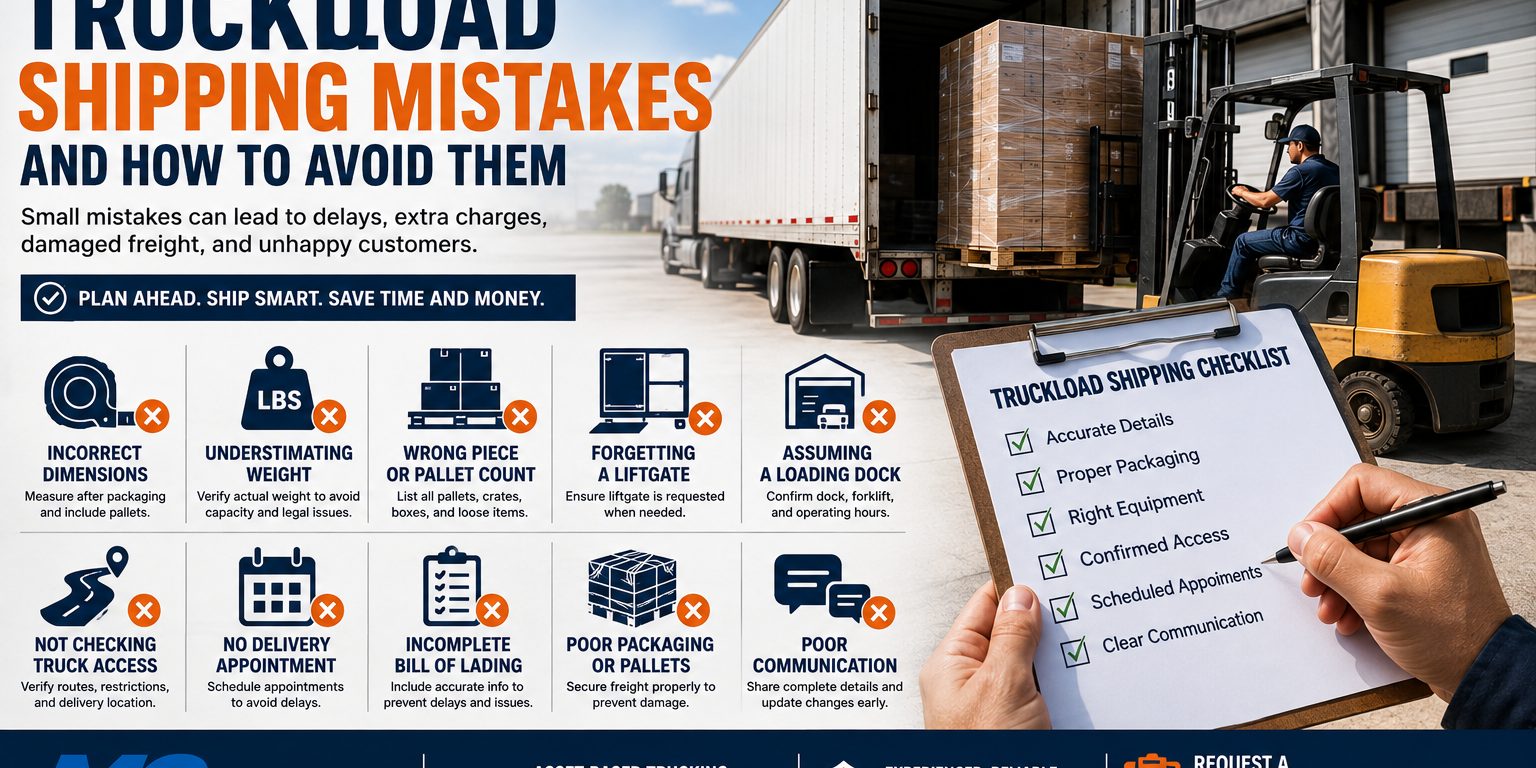
Truckload shipping can be one of the fastest and most efficient ways to move large quantities of freight. However, small planning mistakes can lead to delayed pickups, rejected freight, damaged products, additional charges, and missed delivery appointments.
Many truckload shipping problems can be prevented before the truck is dispatched.
Whether you are shipping one full trailer, arranging a dedicated straight truck, or coordinating a time-sensitive delivery, providing accurate information and preparing the freight correctly can make a major difference.
This guide explains the most common truckload shipping mistakes and how shippers can avoid them.
- Providing Incorrect Freight Dimensions
One of the most common truckload shipping mistakes is providing inaccurate freight dimensions.
Freight dimensions help the carrier determine:
- How much trailer space is required
- Whether the freight will fit through the trailer door
- Whether the freight can be loaded safely
- Whether a straight truck or tractor-trailer is needed
- Whether the freight can be stacked
- Whether oversized permits or special equipment are required
Dimensions should include the complete packaged size of the freight.
For palletized freight, measure:
- Length
- Width
- Total height, including the pallet
- Any freight extending beyond the pallet
Do not provide only the dimensions of the product before it is packaged.
Example
A machine may measure 80 inches long before packaging. Once it is placed on a skid and crated, the total length may be 96 inches.
That difference could affect:
- Trailer space
- Liftgate compatibility
- Door clearance
- Loading equipment
- Final pricing
How to Avoid This Mistake
Measure the freight after it has been completely packaged, wrapped, crated, or placed on pallets.
Provide photographs when the freight is unusually shaped, oversized, fragile, or difficult to describe.
- Underestimating the Freight Weight
Accurate weight is essential for truckload shipping.
The carrier must ensure that the freight does not exceed:
- The truck’s legal payload
- Trailer capacity
- Axle weight limits
- Liftgate capacity
- Pallet jack capacity
- Bridge or roadway restrictions
An incorrect weight can result in the driver being unable to transport the shipment legally or safely.
If the freight is heavier than quoted, the carrier may need to:
- Send different equipment
- Reposition the freight
- Remove part of the load
- Obtain permits
- Adjust the rate
- Refuse the shipment
How to Avoid This Mistake
Use an actual scale weight whenever possible.
Include:
- Freight weight
- Pallet weight
- Crate weight
- Packaging materials
- Any additional equipment traveling with the shipment
Do not rely on an estimate unless you clearly tell the carrier that the weight is estimated.
- Giving the Wrong Pallet or Piece Count
The number of pallets, crates, boxes, or loose pieces affects the amount of trailer space and loading time required.
A shipment quoted as six pallets may turn out to include:
- Six pallets
- Ten loose boxes
- Two long items
- Additional display materials
- Packaging supplies
This may require more space, labor, and handling than originally quoted.
How to Avoid This Mistake
Provide the total number of:
- Pallets
- Crates
- Boxes
- Loose pieces
- Cases
- Machines
- Displays
- Bundles
Explain whether anything will be loaded separately from the pallets.
- Failing to Mention Freight Overhang
Freight overhang occurs when the product extends beyond the edge of the pallet.
Overhanging freight can create several problems:
- It may take up more trailer space than expected.
- It may prevent pallets from being loaded side by side.
- It can be more vulnerable to damage.
- It may not fit safely on a liftgate.
- It may prevent the use of a standard pallet jack.
- It may make the freight difficult to secure.
A standard 48-inch-by-40-inch pallet with freight extending several inches on each side is not the same as a properly contained pallet.
How to Avoid This Mistake
Provide the total outside dimensions of the freight, not just the pallet dimensions.
Photographs are especially helpful for long, wide, or irregularly shaped freight.
- Not Confirming Whether the Freight Is Stackable
Stackability can significantly affect how much trailer space a shipment requires.
A carrier may assume pallets can be stacked if the information is unclear. However, many products cannot safely support freight placed on top of them.
Non-stackable freight may include:
- Machinery
- Furniture
- Trade show displays
- Lighting fixtures
- Glass products
- Fragile merchandise
- Open-top crates
- Tall pallets
- Irregularly shaped freight
How to Avoid This Mistake
Clearly state whether the freight is:
- Stackable
- Non-stackable
- Top-load only
- Fragile
- Safe to double-stack
If stacking is allowed, specify the maximum weight that may be placed on top.
- Requesting the Wrong Truck or Trailer
Different shipments require different types of equipment.
Common equipment options include:
- Cargo van
- Box truck
- 24-foot straight truck
- 26-foot straight truck
- Dry van trailer
- Liftgate trailer
- Flatbed
- Reefer
- Sprinter van
- Power-only tractor
Booking the wrong equipment can cause delays or make the shipment impossible to complete.
Example
A customer may request a 26-foot straight truck because the shipment is small. However, the freight may be too long, too tall, or too heavy for a straight truck.
Another customer may request a standard dry van even though the delivery location has no loading dock or forklift.
How to Avoid This Mistake
Provide complete freight and location details and allow the carrier to recommend the appropriate equipment.
Important information includes:
- Freight dimensions
- Total weight
- Number of pallets
- Loading method
- Unloading method
- Dock availability
- Forklift availability
- Liftgate requirements
- Access restrictions
- Forgetting to Request a Liftgate
A liftgate is a hydraulic platform used to raise or lower freight between the truck floor and street level.
Liftgate service is often required when a location does not have:
- A loading dock
- A forklift
- A ramp
- Other equipment capable of loading or unloading the truck
Not every truck or trailer is equipped with a liftgate.
If the carrier arrives without one, the shipment may not be loaded or delivered.
How to Avoid This Mistake
Confirm liftgate requirements at both pickup and delivery.
Ask each location:
- Is there a loading dock?
- Is there a forklift?
- Can the forklift safely reach the truck?
- Is the freight too large for the available liftgate?
- Is the ground level and paved?
Remember that liftgate service usually means delivery to the street, curb, or sidewalk. It does not automatically include inside delivery.
- Assuming Every Location Has a Loading Dock
A commercial address does not always have a loading dock.
Many commercial locations operate from:
- Storefronts
- Office buildings
- Shopping centers
- Small warehouses
- Storage facilities
- Event venues
- Construction sites
- Residential-style buildings
Some locations may have a dock, but it may not be suitable for a tractor-trailer.
How to Avoid This Mistake
Contact the shipper and receiver before booking.
Confirm:
- Loading-dock availability
- Dock height
- Forklift availability
- Truck-size restrictions
- Delivery entrance
- Hours of operation
- Appointment requirements
- Failing to Check Truck Access
A tractor-trailer may not be able to reach every pickup or delivery location.
Access problems can include:
- Narrow streets
- Low bridges
- Low tree branches
- Tight turns
- Small parking lots
- Gated entrances
- Weight-restricted roads
- Residential neighborhoods
- Construction zones
- Street closures
- Limited loading areas
- Building-length restrictions
This is especially important for deliveries in New York City, Long Island, older industrial areas, and residential neighborhoods.
How to Avoid This Mistake
Confirm the exact location where the truck will park and unload.
Do not assume that a truck can access a property simply because the mailing address appears on a map.
Provide:
- The exact entrance
- The receiving-door location
- Gate instructions
- Building restrictions
- Parking instructions
- Contact information for someone on site
- Booking the Truck Before the Freight Is Ready
Carriers schedule trucks and drivers around specific pickup times.
When freight is not ready, the driver may be forced to wait or leave.
This can create:
- Detention charges
- Missed delivery appointments
- Layover charges
- Truck ordered not used charges
- Rescheduling fees
- Lost production time
How to Avoid This Mistake
Before dispatching the truck, confirm that:
- The product is complete.
- The freight is packaged.
- Pallets are wrapped.
- Labels are attached.
- Paperwork is ready.
- The shipping team is prepared.
- The freight is accessible.
- The correct pickup number is available.
Do not book based only on an estimated production-completion time unless the schedule allows for possible delays.
- Scheduling Unrealistic Pickup and Delivery Times
Truckload transit time is affected by more than mileage.
The driver must also account for:
- Traffic
- Loading time
- Unloading time
- Required breaks
- Federal hours-of-service rules
- Weather
- Tolls
- Appointment windows
- Urban delivery conditions
- Construction
- Truck routes
A delivery that appears to be only a few hours away may not be achievable if the truck is loaded late in the day.
How to Avoid This Mistake
Discuss the full schedule with the carrier before promising a delivery time.
Provide:
- Earliest pickup time
- Latest pickup time
- Required delivery time
- Receiver hours
- Appointment requirements
- Whether next-day delivery is acceptable
- Whether the truck must go directly to delivery
For critical shipments, consider dedicated service rather than shared or partial transportation.
- Confusing Dedicated Truckload With Partial Service
Dedicated service means the truck is assigned specifically to one customer’s shipment.
Partial or shared service means the freight may travel with other customers’ shipments.
With dedicated service, the driver will generally:
- Pick up the shipment
- Travel directly toward delivery
- Avoid unrelated freight stops
- Follow a more predictable schedule
With partial service, the carrier may:
- Pick up other freight
- Deliver other shipments first
- Transfer freight between terminals
- Take longer to reach the destination
How to Avoid This Mistake
Ask whether the quoted rate is for:
- Dedicated service
- Partial service
- Volume LTL
- Standard LTL
- Team service
- Expedited service
Do not assume the lowest quote includes direct transportation.
- Failing to Disclose a Residential or Limited-Access Location
Residential and limited-access locations may require additional time, equipment, and coordination.
Examples include:
- Houses
- Apartment buildings
- Schools
- Hospitals
- Hotels
- Trade shows
- Convention centers
- Airports
- Construction sites
- Storage facilities
- Government buildings
- Farms
- Churches
- Military bases
These locations may require:
- Liftgate service
- Appointments
- Smaller trucks
- Security screening
- Special permits
- Additional waiting time
- Driver identification
- Escorts
How to Avoid This Mistake
Describe the location accurately during the quoting process.
Do not list a location as commercial simply because it belongs to a business.
- Not Arranging Delivery Appointments
Some receivers will not accept freight without an appointment.
If the carrier arrives without one, the driver may be turned away.
This can result in:
- Redelivery charges
- Detention
- Layover charges
- Storage
- Additional transportation fees
How to Avoid This Mistake
Confirm who is responsible for scheduling the appointment.
Provide:
- Receiver name
- Contact person
- Phone number
- Email address
- Purchase-order number
- Delivery-reference number
- Receiving hours
Do not assume the receiver will automatically contact the carrier.
- Providing an Incorrect Address or Contact Number
An incorrect digit in an address or telephone number can cause significant delays.
Common errors include:
- Wrong street number
- Incorrect ZIP code
- Missing suite number
- Wrong warehouse location
- Billing address provided instead of shipping address
- Old contact person
- Disconnected phone number
- Missing gate or entrance instructions
How to Avoid This Mistake
Verify the pickup and delivery details with both locations before dispatch.
For large facilities, include the exact:
- Building number
- Dock number
- Gate
- Entrance
- Department
- Receiving contact
- Preparing an Incomplete Bill of Lading
The bill of lading is one of the most important documents in freight transportation.
It should include accurate information about:
- Shipper
- Receiver
- Carrier
- Commodity
- Piece count
- Pallet count
- Weight
- Pickup number
- Purchase-order number
- Special instructions
An incomplete or inaccurate bill of lading can create:
- Delivery delays
- Billing disputes
- Freight claims
- Misrouted shipments
- Receiver refusals
- Weight discrepancies
How to Avoid This Mistake
Review the bill of lading before the truck arrives.
Make sure it matches the actual freight being loaded.
- Packaging Freight Improperly
The shipper is generally responsible for preparing freight to withstand normal transportation.
Poor packaging can lead to:
- Shifted freight
- Crushed cartons
- Broken products
- Leaning pallets
- Punctured packaging
- Freight falling from the pallet
- Damage during loading or unloading
How to Avoid This Mistake
Use:
- Strong pallets
- Proper shrink wrap
- Strapping when needed
- Corner protectors
- Crates for fragile equipment
- Blocking and bracing
- Adequate cushioning
- Weather-resistant covering when appropriate
Make sure the freight is centered on the pallet and does not move when pushed lightly.
- Using Damaged or Weak Pallets
A broken pallet can collapse during loading, transit, or unloading.
Signs of a poor pallet include:
- Missing boards
- Cracked boards
- Exposed nails
- Broken runners
- Water damage
- Excessive movement
- An uneven surface
How to Avoid This Mistake
Inspect every pallet before loading.
Replace weak or damaged pallets rather than attempting a temporary repair.
Heavy freight may require stronger pallets or custom skids.
- Not Labeling the Freight Properly
Each pallet or piece should be labeled clearly.
Labels may include:
- Shipper name
- Receiver name
- Delivery address
- Purchase-order number
- Piece count
- Pallet number
- Special handling instructions
- Trade show name
- Booth number
- Event move-in date
Poor labeling can be especially problematic when freight is:
- Cross-docked
- Stored
- Consolidated
- Delivered to trade shows
- Transported with other shipments
How to Avoid This Mistake
Place labels on multiple sides of each pallet or crate.
Remove or cover old shipping labels to prevent confusion.
- Failing to Photograph the Freight
Photographs provide important documentation of the freight before pickup.
They can show:
- Packaging condition
- Pallet count
- Freight dimensions
- Existing damage
- Overhang
- Labeling
- Special loading concerns
How to Avoid This Mistake
Take clear photographs after the freight is completely prepared but before it is loaded.
Photograph:
- All sides
- Labels
- Packaging
- Existing damage
- Unusual dimensions
- The freight inside the truck when possible
- Not Declaring High-Value or Fragile Freight
Some freight requires special insurance, securement, equipment, or approval.
Examples include:
- Electronics
- Artwork
- Medical equipment
- Luxury products
- Trade show displays
- High-value machinery
- Fragile lighting
- Glass
- Antiques
- Sensitive technology
Standard cargo-liability limits may not cover the full commercial value of the shipment.
How to Avoid This Mistake
Tell the carrier:
- The commodity
- The replacement value
- Whether it is fragile
- Whether special insurance is required
- Whether temperature control is needed
- Whether photographs or seals are required
Review cargo-insurance limits before dispatch.
- Assuming the Cheapest Quote Is the Best Quote
A low truckload rate may not include the same service as a higher rate.
The cheapest quote may exclude:
- Fuel
- Tolls
- Liftgate service
- Driver assistance
- Appointments
- Detention
- Storage
- Inside delivery
- Direct service
- Cargo coverage
- Tracking
A low quote may also be based on incomplete shipment information.
How to Avoid This Mistake
Compare quotes based on the complete service, not just the transportation rate.
Ask:
- Is fuel included?
- Are tolls included?
- Is the truck dedicated?
- What equipment is being provided?
- How much free loading and unloading time is included?
- What is the detention rate?
- Is liftgate service included?
- Are there any expected accessorial charges?
- Not Reviewing Accessorial Charges
Accessorial charges apply when a shipment requires services beyond standard transportation.
Common accessorial charges include:
- Detention
- Layovers
- Liftgates
- Inside delivery
- Driver assistance
- Residential service
- Limited-access service
- Redelivery
- Reconsignment
- Storage
- Additional stops
- Truck ordered not used
- Pallet jack
- Helpers
- Debris removal
How to Avoid This Mistake
Review the carrier’s accessorial policies before booking.
Provide complete details so the necessary services can be included in the original quote.
For additional information, read our guide to Truckload Accessorial Charges Explained.
- Making Last-Minute Changes
Changing shipment details after dispatch can affect the equipment, route, schedule, and price.
Common last-minute changes include:
- Adding pallets
- Changing the delivery address
- Moving the pickup time
- Adding a stop
- Requesting a liftgate
- Changing the delivery date
- Adding inside delivery
- Increasing the weight
- Changing the commodity
How to Avoid This Mistake
Finalize the shipment details before dispatch.
When a change is unavoidable, contact the carrier immediately rather than waiting until the truck arrives.
- Waiting Too Long to Book the Truck
Truck availability can change quickly, especially during:
- Produce season
- Holidays
- Month-end
- Quarter-end
- Severe weather
- Trade show move-in periods
- Construction season
- Major events
- Regional freight surges
Waiting until the last minute may result in:
- Higher pricing
- Limited equipment
- Unfavorable pickup times
- Missed appointments
- Inability to secure a liftgate truck
- Reduced carrier options
How to Avoid This Mistake
Book as early as possible once the freight details and schedule are confirmed.
Time-sensitive, specialized, or liftgate shipments should be scheduled earlier than standard dock-to-dock freight.
Truckload Shipping Checklist
Before booking a truckload shipment, confirm the following:
- The freight is completely ready.
- Pallet and piece counts are accurate.
- Weight is verified.
- Dimensions include packaging and pallets.
- Freight overhang is disclosed.
- Stackability is confirmed.
- The commodity is accurately described.
- The correct equipment is requested.
- Liftgate requirements are confirmed.
- Loading docks and forklifts are available.
- Truck access has been verified.
- Pickup and delivery times are realistic.
- Appointments are scheduled.
- Addresses and contact information are correct.
- The bill of lading is complete.
- Freight is securely packaged.
- Pallets are in good condition.
- Labels are attached.
- High-value freight is disclosed.
- Insurance limits have been reviewed.
- Accessorial charges are understood.
- Photos have been taken.
Frequently Asked Questions
What information is needed for an accurate truckload quote?
An accurate quote should include the pickup and delivery addresses, dates, times, pallet count, total weight, freight dimensions, commodity, equipment requirements, loading method, unloading method, and any special services.
Should freight dimensions include the pallet?
Yes. The dimensions should include the full outside measurement of the freight after it has been packaged and placed on the pallet.
What happens if the freight weighs more than quoted?
The carrier may need to adjust the rate, send different equipment, redistribute the freight, obtain permits, or refuse the shipment if it cannot be moved legally or safely.
How do I know whether I need a liftgate?
A liftgate is generally required when the location does not have a loading dock, forklift, or other safe way to move freight between the ground and the truck.
Does liftgate service include inside delivery?
Usually not. Standard liftgate service generally lowers the freight to street, curb, or sidewalk level. Moving freight inside a building is normally a separate service.
What is the difference between dedicated and partial truckload service?
Dedicated service assigns the truck to one customer’s shipment. Partial service shares trailer space with other freight and may include additional pickups, deliveries, or terminal handling.
How far in advance should I book a truck?
Standard shipments should be booked as soon as the details are confirmed. Specialized, liftgate, oversized, event, or time-sensitive shipments should be arranged earlier whenever possible.
Why do carriers need photographs?
Photographs help the carrier confirm dimensions, packaging, overhang, loading requirements, and existing freight condition. They can also help prevent disputes if damage occurs.
Is the shipper responsible for packaging?
In most cases, the shipper is responsible for packaging freight so it can withstand normal handling and transportation unless special packaging services are arranged.
How can I avoid unexpected freight charges?
Provide accurate shipment information, prepare the freight before pickup, verify location requirements, review accessorial policies, and notify the carrier immediately when anything changes.
Request a Truckload Freight Quote
MO Trucking Inc. provides asset-based trucking, dedicated transportation, liftgate delivery, cross-docking, warehousing, final-mile delivery, and event logistics throughout Long Island, New York City, and surrounding areas.
Through our freight brokerage division, we can also assist customers with truckload and less-than-truckload transportation throughout the United States and Canada.
To receive an accurate quote, provide complete information about the freight, equipment, pickup location, delivery location, schedule, and handling requirements.
Visit our Truckload Freight Quote page to request pricing for your next shipment.
Contact MO Trucking Inc.
Email: Eric@motruckinginc.com
Phone: 631-755-5858
Text/After Hours: 516-250-4480