Advance Warehouse vs. Direct-to-Show Shipping in NYC: Which Option Is Better?
Trade show shipping in New York City requires careful planning. Exhibitors must coordinate carrier schedules, venue rules, delivery appointments, freight handling, move-in deadlines, and unpredictable traffic.
One of the most important decisions is whether to ship your exhibit materials to an advance warehouse or arrange for direct-to-show shipping at the event venue.
Both options can work, but the right choice depends on your shipping schedule, freight size, budget, carrier reliability, and tolerance for risk.
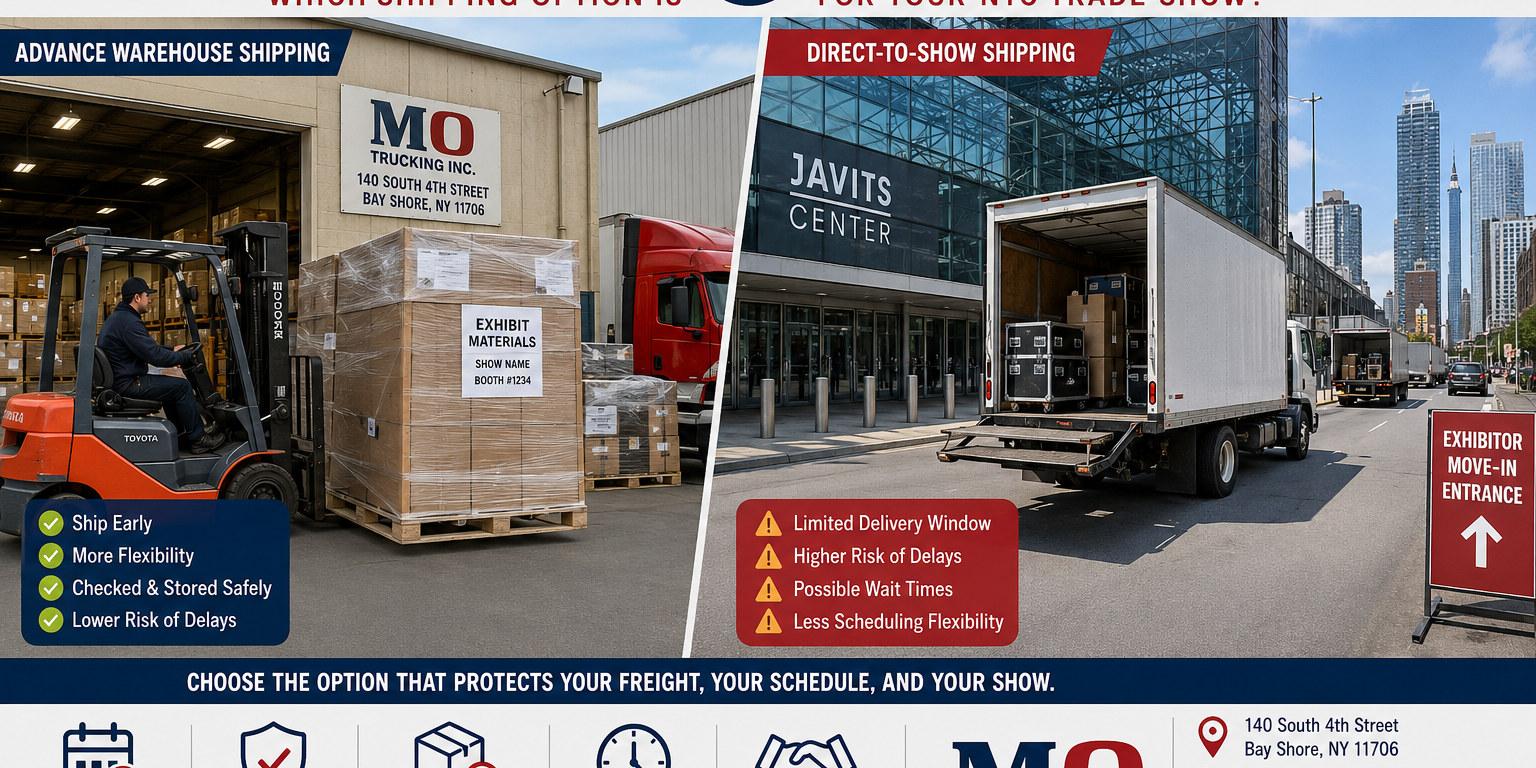
For many exhibitors, especially those traveling from outside the New York metropolitan area, advance warehouse shipping provides more flexibility and a lower risk of missing the event move-in window. Direct-to-show shipping may be appropriate when freight is ready late, the shipment is moving locally, or the show does not offer an advance receiving program.
This guide explains the differences between advance warehouse and direct-to-show shipping in NYC, including the advantages, disadvantages, costs, risks, and situations where each option makes the most sense.
What Is Advance Warehouse Shipping?
Advance warehouse shipping means sending your exhibit materials to a designated warehouse before the trade show begins.
The warehouse receives and stores the freight until the scheduled show move-in date. The freight is then loaded onto local trucks and transported to the venue according to the event’s delivery schedule.
An advance warehouse may receive:
- Palletized exhibit materials
- Display booths
- Crates
- Product samples
- Signs and banners
- Furniture
- Lighting equipment
- Promotional materials
- Boxes and cartons
- Event equipment
The warehouse provides exhibitors with a shipping address, receiving dates, labeling instructions, and freight-handling requirements.
When MO Trucking Inc. provides advance warehouse services, freight is shipped to our facility at:
MO Trucking Inc.
140 South 4th Street
Bay Shore, NY 11706
Our team can receive, store, organize, and transport freight to trade show venues throughout New York City and the surrounding area.
What Is Direct-to-Show Shipping?
Direct-to-show shipping means the carrier delivers the exhibit freight directly to the event venue during the show’s assigned move-in period.
Instead of going to a warehouse first, the shipment travels from the exhibitor, manufacturer, fulfillment center, or another origin directly to the convention center, hotel, pier, event space, or exhibit hall.
The carrier must arrive during the approved delivery window and follow the instructions provided in the exhibitor manual.
Depending on the show and venue, the driver may need to:
- Report to a marshaling yard
- Wait for an unloading assignment
- Present a bill of lading
- Follow a target delivery schedule
- Wait for dock space
- Remain with the truck until unloaded
- Pay parking, permit, or facility-related fees
- Comply with venue security requirements
Direct-to-show shipping can eliminate advance storage, but it also requires tighter scheduling and dependable transportation.
Advance Warehouse vs. Direct-to-Show Shipping: Quick Comparison
| Factor | Advance Warehouse | Direct-to-Show |
| Delivery timing | Freight arrives before move-in | Freight arrives during move-in |
| Scheduling flexibility | More flexible receiving window | Limited delivery window |
| Risk of arriving late | Generally lower | Generally higher |
| Storage | Included or billed separately | Usually not required before move-in |
| Carrier waiting time | Usually more predictable | Can be significant |
| NYC traffic exposure | Local warehouse controls final delivery | Long-distance carrier enters NYC |
| Freight readiness | Must be ready before warehouse deadline | Allows additional preparation time |
| Cost structure | Receiving, storage, and final delivery | Direct transportation and possible waiting |
| Best for | Out-of-state, high-value, or time-sensitive freight | Local, last-minute, or tightly controlled shipments |
Advantages of Advance Warehouse Shipping
- A Larger Delivery Window
An advance warehouse usually accepts freight over several days or weeks.
This gives exhibitors more flexibility than a direct-to-show delivery window that may only last a few hours. Freight can arrive early without requiring the exhibitor to coordinate the exact arrival time with the venue.
A larger receiving window is especially valuable for shipments traveling long distances.
Weather, traffic, mechanical problems, missed pickups, and carrier delays can affect any shipment. Delivering to an advance warehouse creates additional time to address these problems before the event begins.
- Lower Risk of Missing Move-In
Missing the assigned move-in period can create serious problems.
The venue may no longer accept the freight, or the exhibitor may need to arrange an emergency delivery at a higher cost. Booth installation can also be delayed if the display, products, or equipment are not available when the installation team arrives.
Advance receiving allows the freight to reach the New York area before move-in begins.
Once the shipment is safely at the warehouse, a local transportation provider can coordinate the final delivery to the show.
- Local Control of the Final Delivery
Long-distance carriers may not be familiar with New York City delivery conditions.
They may encounter:
- Heavy traffic
- Restricted truck routes
- Limited parking
- Venue congestion
- Difficult loading areas
- Strict appointment times
- Marshaling procedures
- Limited dock availability
With advance warehouse shipping, the long-distance carrier only needs to reach the warehouse. A local trucking company then handles the final portion of the shipment.
MO Trucking Inc. operates straight trucks, tractors, and trailers that travel into New York City regularly. This local experience can make the final delivery more organized and predictable.
- Freight Can Be Checked Before the Show
When freight arrives at an advance warehouse, the receiving team can identify visible problems before move-in.
Depending on the service requested, the warehouse may be able to report:
- Missing pallets
- Damaged shrink wrap
- Crushed boxes
- Broken crates
- Incorrect freight labels
- Freight that arrived without proper paperwork
- Shipments received in multiple deliveries
Discovering a problem several days before the show provides more time to contact the shipper, carrier, or exhibitor.
Finding the same problem while the booth is being installed may leave very little time to correct it.
- Multiple Shipments Can Be Consolidated
Some exhibitors receive materials from several vendors.
For example, an exhibit may include:
- A booth from an exhibit builder
- Samples from a manufacturer
- Printed materials from a marketing company
- Furniture from a rental provider
- Promotional items from a fulfillment center
An advance warehouse can receive these shipments separately and coordinate them for delivery to the venue.
This can be easier than asking several carriers to arrive at the show during the same limited delivery window.
- Better for High-Value or Important Freight
When an event is important to your company, the lowest-priced shipping option is not always the safest choice.
Missing one trade show can cost significantly more than the transportation itself. The exhibitor may lose registration fees, booth costs, labor expenses, travel costs, marketing opportunities, and potential sales.
Advance warehouse shipping adds another step, but that step can provide valuable scheduling protection.
Disadvantages of Advance Warehouse Shipping
- Additional Handling Charges
Advance warehouse service usually includes charges for receiving, unloading, storage, reloading, and transportation to the venue.
Depending on the event, charges may be calculated by:
- Shipment weight
- Number of pallets
- Number of crates
- Linear feet of truck space
- Number of trucks required
- Storage duration
- Special handling requirements
Exhibitors should request a complete estimate before shipping.
- Earlier Shipping Deadline
Freight must be ready before the advance receiving deadline.
This may not work for exhibitors whose products, display materials, or marketing items are still being manufactured shortly before the event.
Late shipments may need to move directly to the venue or through an expedited transportation service.
- Freight Is Handled More Than Once
Advance warehouse freight is unloaded at the warehouse and loaded again for delivery to the show.
Good packaging is important whenever freight is handled multiple times.
Crates should be properly secured, pallets should be stable, and loose boxes should be shrink-wrapped. Fragile items should be protected for forklift and pallet-jack handling.
Advantages of Direct-to-Show Shipping
- Freight Can Leave Later
Direct-to-show shipping gives exhibitors more time to prepare their materials.
This can be useful when:
- Products are still being manufactured
- Marketing materials are being printed
- A booth is being repaired or modified
- Samples are not ready before the warehouse deadline
- The exhibitor is shipping from a nearby location
Freight can leave closer to the event date because it does not need to arrive at an advance warehouse first.
- Advance Storage Charges May Be Avoided
Direct delivery may eliminate advance warehouse receiving and storage charges.
However, this does not always mean the total cost will be lower.
The exhibitor must also consider:
- Carrier waiting time
- Detention
- NYC tolls
- Driver layover charges
- Missed appointment charges
- Redelivery costs
- Expedited transportation
- Venue-related freight-handling charges
A direct shipment that experiences several hours of waiting can become more expensive than expected.
- Freight Is Handled Fewer Times
A direct shipment generally moves from the origin to the event venue without being unloaded at an intermediate warehouse.
This can be beneficial for unusually fragile, oversized, or specialized freight.
However, the freight will still need to be unloaded and handled at the venue. Proper packaging remains essential.
- Direct Shipping Can Work Well for Local Freight
Direct-to-show delivery may be practical when the freight is located in:
- Long Island
- Queens
- Brooklyn
- Manhattan
- The Bronx
- Westchester
- Northern New Jersey
- Another nearby location
A local carrier can pick up the freight and coordinate delivery within the venue’s assigned window.
The closer the origin is to the event, the easier it may be to control the delivery schedule.
Disadvantages of Direct-to-Show Shipping
- Limited Delivery Windows
Direct-to-show shipments must usually arrive during a specific period.
Arriving too early may result in waiting or being turned away. Arriving too late can delay booth installation or cause the shipment to miss move-in entirely.
The carrier must plan around both the scheduled appointment and NYC traffic.
- Unpredictable Waiting Time
Trade show move-ins involve many exhibitors and trucks arriving within a short period.
Even when a carrier arrives on time, the driver may need to wait for:
- Venue access
- Security clearance
- Marshaling instructions
- Dock space
- Forklift availability
- Labor availability
- Permission to enter the unloading area
Carrier detention or waiting-time charges may apply.
Before choosing direct-to-show shipping, ask the carrier how much free waiting time is included and what the hourly detention rate will be afterward.
- Greater Exposure to Long-Distance Delays
A long-distance carrier may provide an estimated arrival time, but the estimate can change.
Traffic, weather, service-hour restrictions, loading delays, mechanical issues, and previous stops may affect the schedule.
If a truck is delayed while delivering to a normal commercial location, the receiver may be able to accept the freight later.
A trade show venue may not have the same flexibility.
- Emergency Costs Can Be Significant
When a direct shipment misses its delivery window, the exhibitor may need:
- Expedited transportation
- A dedicated truck
- Overnight storage
- A second delivery attempt
- After-hours service
- Additional labor
- Special venue approval
The original direct-shipping savings can disappear quickly.
Which Option Is Better for NYC Trade Shows?
For most exhibitors shipping from outside the New York area, advance warehouse shipping is usually the safer option.
It provides a wider receiving window, reduces dependence on a long-distance carrier’s exact arrival time, and places the freight near the venue before move-in begins.
Advance receiving is particularly valuable when:
- The freight is traveling from another state
- The shipment is essential to the booth
- The freight includes several pallets or crates
- Multiple suppliers are shipping materials
- The event has a strict move-in schedule
- The exhibitor wants additional time to address shipping problems
- The long-distance carrier is unfamiliar with NYC deliveries
- Missing the show would cause a major financial loss
Direct-to-show shipping may be the better option when:
- The freight will not be ready before the advance deadline
- The shipment is originating locally
- The exhibitor controls the transportation
- A dedicated truck is being used
- The delivery window is confirmed
- The freight is fragile and should be handled fewer times
- The show does not provide advance receiving
- The exhibitor accepts the scheduling risk
Consider a Hybrid Shipping Strategy
Exhibitors do not always need to select only one option.
A hybrid strategy can provide additional flexibility.
For example:
- Ship the booth and essential equipment to the advance warehouse.
- Send last-minute samples directly to the venue.
- Send printed materials to the warehouse but personally carry small valuable items.
- Consolidate several vendor shipments at the warehouse and send one final truck to the show.
- Ship move-in freight through the advance warehouse and arrange direct transportation after move-out.
The most important materials should generally use the shipping method with the lowest risk.
If your booth cannot operate without a particular crate, display, machine, or product, sending that item early may be worth the additional cost.
What Determines the Cost?
The cost of advance warehouse or direct-to-show shipping depends on several factors.
Freight Size and Weight
Carriers and warehouses may need:
- Number of pallets
- Number of crates
- Number of boxes
- Total weight
- Length, width, and height
- Total linear feet of truck space
Large or unusually shaped freight may require additional space or specialized equipment.
Pickup Location
Transportation costs depend on how far the freight must travel and whether the carrier needs to enter New York City.
The rate may also be affected by:
- Tolls
- Fuel
- Traffic
- Deadhead mileage
- Driver hours
- Overnight travel
- Team-driver requirements
Equipment Required
Trade show freight may move in:
- Cargo vans
- Box trucks
- 24-foot or 26-foot straight trucks
- 48-foot trailers
- 53-foot trailers
- Liftgate trucks
- Air-ride equipment
- Climate-controlled equipment
A shipment requiring a liftgate, pallet jack, helper, or specialized trailer will generally cost more.
Waiting Time
Direct-to-show deliveries can involve waiting.
Ask the carrier to explain:
- Free loading time
- Free unloading time
- Detention rate
- Layover charges
- After-hours charges
- Weekend charges
Warehouse Services
Advance warehouse charges may include:
- Receiving
- Unloading
- Storage
- Inventory tracking
- Repacking
- Shrink-wrapping
- Palletizing
- Cross-docking
- Loading
- Transportation to the venue
Request a written breakdown so you understand which services are included.
Questions to Ask Before Shipping
Before deciding between advance warehouse and direct-to-show shipping, answer the following questions:
- What is the final date the advance warehouse will accept freight?
- What is the direct-to-show delivery window?
- Is the shipment traveling locally or long distance?
- How important is the freight to the exhibit?
- Can the booth operate if the shipment arrives late?
- Is the freight properly crated, palletized, or shrink-wrapped?
- Will the carrier provide a dedicated truck or shared service?
- How much free waiting time is included?
- What are the detention charges?
- Does the venue require marshaling or an appointment?
- Is a liftgate or pallet jack required?
- Who will handle the freight after the show?
- Where will empty containers be stored?
- Does the outbound shipment need to return to a warehouse?
- Who will prepare the outbound bill of lading?
Do Not Forget About Move-Out
Move-out can be more difficult than move-in.
At the end of a trade show, many exhibitors are trying to pack and remove freight at the same time. Carriers may be delayed, paperwork may be incomplete, and freight may not be ready when the driver arrives.
Before the show begins, confirm:
- The move-out date and time
- Carrier check-in requirements
- The outbound shipping destination
- Who will prepare the bill of lading
- Who will label the freight
- Whether the freight will return to an advance warehouse
- What happens if the outbound carrier does not arrive
- Whether storage is available
- Whether the same packaging will be reused
MO Trucking Inc. can assist with advance receiving, show delivery, move-out transportation, warehouse returns, cross-docking, storage, and outbound freight coordination.
Frequently Asked Questions
Is advance warehouse shipping more expensive than direct-to-show shipping?
Advance warehouse shipping includes additional receiving, storage, handling, and final-delivery services, so the initial estimate may be higher.
However, direct-to-show shipping can also generate detention, layover, redelivery, toll, and expedited-service charges. The lowest quoted transportation rate is not always the lowest final cost.
How early should I ship to an advance warehouse?
Follow the receiving dates provided by the warehouse or show organizer.
Allow extra transit time for long-distance shipments. Do not schedule delivery on the final receiving day unless absolutely necessary.
Can I ship individual boxes to an advance warehouse?
Many advance warehouses can receive boxes, but each shipment must be properly labeled.
Small packages may arrive separately, so provide tracking information and make sure the exhibitor name, company name, show name, and booth number are clearly displayed.
What happens if my freight arrives after the advance warehouse deadline?
Late freight may be accepted with additional charges, redirected to another facility, or delivered directly to the venue.
Contact the warehouse before sending freight after the published deadline.
Is direct-to-show shipping safe?
Direct shipping can work successfully when the carrier is reliable, the delivery window is confirmed, and sufficient travel time is allowed.
The primary risk is timing. The shipment must arrive during a limited window, often while many other exhibitors are moving in.
Should I use a dedicated truck?
A dedicated truck provides more control because the vehicle is reserved for your shipment.
The driver normally picks up the freight and travels directly to the delivery location without making unrelated pickups or deliveries.
Dedicated service is often recommended for time-sensitive trade show freight.
Can MO Trucking Inc. receive freight from multiple vendors?
Yes. We can receive multiple shipments at our Bay Shore warehouse and coordinate delivery to the event.
Each shipment should be labeled with the exhibitor name, show name, booth number, and any other requested reference information.
Can MO Trucking Inc. handle outbound freight after the show?
Yes. We can assist with move-out transportation, warehouse returns, cross-docking, temporary storage, and preparation for the next carrier or destination.
Get a Trade Show Shipping Quote
The best shipping method depends on your freight, schedule, origin, venue, and event requirements.
MO Trucking Inc. provides trade show transportation and warehouse support throughout New York City and the surrounding area. Our Bay Shore facility can support advance receiving, temporary storage, cross-docking, scheduled show deliveries, move-out transportation, and outbound freight coordination.
To receive an accurate quote, send us:
- Show name
- Venue
- Booth number
- Move-in and move-out dates
- Pickup location
- Number of pallets, crates, or boxes
- Freight dimensions
- Total weight
- Required equipment
- Advance warehouse deadline
- Direct-to-show delivery window
- Special handling requirements
We will review the shipment and help you determine whether advance warehouse or direct-to-show shipping is the better option.
MO Trucking Inc.
Email: Eric@motruckinginc.com
Phone: 631-755-5858
Text/After Hours: 516-250-4480
Warehouse: 140 South 4th Street, Bay Shore, NY 11706