
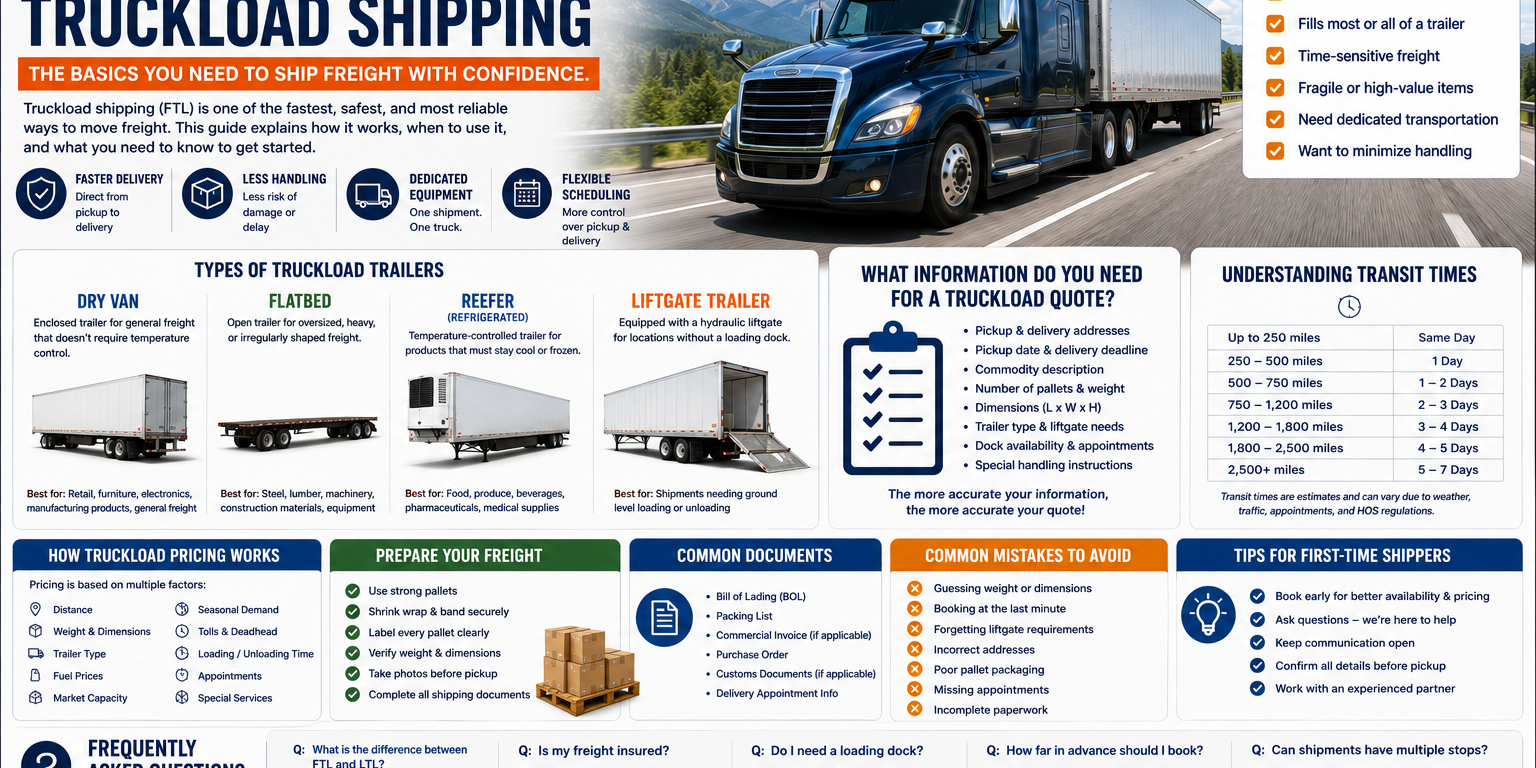
Beginner’s Guide to Truckload Shipping
If you’ve never shipped freight before, truckload shipping may seem complicated. Questions about pricing, trailer types, insurance, transit times, and shipping documents are common for first-time shippers.
The good news is that truckload shipping is easier to understand than many people think.
This Beginner’s Guide to Truckload Shipping explains the basics of Full Truckload (FTL) shipping, how it works, when you should use it, how to prepare your freight, and what information you’ll need to receive an accurate truckload freight quote.
Whether you’re shipping one truckload or planning ongoing transportation, this guide will help you make informed shipping decisions.
What Is Truckload Shipping?
Truckload shipping, commonly called Full Truckload (FTL), is a transportation service where one shipment travels on a dedicated truck or trailer.
Unlike Less Than Truckload (LTL) shipping, truckload freight usually moves directly from the pickup location to the delivery destination without passing through multiple freight terminals.
Because the freight remains on the same trailer throughout the trip, truckload shipping often provides:
- Faster transit times
- Less freight handling
- Lower risk of damage
- Dedicated transportation
- Greater scheduling flexibility
When Should You Use Truckload Shipping?
Truckload shipping is often the best choice when:
- Your shipment fills most of a trailer.
- You have 10 or more pallets.
- Your freight weighs more than 15,000 pounds.
- You need dedicated transportation.
- Your shipment is time-sensitive.
- Your freight is fragile or high value.
- You want to minimize handling during transit.
Even smaller shipments may benefit from truckload service when speed or dedicated equipment is important.
Types of Truckload Trailers
Choosing the correct trailer is one of the most important decisions when shipping freight.
Dry Van
The most common trailer used for general freight.
Best for:
- Retail products
- Manufacturing goods
- Consumer products
- Furniture
- Trade show exhibits
- Palletized freight
Flatbed
Designed for oversized or irregularly shaped freight.
Best for:
- Steel
- Lumber
- Machinery
- Construction materials
- Industrial equipment
Reefer
A refrigerated trailer used for temperature-sensitive freight.
Best for:
- Food products
- Pharmaceuticals
- Medical supplies
- Beverages
- Fresh produce
Liftgate Trailer
Ideal when a loading dock is unavailable.
A hydraulic liftgate safely lowers freight to ground level.
What Information Do You Need for a Truckload Quote?
Providing complete shipment information helps ensure accurate pricing.
Be prepared to provide:
- Pickup address
- Delivery address
- Pickup date
- Delivery deadline
- Commodity
- Number of pallets
- Weight
- Dimensions
- Trailer type
- Liftgate requirements
- Appointment information
- Special handling instructions
The more accurate your information, the more accurate your truckload freight quote will be.
How Truckload Pricing Works
Truckload pricing depends on several factors, including:
- Distance
- Pickup and delivery locations
- Weight
- Dimensions
- Trailer type
- Fuel prices
- Market capacity
- Seasonal demand
- Toll roads
- Loading and unloading time
- Delivery appointments
- Specialized services
No two truckload shipments are exactly alike, which is why rates vary from shipment to shipment.
Understanding Transit Times
Truckload shipments generally move directly from pickup to delivery, reducing handling and improving transit speed.
Typical transit estimates include:
| Distance | Estimated Transit Time |
| Up to 250 miles | Same day |
| 250–500 miles | Approximately 1 day |
| 500–750 miles | 1–2 days |
| 750–1,200 miles | 2–3 days |
| 1,200–1,800 miles | 3–4 days |
| 1,800–2,500 miles | 4–5 days |
| 2,500+ miles | 5–7 days |
Transit times may vary due to weather, appointments, traffic, and federal Hours of Service regulations.
Preparing Your Freight
Properly preparing freight helps reduce damage and shipping delays.
Before pickup:
- Use sturdy pallets.
- Shrink-wrap freight securely.
- Band heavy shipments.
- Label each pallet clearly.
- Measure dimensions accurately.
- Verify shipment weight.
- Photograph the freight.
- Complete all shipping paperwork.
Good preparation helps your shipment move efficiently from pickup to delivery.
Common Truckload Shipping Documents
You may need:
- Bill of Lading (BOL)
- Packing List
- Purchase Order
- Commercial Invoice
- Customs Documents (if applicable)
- Delivery Appointment Information
- Reference Numbers
Having documents ready before the truck arrives helps avoid delays.
Common Mistakes First-Time Shippers Make
Avoid these common mistakes:
- Guessing shipment weight
- Providing incorrect dimensions
- Booking transportation at the last minute
- Forgetting delivery appointments
- Choosing the wrong trailer
- Failing to mention liftgate requirements
- Poor pallet packaging
- Incorrect addresses
- Missing paperwork
Accurate information helps ensure a smoother shipping experience.
Tips for First-Time Truckload Shippers
If you’re shipping freight for the first time:
- Book transportation early.
- Measure and weigh your freight accurately.
- Keep communication open.
- Confirm pickup and delivery appointments.
- Clearly label every pallet.
- Take photographs before pickup.
- Review insurance coverage.
- Ask questions if you’re unsure.
Working with an experienced transportation provider can help eliminate uncertainty.
Benefits of Truckload Shipping
Truckload transportation offers many advantages, including:
- Faster delivery
- Less freight handling
- Reduced damage risk
- Dedicated equipment
- Flexible scheduling
- Nationwide service
- Reliable transit times
- Better control over your shipment
For many businesses, truckload shipping provides an efficient and dependable transportation solution.
Frequently Asked Questions
What is the difference between Truckload (FTL) and LTL shipping?
Truckload (FTL) uses a dedicated truck or trailer for one shipment, while Less Than Truckload (LTL) combines freight from multiple customers on the same trailer.
How much does truckload shipping cost?
Truckload pricing depends on factors such as distance, weight, dimensions, trailer type, fuel prices, market conditions, and any special services required.
Is truckload shipping faster than LTL?
In many cases, yes. Truckload shipments generally travel directly from pickup to delivery without passing through multiple freight terminals, reducing handling and transit time.
Do I need a loading dock?
Not necessarily. If your location does not have a loading dock, a liftgate-equipped truck or trailer may be able to load or unload your shipment safely.
How far in advance should I book a truckload shipment?
Whenever possible, book several days before pickup. Early booking generally improves equipment availability and may provide more scheduling flexibility.
What documents do I need?
Most shipments require a Bill of Lading (BOL). Depending on the shipment, you may also need a packing list, purchase order, commercial invoice, customs documentation, or appointment information.
Is my freight insured?
Most professional carriers maintain cargo insurance, but coverage limits vary. If your shipment is particularly valuable, ask about additional cargo insurance options before shipping.
Can truckload shipments have multiple stops?
Yes. Truckload shipments can include multiple pickups or deliveries, although additional stops may affect pricing and transit time.
What is the best trailer for general freight?
A Dry Van trailer is the most common choice for general freight because it provides enclosed protection from weather and road debris while accommodating a wide variety of palletized shipments.
Can MO Trucking Inc. help first-time shippers?
Absolutely. Our team works with businesses of all sizes and can help you choose the right equipment, explain the shipping process, answer your questions, and provide a competitive truckload freight quote tailored to your shipment.
Final Thoughts
Truckload shipping is one of the safest, fastest, and most reliable ways to move freight across the country. Understanding the basics of equipment, pricing, transit times, insurance, and freight preparation helps you make informed shipping decisions and avoid unnecessary delays.
Whether you’re shipping one truckload or planning regular freight movements, taking the time to learn the fundamentals of truckload transportation will help ensure a smooth and successful shipping experience.
Contact MO Trucking Inc.
If you need a truckload freight quote, dedicated transportation, cross-docking, final-mile delivery, or assistance with your first shipment, our team is ready to help.
MO Trucking Inc.
Email: Eric@motruckinginc.com
Phone: 631-755-5858
Text or After-Hours: 516-250-4480
Whether you’re a first-time shipper or an experienced logistics professional, we’ll help you choose the right equipment, answer your questions, and provide a competitive truckload freight quote for your shipment.