
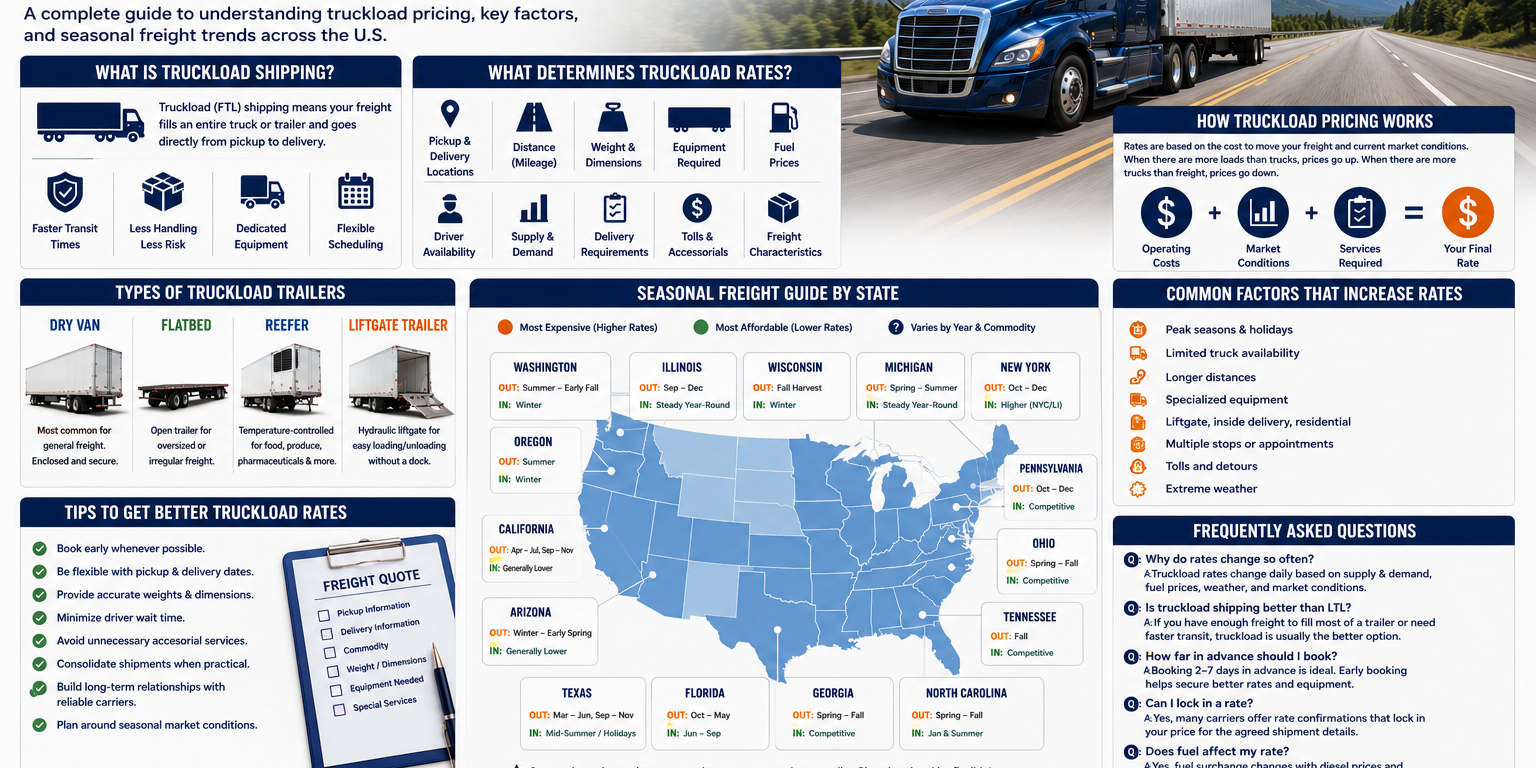
How Truckload Freight Is Priced: What Determines Truckload Rates? A Complete Guide by State and Season
If you’ve ever requested a truckload freight quote, you’ve probably wondered why one shipment costs $1,200 while another similar shipment costs $2,000—or why the exact same shipment can have a different price a few weeks later.
The answer is simple: truckload freight pricing is constantly changing.
Unlike parcel shipping, truckload rates are determined by real-time supply and demand, equipment availability, seasonal freight patterns, fuel prices, weather, and many other factors.
This guide explains exactly how truckload freight is priced, what determines truckload rates, and how seasonal freight trends affect shipping costs across the United States.
How Are Truckload Freight Rates Calculated?
Truckload pricing is based on a combination of operational costs and market conditions.
The biggest pricing factors include:
- Pickup location
- Delivery location
- Total mileage
- Freight weight
- Freight dimensions
- Equipment required
- Market supply and demand
- Fuel prices
- Driver availability
- Seasonal shipping trends
- Delivery appointments
- Tolls
- Special services
Every shipment is unique, which is why there is no universal truckload rate.
What Determines Truckload Rates?
-
Supply and Demand
The single biggest factor affecting truckload pricing is the balance between available freight and available trucks.
When there are more loads than trucks, prices increase.
When there are more trucks than freight, prices typically decrease.
- Distance
Longer shipments generally cost more overall.
However, the cost per mile often decreases as distance increases because fixed operating costs are spread over more miles.
-
Pickup and Delivery Markets
Some freight markets have excellent outbound freight while others have very little.
Markets with limited outbound freight generally cost more because carriers may have difficulty finding a return load.
-
Equipment Type
Equipment affects pricing.
Examples include:
- Dry Van
- Flatbed
- Reefer
- Liftgate Trailer
- Straight Truck
- Step Deck
- Power Only
Specialized equipment generally commands higher rates.
-
Fuel Prices
Diesel fuel is one of the trucking industry’s largest expenses.
As fuel prices rise, transportation costs often increase as well.
-
Driver Availability
Even if trucks are available, a shortage of qualified drivers can increase transportation rates.
-
Freight Characteristics
Pricing is affected by:
- Weight
- Dimensions
- Commodity
- Value
- Stackability
- Special handling
-
Delivery Requirements
Additional services such as:
- Liftgate delivery
- Residential delivery
- Driver assist
- Inside delivery
- Multiple stops
- Appointments
may increase pricing.
Why Do Freight Rates Change Throughout the Year?
Seasonality is one of the biggest drivers of truckload pricing.
Agricultural harvests, construction activity, retail demand, holidays, and weather all influence freight capacity.
Understanding these seasonal trends can help businesses plan shipments more effectively.
Seasonal Freight Guide by State
The following overview highlights common seasonal trends. Actual market conditions vary by year, commodity, and economic activity.
California
Outbound Rates
Most Expensive
- April–July
- September–November
Driven by produce harvests, imports through the Ports of Los Angeles and Long Beach, and retail freight.
Most Affordable
- January–February
Produce activity is lighter and truck availability is often higher.
Inbound Rates
Inbound pricing is typically more competitive because California consistently generates large volumes of outbound freight.
Florida
Outbound Rates
Most Expensive
- October–May
Produce, citrus, and agricultural shipments create strong demand for trucks.
Most Affordable
- June–September
Produce volumes decline, and outbound freight becomes less balanced.
Inbound Rates
Inbound rates often increase during hurricane season because carriers consider weather-related risks and potential disruptions.
Texas
Outbound Rates
Most Expensive
- March–June
- September–November
Driven by manufacturing, oil and gas, construction, imports, and cross-border trade with Mexico.
Most Affordable
- Mid-summer and around major holidays when industrial activity can slow.
Inbound Rates
Generally competitive because Texas has strong freight volumes in both directions.
Georgia
Outbound Rates
Most Expensive
- Spring
- Fall
Atlanta is one of the nation’s largest freight hubs, with strong retail and manufacturing activity.
Most Affordable
- January and late summer, when freight volumes are often more balanced.
Inbound Rates
Generally stable due to Atlanta’s consistent freight demand.
Illinois
Outbound Rates
Most Expensive
- September–December
Retail distribution and holiday inventory increase freight demand.
Most Affordable
- January–February
Freight volumes often soften after the holiday season.
Inbound Rates
Chicago remains one of the country’s busiest freight markets, creating steady inbound demand.
Ohio
Outbound Rates
Most Expensive
- Spring
- Fall
Manufacturing activity drives truck demand.
Most Affordable
- Winter months, excluding weather-related disruptions.
Inbound Rates
Generally competitive because Ohio has balanced freight activity.
Pennsylvania
Outbound Rates
Most Expensive
- October–December
Holiday retail distribution and manufacturing increase truck demand.
Most Affordable
- January–March
Freight volumes often decrease after the holiday season.
Inbound Rates
Typically competitive because Pennsylvania serves major Northeast markets.
North Carolina
Outbound Rates
Most Expensive
- Spring
- Fall
Furniture, manufacturing, and consumer goods increase shipping activity.
Most Affordable
- January and portions of summer, depending on manufacturing schedules.
Inbound Rates
Usually stable due to consistent manufacturing demand.
Tennessee
Outbound Rates
Most Expensive
- Fall
Retail distribution, manufacturing, and logistics activity increase.
Most Affordable
- Early winter following the holiday rush.
Inbound Rates
Generally balanced because Tennessee is a major logistics hub.
Michigan
Outbound Rates
Most Expensive
- Spring
- Summer
Automotive manufacturing increases shipping demand.
Most Affordable
- Winter, when production schedules may slow.
Inbound Rates
Automotive suppliers help maintain steady inbound freight.
Arizona
Outbound Rates
Most Expensive
- Winter
- Early Spring
Produce and imported freight increase demand.
Most Affordable
- Mid-summer, when agricultural activity slows.
Inbound Rates
Usually competitive because of cross-border freight activity.
Washington
Outbound Rates
Most Expensive
- Summer
- Early Fall
Apples, cherries, potatoes, and agricultural products create strong truck demand.
Most Affordable
- Late winter.
Inbound Rates
Generally competitive due to port activity in Seattle and Tacoma.
Oregon
Outbound Rates
Most Expensive
- Summer harvest season.
Most Affordable
- Winter months.
Inbound Rates
Moderately balanced due to agriculture and manufacturing.
Wisconsin
Outbound Rates
Most Expensive
- Fall harvest season.
Most Affordable
- Winter.
Inbound Rates
Generally stable due to food production and manufacturing.
New York
Outbound Rates
Most Expensive
- October–December
Holiday retail and distribution increase truck demand.
Most Affordable
- January–February
Freight activity often slows after the holiday season.
Inbound Rates
Deliveries into New York City and Long Island may cost more due to traffic, tolls, appointments, and congestion.
Why Seasonal Freight Patterns Matter
Understanding freight seasons allows businesses to:
- Plan shipments earlier
- Improve budgeting
- Increase equipment availability
- Reduce transportation costs
- Avoid peak market surcharges
- Improve supply chain planning
Businesses with recurring freight can often save money by scheduling shipments outside of peak demand whenever possible.
Tips for Getting Better Truckload Rates
- Book transportation several days in advance whenever possible.
- Be flexible with pickup and delivery dates.
- Provide accurate weights and dimensions.
- Minimize driver wait time.
- Avoid unnecessary accessorial services.
- Consolidate shipments when practical.
- Build long-term relationships with reliable transportation providers.
- Plan around seasonal market conditions.
These strategies can help improve pricing and equipment availability.
Frequently Asked Questions
Why do truckload freight rates change every day?
Truckload rates fluctuate because of supply and demand, fuel prices, seasonal freight volumes, weather, driver availability, and equipment capacity.
What is the biggest factor affecting truckload pricing?
Supply and demand is typically the largest factor. When there are more loads than available trucks, prices usually increase.
Why is Florida more expensive during produce season?
Florida ships large volumes of fresh produce during the harvest season. Increased outbound freight creates strong demand for refrigerated and dry van equipment, pushing rates higher.
Why does California have seasonal pricing?
California experiences major agricultural harvests and handles significant import freight through the Ports of Los Angeles and Long Beach. These factors create periods of high truck demand throughout the year.
Does weather affect truckload rates?
Yes. Snowstorms, hurricanes, flooding, and other severe weather events can reduce truck availability, increase transit times, and raise transportation costs.
Are outbound rates different from inbound rates?
Yes. Some states produce far more outbound freight than inbound freight, while others receive more freight than they ship. This imbalance affects pricing in both directions.
Can booking early reduce truckload costs?
In many cases, yes. Booking transportation in advance generally provides more equipment options and may help secure better pricing than last-minute shipments.
How can MO Trucking Inc. help me get competitive truckload rates?
Our team monitors market conditions, equipment availability, and seasonal freight trends to provide competitive truckload freight quotes tailored to your shipment’s requirements.
Final Thoughts
Truckload freight pricing is constantly changing because the transportation market is dynamic. Fuel prices, freight demand, weather, equipment availability, and seasonal shipping patterns all influence the final rate.
By understanding how truckload freight is priced—and how seasonal freight cycles affect different regions—you can make better shipping decisions, improve budgeting, and avoid unnecessary transportation costs.
Planning ahead and working with an experienced transportation provider can help you secure reliable capacity and competitive pricing throughout the year.
Contact MO Trucking Inc.
If you need a truckload freight quote, dedicated transportation, cross-docking, final-mile delivery, or assistance understanding current market rates, our team is ready to help.
MO Trucking Inc.
Email: Eric@motruckinginc.com
Phone: 631-755-5858
Text or After-Hours: 516-250-4480
Whether you’re shipping across town or across the country, we’ll help you navigate changing freight markets and provide a competitive truckload freight quote tailored to your shipment.