Truckload Accessorial Charges Explained: Detention, Layovers, Liftgates, Inside Delivery, and More
This is the best next topic because it naturally follows your pricing guide and answers one of the biggest customer questions: why the final freight bill can be higher than the original linehaul quote.
Truckload Accessorial Charges Explained: Detention, Layovers, Liftgates, Inside Delivery, and More
When requesting a truckload freight quote, many customers focus primarily on the transportation rate from the pickup location to the delivery location. However, additional services or delays can create extra charges that are not included in the basic linehaul rate.
These additional fees are known as truckload accessorial charges.
Understanding truckload accessorial charges before booking a shipment can help you receive a more accurate quote, avoid billing surprises, and keep your freight moving efficiently.
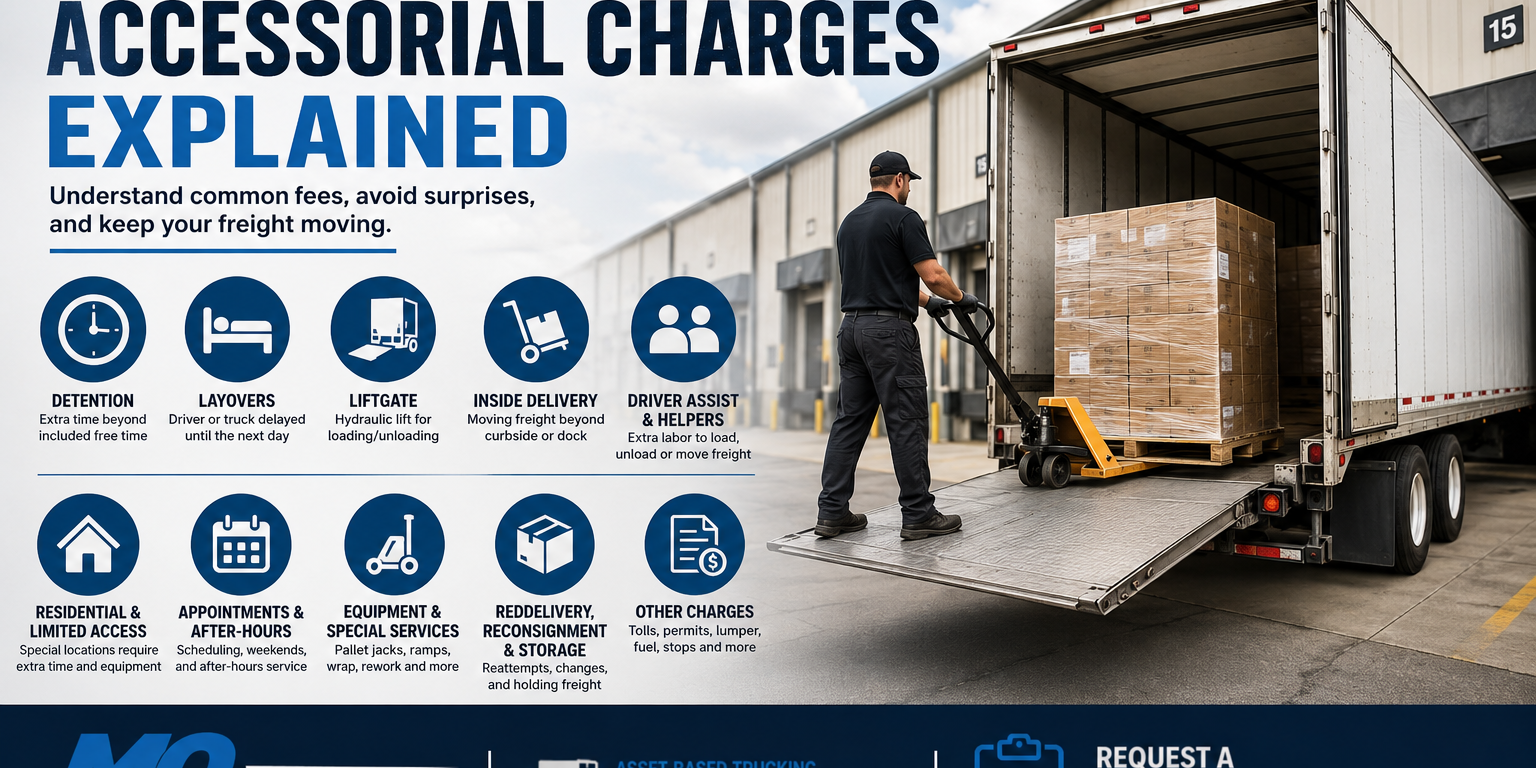
This guide explains the most common truckload accessorial fees, including detention, layovers, liftgate service, inside delivery, driver assistance, storage, redelivery, and other charges that may apply to a shipment.
What Are Truckload Accessorial Charges?
Truckload accessorial charges are fees for services or circumstances beyond the standard transportation of freight from one location to another.
A basic truckload rate typically assumes:
- The freight is ready when the truck arrives.
- The pickup and delivery locations can accommodate the requested equipment.
- The truck can be loaded and unloaded within the included free time.
- The freight is properly packaged and accessible.
- No additional labor or equipment is required.
- The shipment information provided during quoting is accurate.
When the actual shipment requires additional time, equipment, labor, handling, or changes, accessorial charges may apply.
The exact amount and type of charge will vary depending on the carrier, shipment, equipment, location, and circumstances.
Customers looking for transportation pricing can also visit our Truckload Freight Quote page to request a customized rate.
Why Accessorial Charges Matter
Accessorial charges can significantly affect the total cost of a truckload shipment.
For example, a customer may receive a competitive rate for transportation but later require:
- A liftgate at delivery
- Several hours of unloading time
- A helper to bring freight inside
- Overnight trailer storage
- A second delivery attempt
- A change to the delivery address
Each of these services requires additional equipment, labor, or truck time.
The best way to avoid unexpected charges is to provide complete and accurate shipment details before the truck is dispatched.
- Detention Charges
Detention is one of the most common truckload accessorial charges.
A detention charge applies when a driver or truck is held at the pickup or delivery location beyond the amount of free time included in the rate.
Many truckload quotes include a specific amount of free loading and unloading time. Once that free time expires, detention is normally charged by the hour.
For example, a trailer shipment may include:
- Two hours of free loading time
- Two hours of free unloading time
- An hourly detention charge after the free time expires
A straight-truck shipment may include less free time because local trucks often operate on tighter daily schedules.
What Causes Detention?
Common causes of detention include:
- Freight is not ready when the truck arrives.
- The shipping department is backed up.
- The loading dock is occupied.
- The receiver is not prepared to unload.
- Paperwork is incomplete.
- The freight must be counted or inspected.
- The driver is waiting for authorization.
- The delivery appointment is delayed.
- The facility does not have enough employees or equipment.
How to Avoid Detention Charges
To reduce the risk of detention:
- Confirm that the freight is ready before dispatch.
- Schedule realistic pickup and delivery appointments.
- Make sure dock personnel know when the truck will arrive.
- Have loading equipment available.
- Prepare all paperwork in advance.
- Notify the carrier immediately if the schedule changes.
- Confirm that the receiver has the equipment needed to unload.
Detention not only increases shipment costs but may also affect other pickups and deliveries assigned to that truck.
- Layover Charges
A layover charge may apply when a driver or truck is delayed until the next day.
Detention usually covers a delay measured in hours. A layover generally applies when the delay prevents the driver from completing the shipment during the scheduled day.
Examples include:
- The receiver closes before the truck can unload.
- The shipment is rejected and must remain on the truck overnight.
- The driver is told to return the following morning.
- The loading process takes so long that the driver cannot legally continue.
- A delivery appointment is unexpectedly rescheduled.
A layover can be expensive because the carrier loses the use of the truck and driver for another portion of the day or possibly the entire next day.
- Truck Ordered Not Used
A truck ordered not used charge, sometimes called a TONU, may apply when a carrier dispatches a truck but the shipment is canceled or unavailable.
This can happen when:
- The customer cancels after the truck has been dispatched.
- The freight is not ready.
- The freight has already been picked up.
- The shipment details were incorrect.
- The facility is closed.
- The customer no longer requires transportation.
Once a truck is committed and sent toward the pickup location, the carrier has already incurred costs and may have turned down other work.
Customers should notify the carrier as early as possible when a shipment may be canceled or postponed.
- Liftgate Service
A liftgate is a hydraulic platform attached to the rear of a truck or trailer. It raises or lowers freight between the truck floor and street level.
Liftgate service is commonly required when the pickup or delivery location does not have a loading dock or forklift.
Common liftgate delivery locations include:
- Retail stores
- Residential buildings
- Offices
- Schools
- Hotels
- Event venues
- Construction sites
- Medical offices
- Storage facilities
- Sidewalk or curbside delivery locations
Not every truck or trailer is equipped with a liftgate. Liftgate requirements must be disclosed before the shipment is booked so the carrier can dispatch the correct equipment.
Liftgate Delivery Does Not Always Include Inside Delivery
A standard liftgate service normally means the freight is lowered from the truck to street, curb, or sidewalk level.
It may not include:
- Bringing freight through a doorway
- Moving freight into an office or building
- Delivering to another floor
- Unpacking freight
- Removing skids
- Removing crates
- Disposing of packaging or garbage
- Positioning equipment inside the building
These services should be discussed separately before dispatch.
- Inside Delivery
Inside delivery means the driver is required to move freight beyond the normal curbside, sidewalk, or loading-dock delivery point.
The exact meaning of inside delivery can vary depending on the location and carrier.
It may involve:
- Moving freight through a doorway
- Bringing freight into a lobby
- Moving freight into a warehouse
- Delivering to a specific room
- Navigating hallways or elevators
- Placing freight in a designated area
Inside delivery may require additional labor, time, pallet jacks, carts, or helpers.
Customers should provide detailed information before requesting inside delivery, including:
- The distance from the truck to the final placement area
- Whether stairs are involved
- Whether an elevator is available
- Door dimensions
- Freight dimensions and weight
- Whether the freight is palletized
- Whether the pallet must be removed
- Whether a helper is required
- Whether the freight must be unpacked or assembled
A carrier may decline inside delivery if the freight cannot be moved safely with the available equipment and labor.
- Driver Assist Charges
Standard truckload service may assume that the shipper loads the truck and the receiver unloads it.
A driver assist charge may apply when the driver is asked to help load, unload, move, count, wrap, or position freight.
Driver assistance may include:
- Using a pallet jack
- Moving pallets to the rear of the trailer
- Helping break down freight
- Assisting warehouse employees
- Moving freight onto a liftgate
- Helping position crates or equipment
- Shrink-wrapping pallets
- Securing freight inside the truck
Drivers are not always permitted or equipped to perform these services. The request should be discussed before dispatch.
- Helper or Additional Labor Charges
Some shipments require more than one person.
A helper may be required when:
- Freight is too large or heavy for one person.
- The delivery requires inside placement.
- There are stairs or long hallways.
- The shipment contains loose boxes.
- Freight must be carried by hand.
- A pallet cannot fit through the doorway.
- Equipment must be removed from a skid.
- The job requires assembly, unpacking, or debris removal.
The carrier may charge a flat helper rate, an hourly labor rate, or both.
Accurate photographs and measurements can help determine how many people are needed.
- Pallet Jack or Special Equipment Charges
A pallet jack may be required when a facility does not have one available.
Other special equipment may include:
- Electric pallet jack
- Forklift
- Dock plate
- Load bars
- Straps
- Blankets
- Ramps
- Carts
- Crane service
- Rigging equipment
Equipment requirements should be identified before the truck is dispatched.
For example, a manual pallet jack may not be sufficient for a very heavy pallet, an incline, an uneven surface, or a long-distance move.
- Residential Delivery Charges
Residential delivery charges may apply when freight is delivered to a house, apartment building, residential complex, or other location not designed for commercial truck deliveries.
Residential locations often require:
- Liftgate service
- Delivery appointments
- Smaller trucks
- Additional driver time
- Curbside unloading
- Coordination with the customer
- Special parking arrangements
Customers should confirm whether a tractor-trailer can safely access the property.
Low branches, narrow streets, parked vehicles, restricted roads, tight turns, and local truck restrictions can make residential deliveries difficult.
- Limited-Access Location Charges
A limited-access charge may apply when the pickup or delivery location has restricted access, security requirements, unusual operating procedures, or limited loading facilities.
Examples may include:
- Schools
- Hospitals
- Airports
- Military bases
- Government buildings
- Construction sites
- Trade shows
- Event venues
- Convention centers
- Prisons
- Farms
- Storage facilities
- Hotels
- Churches
- Camps
- Marinas
- Utility sites
These locations may require appointments, identification, security screening, escorts, special permits, or extended waiting time.
- Appointment Delivery Charges
Some facilities require a scheduled delivery appointment.
The carrier may need to contact the receiver, arrange a delivery window, and hold the freight until the appointment date.
Appointment-related charges may apply when:
- The receiver requires advance scheduling.
- The appointment is not available for several days.
- The truck must arrive during a narrow delivery window.
- The receiver reschedules the appointment.
- The driver arrives on time but cannot unload.
- The shipment requires after-hours coordination.
Customers should provide accurate receiver contact information when requesting a quote.
- After-Hours, Weekend, or Holiday Service
Standard freight rates may assume pickup and delivery during normal business hours.
Additional charges may apply for:
- Night deliveries
- Early-morning deliveries
- Weekend service
- Holiday service
- Emergency dispatch
- Overnight transportation
- Guaranteed time-sensitive service
After-hours service can require overtime labor, special staffing, permits, or dedicated equipment.
For time-sensitive shipments, the requested pickup and delivery times should be clearly stated during the quoting process.
- Redelivery Charges
A redelivery charge may apply when the carrier attempts delivery but cannot complete it.
Common causes include:
- The receiver is closed.
- Nobody is available to unload.
- The delivery address is incorrect.
- The receiver refuses the shipment.
- The truck cannot access the location.
- A required appointment was not scheduled.
- Payment or paperwork is missing.
- The receiver does not have a forklift or loading dock.
- The freight cannot fit through the available entrance.
A redelivery may also create storage, layover, handling, and additional transportation charges.
- Reconsignment Charges
Reconsignment means changing the delivery destination after the shipment has already been dispatched or picked up.
A reconsignment charge may apply when:
- The customer changes the delivery address.
- The receiver refuses the freight.
- The shipment must be redirected to a warehouse.
- The freight must be returned to the shipper.
- The final destination changes while the truck is in transit.
The new rate may depend on the revised mileage, tolls, route, delivery requirements, and available driver hours.
- Storage Charges
Storage charges may apply when freight cannot be delivered and must be held at a warehouse, terminal, yard, or inside a trailer.
Storage situations may include:
- The receiver is not ready.
- The delivery appointment is several days later.
- A trade show or event has not opened.
- The customer requests delayed delivery.
- The freight is rejected.
- The destination changes.
- Payment or documentation is pending.
Storage is often charged per pallet, per square foot, per trailer, or per day.
Additional handling charges may apply when freight must be unloaded, stored, and reloaded.
- Cross-Dock and Warehouse Handling Charges
Cross-docking involves unloading freight from one truck and transferring it to another truck.
It may be needed when:
- A tractor-trailer cannot access the final delivery location.
- Freight must be transferred to smaller trucks.
- Several shipments must be consolidated.
- A load must be separated by destination.
- Freight must be temporarily stored.
- Damaged pallets require reworking.
- A shipment must be transferred between carriers.
Cross-dock charges may be based on:
- Number of pallets
- Freight weight
- Number of trucks
- Labor hours
- Forklift time
- Warehouse space
- Special handling requirements
MO Trucking Inc. operates a 20,000-square-foot cross-dock warehouse in Bay Shore, New York, with 40 bay doors to support local, regional, final-mile, and event-related freight.
- Pallet Restacking and Rework Charges
Freight may sometimes arrive with leaning, shifted, broken, or damaged pallets.
Rework may include:
- Restacking cartons
- Replacing damaged pallets
- Shrink-wrapping freight
- Banding freight
- Centering freight on pallets
- Separating damaged products
- Rebuilding unstable loads
- Photographing and documenting damage
Restacking charges depend on the number of pallets, freight condition, product type, labor required, and difficulty of the work.
A minor pallet adjustment is very different from completely unloading and rebuilding a pallet one box at a time.
- Shrink-Wrapping and Packaging Charges
Freight must be packaged securely enough to withstand normal transportation.
Additional packaging charges may apply when:
- Pallets are not wrapped.
- Cartons are loose.
- Freight is unstable.
- Products extend beyond the pallet.
- Additional straps or bands are required.
- The freight needs corner protection.
- A crate must be repaired.
- The load must be rebuilt before transportation.
The shipper is generally responsible for preparing freight properly before pickup unless packaging services are arranged in advance.
- Debris, Pallet, and Crate Removal
Standard delivery usually does not include removing packaging materials.
Separate charges may apply for removing:
- Empty pallets
- Wooden crates
- Shrink wrap
- Cardboard
- Strapping
- Protective materials
- Construction debris
- Trade show packing materials
The carrier must consider labor, truck space, disposal costs, and local waste rules.
Customers requiring debris removal should disclose the type and approximate volume of material before delivery.
- Tolls, Parking, Permits, and Escort Charges
Some routes and delivery locations create additional operating costs.
These may include:
- Bridge and tunnel tolls
- Ferry charges
- Parking fees
- Street permits
- Loading-zone permits
- Police escorts
- Flaggers
- Security escorts
- Venue access fees
- Convention-center fees
- Union labor requirements
New York City deliveries can be especially sensitive to truck routes, parking restrictions, street access, and venue rules.
The exact delivery address and unloading location should be provided before quoting so the carrier can evaluate access.
- Overweight and Oversize Charges
Truckload rates assume the shipment complies with legal equipment, axle, weight, height, width, and length limits.
Oversize or overweight freight may require:
- Special permits
- Route surveys
- Escort vehicles
- Specialized trailers
- Additional securement
- Restricted travel times
- Additional insurance
- Cranes or rigging services
Always provide accurate freight dimensions and weight.
For palletized freight, include the total dimensions after the freight is packaged, wrapped, and placed on the pallet.
- Stop-Off Charges
A standard truckload quote may include one pickup and one delivery.
Additional charges normally apply when the truck must make multiple pickups or deliveries.
Each additional stop can create:
- Extra mileage
- Additional tolls
- More loading or unloading time
- Appointment requirements
- Increased paperwork
- Route changes
- Greater risk of detention
Provide all pickup and delivery locations during the initial quote request.
- Lumper Charges
A lumper is a third-party worker or unloading service used at certain warehouses and distribution centers.
Some facilities require carriers or drivers to pay a lumper service to unload the truck.
Lumper charges are often billed back to the customer with supporting documentation.
Customers should ask the receiver whether a lumper service is required before scheduling delivery.
- Fuel Surcharges
Depending on the carrier and quote structure, fuel may be:
- Included in the rate
- Listed separately
- Calculated as a percentage
- Based on mileage
- Adjusted using a fuel index
Always confirm whether the quoted truckload rate includes fuel.
A quote described as “all-in” should still be reviewed carefully to determine which accessorial services are included and which are excluded.
- Changes to Freight Details
The rate may change when the actual shipment is different from the information provided during quoting.
Examples include:
- More pallets than originally stated
- Higher weight
- Larger dimensions
- Loose freight instead of palletized freight
- Additional pickup or delivery locations
- Liftgate requirements not previously disclosed
- Residential delivery instead of commercial delivery
- Inside delivery
- Longer loading time
- Different equipment requirements
Accurate shipment information is essential for an accurate truckload freight quote.
Information to Provide When Requesting a Truckload Quote
To receive the most accurate rate possible, provide:
- Pickup address
- Delivery address
- Pickup date and time
- Delivery date and time
- Number of pallets, crates, or pieces
- Total weight
- Exact dimensions
- Commodity description
- Whether the freight is stackable
- Loading-dock availability
- Forklift availability
- Liftgate requirements
- Residential or commercial location
- Inside-delivery requirements
- Driver-assistance requirements
- Appointment requirements
- Special equipment requirements
- Photos of unusual or oversized freight
The more information provided at the beginning, the easier it is for the carrier to dispatch the correct equipment and include the necessary services in the quote.
How to Avoid Unexpected Truckload Accessorial Charges
Most unexpected charges can be reduced through preparation and communication.
Before booking a truck:
- Confirm the freight is ready.
- Verify the pallet count, weight, and dimensions.
- Confirm the exact pickup and delivery addresses.
- Ask whether both locations have loading docks.
- Determine whether a liftgate is required.
- Confirm whether the receiver can unload the freight.
- Disclose residential or limited-access locations.
- Schedule appointments in advance.
- Explain any inside-delivery requirements.
- Confirm the included loading and unloading time.
- Review detention, layover, and cancellation policies.
- Notify the carrier immediately when anything changes.
Frequently Asked Questions About Truckload Accessorial Charges
Are accessorial charges included in a truckload quote?
Some accessorial services may be included, while others may be billed separately. Review the quote carefully and confirm whether fuel, liftgate service, detention, inside delivery, tolls, storage, and other services are included.
What is the difference between detention and a layover?
Detention normally applies when a driver is delayed beyond the included free time. A layover generally applies when the delay continues overnight or prevents the driver from completing the shipment that day.
How much free time is included for loading and unloading?
The amount of free time varies by carrier, equipment type, and shipment. The quote should clearly state the included time and the hourly detention rate that applies afterward.
Does liftgate service include bringing freight inside?
Usually not. Standard liftgate service generally lowers the freight to street, curb, or sidewalk level. Inside placement, unpacking, pallet removal, and debris removal are normally separate services.
Can a driver help unload the truck?
Possibly, but driver assistance must normally be arranged in advance. The driver may not have the equipment, time, authorization, or physical ability to perform additional handling.
What happens if the receiver refuses the shipment?
The carrier may need to return the freight, deliver it to another location, store it, or hold it on the truck. Redelivery, reconsignment, storage, handling, detention, or layover charges may apply.
Why is residential delivery more expensive?
Residential locations often lack loading docks, forklifts, truck access, and receiving personnel. The delivery may require a liftgate, appointment, smaller truck, additional time, or special coordination.
What happens if the freight is larger or heavier than quoted?
The carrier may adjust the rate, dispatch different equipment, refuse the shipment, or apply additional handling charges. Accurate dimensions and weight should always be provided before dispatch.
Are tolls included in truckload pricing?
It depends on the quote. Some rates include tolls and fuel, while others list them separately. Confirm this before booking, especially for shipments traveling through New York City, Long Island, New Jersey, bridges, tunnels, or toll roads.
Can accessorial charges be avoided?
Not every charge can be avoided, but accurate information, realistic scheduling, prepared freight, available loading equipment, and good communication can prevent many additional fees.
Request a Truckload Freight Quote
MO Trucking Inc. provides asset-based trucking, dedicated truckload transportation, liftgate service, cross-docking, warehousing, final-mile delivery, and event logistics throughout Long Island, New York City, and surrounding areas.
Through our freight brokerage division, we can also assist with truckload and less-than-truckload shipments throughout the United States and Canada.
When requesting a quote, provide as much information as possible about the freight, locations, schedule, equipment, and handling requirements. This allows us to quote the shipment accurately and identify potential accessorial charges before the truck is dispatched.
Visit our Truckload Freight Quote page to request pricing for your next shipment.
Contact MO Trucking Inc.
Email: Eric@motruckinginc.com
Phone: 631-755-5858
Text/After Hours: 516-250-4480