
Truckload Rates Per Mile in Today’s Market (2026 Benchmarks)
If you’re budgeting transportation right now, you don’t need generic advice — you need real benchmarks and a clear way to turn them into an accurate quote.
This guide breaks down today’s market pricing, what’s moving rates up/down, and a simple checklist to help you lock in capacity without overpaying.
✅ Quick takeaway: national averages are useful, but your lane + equipment + timing is what determines your final number.
📊 Current Truckload Rates Per Mile (National Averages)
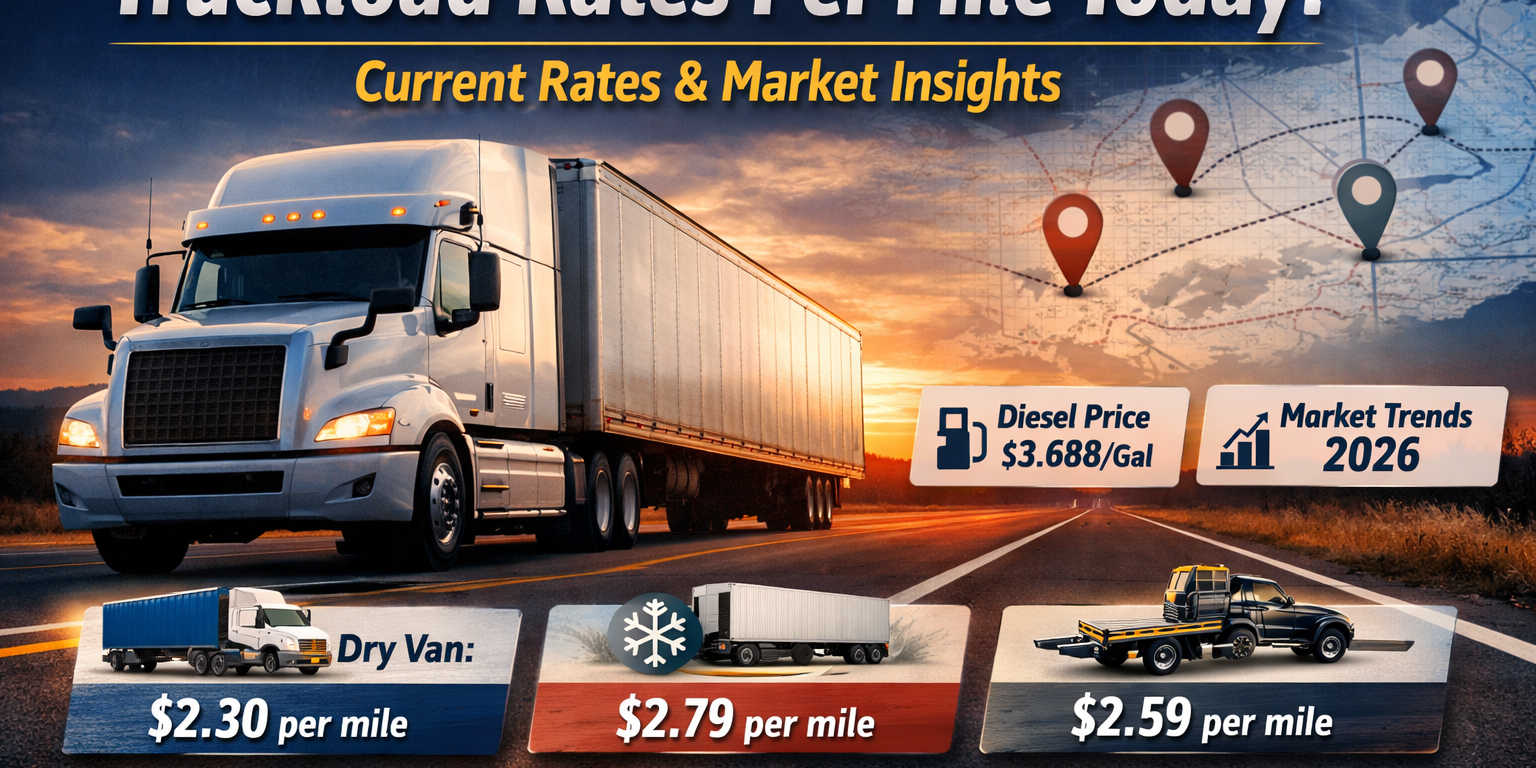
Below are widely cited national averages pulled from DAT Trendlines reporting (as republished with details on Jan 27, 2026). Use these as a starting benchmark:
🚚 Dry Van (Spot)
- National average: $2.30 per mile (spot)
- Midwest tends to run higher; Northeast tends to run lower.
Source: Scale Funding summary of DAT Trendlines (Jan 27, 2026): https://getscalefunding.com/resources/current-freight-rates/ and DAT Trendlines hub: https://www.dat.com/trendlines
🧊 Reefer (Spot)
- National average: $2.79 per mile (spot)
Source: https://getscalefunding.com/resources/current-freight-rates/
🏗️ Flatbed (Spot)
- National average: $2.59 per mile (spot)
Source: https://getscalefunding.com/resources/current-freight-rates/
Important: These are national averages (including fuel). Your lane can be meaningfully above/below average depending on outbound demand, deadhead, seasonality, and appointment requirements. DAT notes Trendlines are national-level indicators and lanes vary. https://www.dat.com/trendlines
⛽ Fuel Snapshot (Why Diesel Still Matters)
Even when linehaul softens, fuel volatility can move your “all-in” quickly.
- U.S. on-highway diesel: $3.688/gal (week of Feb 9, 2026)
Source (EIA): https://www.eia.gov/petroleum/gasdiesel/
Fuel is one reason two quotes on the same lane can differ—especially if one includes a tighter pickup window or more deadhead.
🧠 What’s Driving Truckload Pricing Right Now?
Here’s what matters most in early 2026:
1) Capacity is tightening in “bursts”
Seasonal weather and disruption weeks can cause sudden cost spikes even if overall demand isn’t exploding. C.H. Robinson notes the market is seeing heightened seasonal disruption and that tighter capacity increases the magnitude of rate moves in 2026.
Source: https://www.chrobinson.com/en-us/resources/insights-and-advisories/north-america-freight-insights/jan-2026-freight-market-update/na-truckload/
2) Demand is “muted,” but supply is adjusting
ACT Research describes 2026 as a transition year with fragile demand fundamentals in many sectors, while the supply side adjusts (capacity contraction ongoing, but supply still often exceeds demand).
Source: https://www.actresearch.net/resources/blog/trucking-industry-forecast-for-2026
3) Lane imbalance is everything
National averages don’t tell you whether your origin is a “hot” outbound market this week. That’s why good quoting requires lane context, not just a single per-mile number.
✅ How to Estimate Your Rate (A Simple Shipper-Friendly Formula)
Use this to build a fast internal estimate before you request a formal quote:
Estimated Total = (Per-mile benchmark × Miles) + Accessorials + Appointment / Handling requirements
Common accessorials that change cost:
- ⏱️ Detention / layover risk (tight docks, drop times)
- 🧰 Driver assist / liftgate (if applicable)
- 🧾 Lumper fees (common in grocery/food DCs)
- 📍 Limited access pickup/delivery
📌 Real-World “Lane Reality Check” Examples
These are illustrative examples to show how totals can pencil out using the current national benchmarks above (your quote can differ based on lane conditions, timing, and freight details).
Example A: Dry Van (800 miles)
- Benchmark: $2.30 × 800 = $1,840
- Add: $150 accessorial buffer (appointments / dwell risk)
- Planning estimate: ~$1,990
B Example: Reefer (1,100 miles)
- Benchmark: $2.79 × 1,100 = $3,069
- Add: $200 for stricter temp/appointments
- Planning estimate: ~$3,269
Example C: Flatbed (650 miles)
- Benchmark: $2.59 × 650 = $1,683.50
- Add: $175 for securement complexity
- Planning estimate: ~$1,859
🧾 The “Fast Quote” Checklist (So You Don’t Get Garbage Pricing)
If you want a quote that’s accurate (and avoids surprise fees), provide:
- 📍 Pickup city/state + ZIP
- 📦 Delivery city/state + ZIP
- 📏 Weight + pallet count + dimensions (or linear feet)
- 🚛 Equipment needed (van / reefer / flatbed)
- 🧊 If reefer: temperature + continuous/stop-start
- 🗓️ Pickup date + required delivery window
- 🧷 Any special requirements (hazmat, team, driver assist, drop trailer)
The better your inputs, the fewer “padding dollars” you’ll see in the quote.
🚀 Get a Truckload Quote That Matches the Market (Not a Guess)
MO Trucking Inc. helps shippers move full truckload freight with faster pricing and support built for real operations — not generic estimates.
👉 Get a Truckload Quote here: https://motruckinginc.com/truckload-quote/
👉 Truckload Shipping Services: https://motruckinginc.com/truckload-shipping-services/
And if you’re comparing providers, use this guide as your baseline so you can spot inflated pricing instantly.
Include these lines as-is in the post (I’m giving you 4 uses):
- “This guide focuses on truckload rates per mile today so you can budget with real benchmarks.”
- “National averages are useful, but truckload rates per mile today still depend on lane conditions.”
- “If you’re seeing pricing far above these benchmarks, your shipment likely has accessorial risk baked in — which is why truckload rates per mile today vary so much.”
- “Want a quote that matches the market? Start with these benchmarks for truckload rates per mile today and request a same-day quote.”
🔗 Sources (hyperlinked inside the post)
- DAT Trendlines hub (market context): https://www.dat.com/trendlines
- Current national averages (DAT Trendlines republished w/ figures): https://getscalefunding.com/resources/current-freight-rates/
- Diesel prices (EIA): https://www.eia.gov/petroleum/gasdiesel/
- 2026 market volatility/capacity commentary (C.H. Robinson): https://www.chrobinson.com/en-us/resources/insights-and-advisories/north-america-freight-insights/jan-2026-freight-market-update/na-truckload/
- 2026 market balance commentary (ACT Research): https://www.actresearch.net/resources/blog/trucking-industry-forecast-for-2026
FAQs
Q: Are these rates spot or contract?
The benchmarks above reflect spot market averages as reported via DAT Trendlines summaries. Contract pricing can be steadier but depends on volume, commitments, and lane consistency.
Q: Why is my lane higher than the national average?
Lane imbalance, tight pickup windows, deadhead, and appointment risk can raise the quote above national averages.
Q: Does diesel still matter if rates include fuel?
Yes—fuel trends influence carrier acceptance and all-in pricing expectations, and can change quickly week to week.