
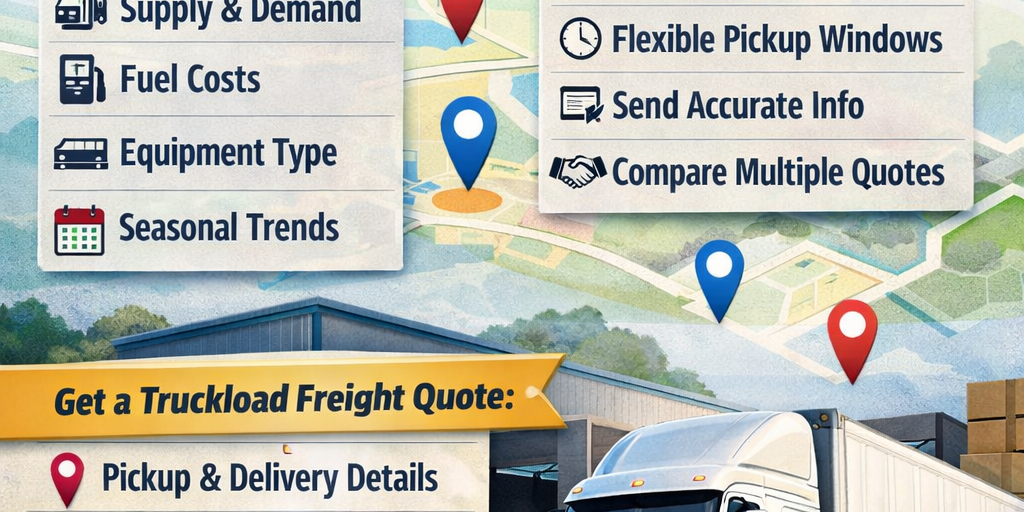
Freight Rates for Truckload Shipping: The Shipper’s Guide to Getting a Better Truckload Freight Quote
If you’re shopping for a truckload freight quote, you’ve probably noticed one thing: pricing can move fast. One day a lane looks normal, the next day it spikes. That’s because truckload is a living market—capacity, demand, fuel, and equipment availability change constantly.
This guide breaks down what actually drives truckload pricing, how to compare quotes the right way, and what details to send up front so you get fewer “re-quotes” and more accurate pricing—especially when you need a fast FTL Shipping Quote.
Along the way, you’ll see the difference between Truckload Freight Charges vs. accessorials, how to avoid paying unnecessary Truckload Shipping Fees, and how to set your shipment up to win better Full Truckload Rate Quotes.
What drives truckload rates (the stuff that actually moves the needle)
Here are the biggest factors that influence truckload pricing in real life:
1) Supply vs. demand (capacity)
When more loads are posted than trucks available, rates rise. Market indicators like DAT’s weekly Trendlines are designed to summarize national spot conditions and demand metrics.
Truckstop’s Market Demand Index (MDI) is another commonly referenced signal (loads-to-trucks ratio).
2) Fuel (and how fuel surcharges get applied)
Fuel doesn’t just “raise rates”—it often appears as a separate fuel surcharge or gets blended into the total, depending on how the quote is structured. Recent reporting on truck freight rates highlights how volatility in fuel surcharges can materially change all-in pricing.
3) Equipment type and service expectations
Dry van vs. reefer vs. flatbed can change the lane economics dramatically. If you need strict pickup windows, team drivers, or drop trailer capability, your Full Truckload Service Rate will reflect it.
4) Distance + routing complexity
Longer miles usually lower the per-mile price (not always), but metro pickups, toll-heavy routes, and “deadhead” positioning can increase your Truckload Delivery Rates.
5) Timing and seasonality
End-of-month, produce seasons, holidays, and weather disruptions can all move your Freight Rates for Truckload Shipping.
The quote types you’ll see (and how to compare apples-to-apples)
When shippers say “quote,” they might mean different things. Make sure you know which you’re receiving:
- Truckload Shipping Rate Quote: A general price for a lane + equipment, usually time-sensitive.
- Truckload Rate Estimate: Often an early budget number that can change once details are confirmed.
- Truckload Shipping Estimates (plural): What you get when you compare multiple providers and service options.
- Full Load Transport Quotes: Similar concept—just phrased differently; confirm the equipment and service included.
- Full Truckload Delivery Rate: Usually implies an all-in door-to-door rate (verify accessorials).
- Truckload Freight Pricing: The broader “how it’s calculated” concept (linehaul + fuel + accessorials).
Quick rule:
If you’re comparing Full Load Rate options from multiple providers, confirm the same:
- equipment (53’ dry van / reefer / flatbed)
- service (standard vs. expedited)
- pickup/delivery windows
- detention/free time policy
- accessorials (liftgate, inside delivery, etc.)
What to send to get a faster, more accurate truckload quote
If you want fewer delays and fewer re-quotes, send this in the first message:
- Lane: pickup city/ZIP → delivery city/ZIP
- Dates: ready date + delivery deadline
- Equipment: dry van / reefer temp & setpoint / flatbed
- Commodity + packaging (pallets, slipsheet, floor-loaded)
- Weight (total + per pallet if possible)
- Dims (especially if light but bulky)
- Dock type (live load/unload vs. drop)
- Accessorials you know you need (lumper, appointment, etc.)
This directly impacts the accuracy of your Truckload Rate Service and reduces surprise Truckload Shipping Fees later.
How to lower your all-in truckload cost without sacrificing reliability
Book earlier (when you can)
Same-day shipments tend to cost more because carriers have fewer repositioning options.
Offer flexible pickup windows
Even 2–4 hours of flexibility can reduce Truckload Freight Charges on busy lanes.
Confirm detention terms
Detention can turn a “good quote” into a bad one. Clarify free time, hourly rates, and billing triggers.
Consider mode alternatives for “almost truckload”
If you’re not truly filling a trailer, some providers position partial/volume solutions using unused truckload space (conceptually similar to “volume services” described by major carriers).
Market context (why rates feel weird lately)
Industry commentary and data products suggest the market can stay “inverted” at times (spot below contract) and still be unstable because carrier costs and capacity shifts can create sharp moves when demand returns.
For a quick pulse check, many shippers watch weekly snapshots like DAT Trendlines.
Q & A (FAQ)
Q: What’s the difference between “Truckload Freight Charges” and accessorials?
A: “Charges” often refers to the main linehaul (and sometimes fuel). Accessorials are add-ons like detention, layover, lumper fees, appointment handling, or special equipment.
Q: How long is a truckload quote valid?
A: Sometimes only hours, often same-day, occasionally 24–72 hours for certain lanes—because capacity and fuel move. Use market snapshots like DAT’s weekly view for context, but always confirm validity in writing.
Q: Why did my price change after I booked?
A: Common reasons: weight/dims changed, accessorials weren’t disclosed, appointment requirements were added, or the carrier had to re-route/reposition.
Q: What should I do if I need “Full Truckload Freight Cost” certainty?
A: Ask for an all-in quote that clearly lists what is included/excluded, plus detention terms, and confirm the service level (standard vs. expedited/team). (Yes, Full Truckload Freight Cost can be quoted all-in, but only if details are locked.)
Q: Are “Full Truckload Rate Quotes” always cheaper than LTL?
A: Not always. If you’re shipping a few pallets, LTL can be cheaper; if you’re near a full trailer or need direct transit with less handling, truckload can win on both cost and risk.
Review snippets mentioning “truckload” terms (publicly available examples)
Important note: Google Maps reviews are not reliably accessible for republishing via normal web pages, and pulling them programmatically typically requires the Google Places/Maps APIs and compliance with Google’s policies. Google documents how place review data can be retrieved via the Places APIs.
That said, here are public review snippets from third-party review pages that explicitly include truckload terms:
- “I booked a truckload shipment and MO Trucking offered a very competitive freight rates for truckload shipping from New York to Florida…”
- “Excellent service… Competitive LTL Freight Quote… (review page includes truckload-related context and offerings)… ”
If you want, I can also format a “Reviews” section that’s ready for your site once you provide:
- the exact Google Business Profile link(s), and
- the specific reviews you want to feature (copy/paste text),
so you stay clean on licensing/policy and keep everything accurate.
3) Use conversion-focused sections Google likes to see
Include:
- “What you’ll need to get a quote” checklist (done above)
- FAQs (done)
- Clear CTA with trust signals (reviews, response time, coverage)
Wrap-up + next step
Getting a great truckload freight quote is less about hunting the absolute lowest number and more about getting a clean, comparable, all-in offer that matches your timeline and risk tolerance.
If you want this tailored to MO Trucking Inc. (so it’s more likely to rank and convert), tell me:
- your top 5 origin metros + destination metros, and
- the equipment mix you want to push most (dry van vs reefer vs flatbed)