
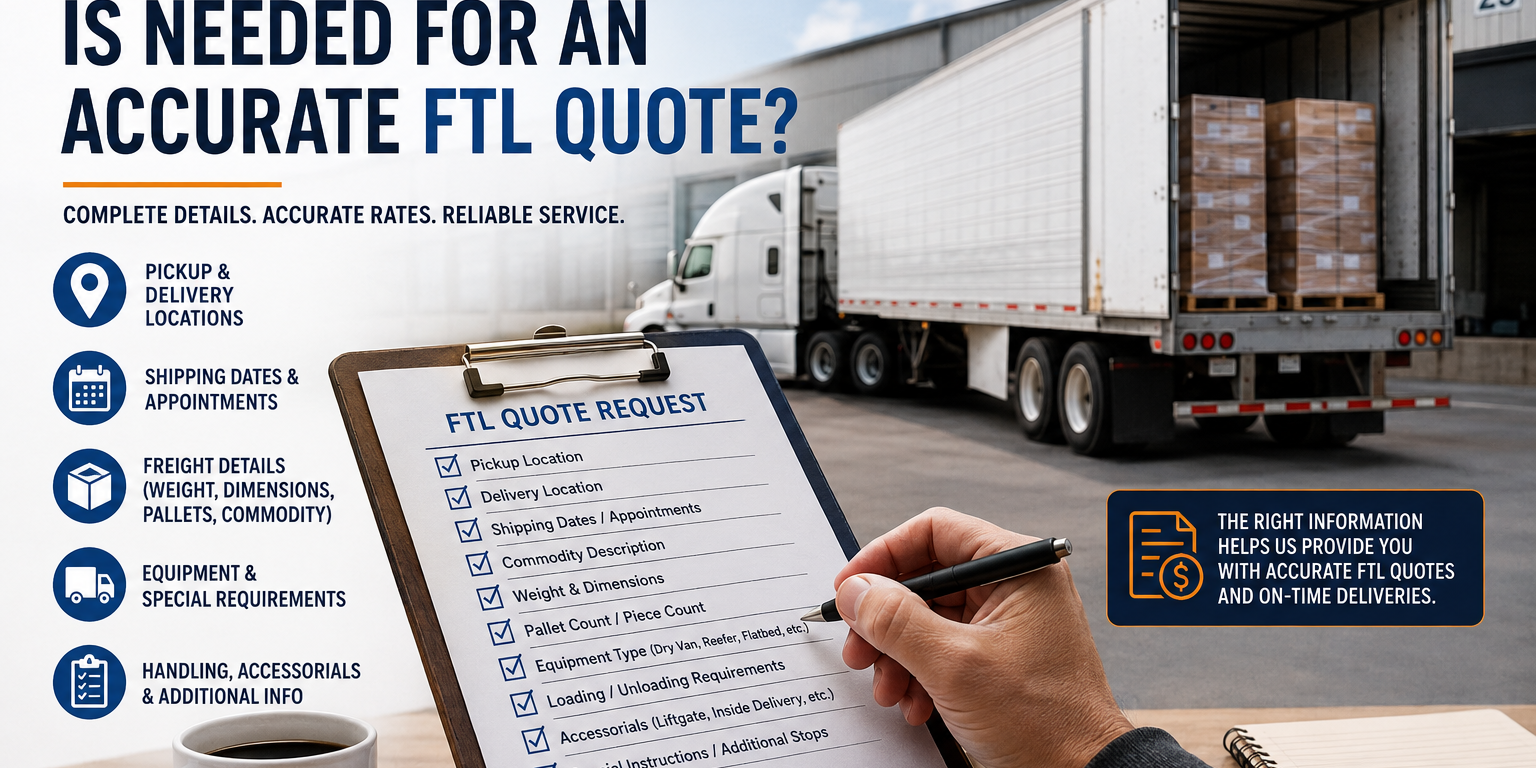
What Information Is Needed for an Accurate FTL Quote?
Obtaining accurate FTL quotes requires more than providing a pickup city and delivery city. A full truckload carrier must understand the freight, equipment requirements, facility restrictions, schedule, handling needs, and potential risks before determining the correct rate.
Missing information can result in a quote that changes after the shipment is booked. It may also lead to the wrong equipment arriving, missed appointments, unexpected accessorial charges, or difficulty finding a qualified carrier.
Shippers can avoid these problems by providing complete information when requesting a full truckload quote.
This guide explains exactly what information a trucking company needs to calculate an accurate rate and arrange dependable full truckload transportation.
What Is an FTL Quote?
An FTL quote is an estimated price for transporting a shipment using a dedicated truck or trailer.
FTL stands for full truckload. Unlike less-than-truckload shipping, the freight normally moves on one truck from the pickup location to the delivery location without being transferred through multiple freight terminals.
A shipment does not necessarily have to fill every inch of the trailer to qualify as FTL. Shippers may choose dedicated truckload service when they:
- Have enough freight to use most of a trailer
- Want the entire trailer reserved for one shipment
- Need faster transit than traditional LTL service
- Want to reduce freight handling
- Are shipping fragile, valuable, oversized, or time-sensitive products
- Require direct transportation between two facilities
The accuracy of a truckload quote depends heavily on the accuracy of the information supplied by the shipper.
Information Required for Accurate FTL Quotes
For the fastest and most accurate response, include the following information in every quote request:
| Information | Details to Provide |
| Pickup location | Complete address, ZIP code, facility type, hours and appointment requirements |
| Delivery location | Complete address, ZIP code, facility type, hours and appointment requirements |
| Shipping dates | Freight-ready date, pickup window and required delivery date |
| Commodity | Exact product description and packaging type |
| Quantity | Number of pallets, pieces, crates, bundles or containers |
| Weight | Total shipment weight and unusually heavy individual pieces |
| Dimensions | Pallet or item length, width and height |
| Equipment | Dry van, refrigerated trailer, flatbed, liftgate or other equipment |
| Handling | Driver assist, pallet jack, liftgate, tarping or other special service |
| Special conditions | Hazardous materials, temperature control, high value or oversize freight |
| Additional stops | Any extra pickups or deliveries |
| Contact information | Name, phone number and email for each facility |
The more complete the request, the less likely the rate will need to be revised later.
- Exact Pickup and Delivery Locations
The origin and destination are the foundation of every truckload rate.
At a minimum, provide the city, state and ZIP code for both locations. Complete street addresses are even better because they allow the carrier to evaluate the actual route and identify potential restrictions.
Two facilities in the same ZIP code may have very different operating conditions. One may be a large distribution center with multiple loading docks, while the other may be a retail store located on a congested street.
Include the following information for each location:
- Complete street address
- Business name
- Facility type
- Receiving or shipping hours
- Appointment requirements
- Contact name and telephone number
- Dock availability
- Trailer access limitations
- Security or check-in procedures
- Parking or staging availability
The carrier should also know whether the location is a:
- Warehouse
- Distribution center
- Manufacturing facility
- Construction site
- Retail store
- Residential property
- Convention center
- Port or rail facility
- Airport
- School, hospital or government building
Facility type can affect equipment selection, driver time and the overall cost of the shipment.
Why ZIP Codes Alone May Not Be Enough
A ZIP-to-ZIP request may be sufficient for a preliminary estimate, but it may not produce a final rate.
Urban areas, limited-access streets, bridges, tunnels, toll routes and local truck restrictions can materially affect the route. A tractor-trailer may also be unable to access a location that can accommodate a straight truck.
Providing the complete address helps the trucking company determine whether the requested equipment can safely and legally reach the facility.
- Freight-Ready Date and Appointment Times
An accurate quote must be based on actual shipping dates.
Provide:
- The date the freight will be ready
- The earliest allowable pickup time
- The latest allowable pickup time
- Whether an appointment is required
- The required delivery date
- The delivery appointment or receiving hours
- Whether the shipment can move earlier or later
A flexible shipping window may provide access to more available trucks. A narrow appointment window limits the number of carriers that can service the load.
Pickup timing also affects truck utilization. For example, a midday appointment may prevent a driver from completing another revenue-producing move before or after the shipment. Consequently, a load with a narrow midday appointment may be priced differently from a similar load that can be collected early in the morning.
Urgent requests, same-day transportation, weekend service and holiday pickups may also carry different pricing because fewer trucks may be available.
Avoid Using Unclear Scheduling Language
Terms such as “pickup sometime Thursday” or “deliver as soon as possible” leave too much room for interpretation.
Use specific instructions, such as:
Freight will be ready Thursday at 8:00 a.m. Pickup is available from 8:00 a.m. to noon. Delivery must be completed Friday before 2:00 p.m.
That information allows the carrier to evaluate driver hours, transit time and appointment feasibility before accepting the shipment.
- An Accurate Commodity Description
“General freight” is rarely a sufficient commodity description.
The carrier needs to know what is being transported because the commodity can affect:
- Trailer suitability
- Cargo securement
- Insurance requirements
- Loading procedures
- Weight distribution
- Temperature requirements
- Risk of contamination
- Carrier availability
Provide the actual product description, such as:
- Packaged food products
- Machinery
- Furniture
- Building materials
- Consumer electronics
- Printed materials
- Plastic packaging
- Automotive components
- Medical supplies
- Clothing
- Nonhazardous chemicals
A precise description helps the trucking company determine whether the freight is compatible with the available equipment.
Federal cargo-securement requirements are designed to prevent freight from shifting, spilling, leaking, blowing or falling from a commercial vehicle. Certain commodities require specific securement methods, making an accurate description especially important.
Include the Packaging Type
State whether the freight is:
- Palletized
- Floor-loaded
- Crated
- Boxed
- Bundled
- Rolled
- Bagged
- Drummed
- Loose
- Mounted on machinery skids
Floor-loaded cartons may require more loading and unloading time than palletized freight. Machinery may require chains, straps, blocking or specialized equipment. Rolled products may require cradles or other securement materials.
Packaging details should never be omitted from a quote request.
- Total Weight and Weight Distribution
Every FTL quote request should include the shipment’s total gross weight.
The carrier may also need:
- Weight per pallet
- Weight of the heaviest piece
- Number of pallets
- Whether weight is evenly distributed
- Whether any item creates a concentrated load
- Whether the listed weight includes packaging and pallets
Weight affects equipment selection, fuel consumption, axle distribution and legal routing.
Federal and state requirements regulate commercial vehicle size and weight. Oversized or overweight freight may require permits, route planning or specialized equipment.
Do not estimate weight unless the quote is clearly identified as preliminary. A substantial difference between quoted and actual weight can cause:
- Equipment problems
- Rejected pickups
- Reworking or repositioning freight
- Permit requirements
- Rate adjustments
- Delays at the shipping facility
When possible, provide weight from a bill of lading, production record, packing list or certified scale.
- Pallet Count and Freight Dimensions
Provide the number of handling units and the dimensions of each unit.
For palletized freight, list:
- Number of pallets
- Length of each pallet
- Width of each pallet
- Loaded height
- Weight per pallet
- Whether pallets can be stacked
- Whether anything overhangs the pallet
For machinery, crates or irregular freight, provide dimensions for each individual piece.
Why Stackability Matters
Twenty standard pallets may fit in a dry van differently from twenty oversized pallets. Non-stackable freight may consume significantly more trailer space than stackable freight.
A pallet should not be described as stackable unless another loaded pallet can safely be placed on top of it during transportation.
Also disclose:
- Fragile tops
- Uneven surfaces
- Leaning freight
- Protruding parts
- Pallet overhang
- Damaged packaging
- Unusually tall freight
Photographs are helpful when freight has unusual dimensions or packaging.
- Required Truck and Trailer Type
The shipper should identify the requested equipment whenever possible. When the proper equipment is unknown, provide complete freight and facility information so the carrier can recommend it.
Common equipment options include:
Dry Van
A dry van is commonly used for packaged freight that does not require temperature control or exposure during loading.
Potential requirements may include:
- 53-foot trailer
- 48-foot trailer
- Swing doors
- Roll-up doors
- Air-ride suspension
- Food-grade interior
- E-track or logistics posts
- Liftgate
Refrigerated Trailer
A refrigerated trailer—or reefer—is used when the product must remain within a specified temperature range.
The shipper must provide:
- Required temperature
- Whether the product is frozen, chilled or protected from freezing
- Whether continuous operation is required
- Whether the shipment must be precooled
- Acceptable temperature variance
- Whether a temperature recorder is required
- Sanitation or washout requirements
A request that says only “keep cold” is not specific enough for an accurate refrigerated freight quote.
Flatbed, Step Deck or Specialized Open-Deck Equipment
Open-deck freight requires additional details, including:
- Exact dimensions
- Weight of every piece
- Loading method
- Unloading method
- Tarping requirements
- Securement points
- Crane or forklift availability
- Whether the freight is oversize
- Whether permits or escorts may be needed
Straight Truck or Box Truck
A straight truck may be appropriate for smaller dedicated shipments or locations that cannot accommodate a tractor-trailer.
State whether the truck requires:
- A liftgate
- A pallet jack
- Inside-delivery service
- Residential access
- Limited-height clearance
- Local urban delivery capability
Do not assume that every truck automatically carries a liftgate or pallet jack.
- Loading and Unloading Requirements
The quote should explain exactly how the freight will enter and leave the truck.
Confirm whether each facility has:
- A standard loading dock
- A forklift
- A crane
- Ground-level access
- A ramp
- A loading crew
- A pallet jack
- Space for a full-size tractor-trailer
Identify any additional service required, including:
- Liftgate pickup or delivery
- Driver assist
- Driver count
- Inside delivery
- Pallet jack service
- Hand unloading
- Tarping
- Debris removal
- Skid removal
- Unpacking
- Cross-docking
- Restacking
- Sorting or segregation
These services are not automatically included in a standard truckload rate.
For example, “liftgate delivery” may mean only lowering palletized freight to the street or sidewalk. It does not necessarily include moving the freight inside the building, removing packaging or disposing of pallets.
The requested scope of service should be stated clearly before the truck is dispatched.
- Appointment, Detention and Facility Conditions
Loading and unloading time are important components of truckload pricing.
Provide realistic expectations for:
- Check-in time
- Loading time
- Unloading time
- Security processing
- Driver waiting
- Dock congestion
- Product inspection
- Paperwork
- Lumper service
Many truckload rates include a limited amount of free time for loading and unloading. Detention charges may begin when that allowance is exceeded.
Before accepting a quote, verify:
- How much free time is included
- The hourly detention rate
- When detention begins
- Whether signed arrival and departure times are required
- Whether the facility regularly experiences delays
A shipment with a six-hour loading process should not be quoted as though the driver will be loaded immediately.
- Hazardous Materials or Regulated Freight
Hazardous materials must be disclosed before the carrier provides a final quote.
Provide all applicable information, including:
- Proper shipping name
- UN or NA identification number
- Hazard class
- Packing group
- Quantity
- Packaging type
- Placard requirements
- Safety Data Sheet
- Emergency contact information
Do not describe hazardous freight only by its commercial product name.
Hazardous-material shipments may require qualified carriers, proper documentation, specialized insurance and drivers with the appropriate endorsement. The Transportation Security Administration conducts security threat assessments for drivers who require a hazardous-material endorsement on their commercial driver’s license.
Failure to disclose regulated freight can result in cancellation, delays and serious compliance problems.
- Shipment Value and Insurance Requirements
High-value freight should be identified during the quoting process.
Provide:
- Actual cargo value
- Required cargo-insurance limit
- Type of product
- Whether special security procedures are required
- Whether team drivers are required
- Whether unattended parking is prohibited
- Whether tracking or check calls are required
Do not assume that a carrier’s standard cargo policy automatically covers the full value of every shipment or every commodity.
Some products may be subject to exclusions, sublimits or special underwriting requirements. The shipper should verify coverage before the freight is loaded.
High-value goods may also require:
- Additional insurance
- Approved parking locations
- Trailer seals
- Team service
- Enhanced tracking
- Direct delivery without overnight stops
- Written chain-of-custody procedures
These requirements may affect the final rate.
- Additional Stops or Route Requirements
Every stop should be included in the original quote request.
Specify:
- Number of pickups
- Number of deliveries
- Address of each stop
- Appointment time at each stop
- Quantity loaded or unloaded
- Required stop sequence
- Whether the trailer must be resealed
- Whether paperwork must be collected
Additional stops increase mileage, driver time and scheduling complexity.
Also disclose route requirements such as:
- Avoiding toll roads
- Avoiding ferries
- Crossing an international border
- Entering a port
- Delivering to a trade show
- Using a specific gate or entrance
- Returning empty pallets
- Returning rejected or damaged products
A quote for one pickup and one delivery cannot be assumed to include unlisted stops.
- Fuel, Tolls and Other Rate Components
Ask whether the FTL quote includes:
- Linehaul
- Fuel surcharge
- Tolls
- Appointment fees
- Liftgate service
- Driver assist
- Detention
- Layover
- Truck ordered not used
- Lumper fees
- Permit costs
- Tarping
- Additional stops
- Residential or limited-access service
A low initial price is not always the lowest final price.
The most useful quote is one that clearly explains what is included, what is excluded and which circumstances may generate additional charges.
Fuel efficiency and operational planning are significant parts of freight transportation. The EPA’s SmartWay program works with shippers, carriers and logistics providers to improve freight efficiency and reduce fuel use across supply chains.
Common Mistakes When Requesting FTL Quotes
Shippers can improve quote accuracy by avoiding several common mistakes.
Providing Only the Cities
City-to-city information may produce a rough estimate, but final pricing often requires complete addresses and facility details.
Underestimating Weight
An incorrect weight can affect legal loading, equipment suitability and carrier acceptance.
Omitting Pallet Dimensions
The pallet count alone does not reveal whether the freight will fit in the requested trailer.
Forgetting to Mention a Liftgate
A standard tractor-trailer may arrive without a liftgate, making ground-level unloading impossible.
Leaving Out Appointment Requirements
A strict appointment can affect carrier availability and transit planning.
Calling Freight “General Merchandise”
An accurate commodity description is necessary for equipment, insurance and handling decisions.
Failing to Disclose Special Handling
Driver assist, inside delivery, tarping and pallet-jack service should be included in the original request.
Requesting a Rate Before the Shipment Is Ready
Rates are affected by equipment availability and timing. A preliminary budget estimate obtained months in advance may not represent the rate available when the freight is actually ready.
Sample FTL Quote Request
Shippers can use the following format when requesting truckload pricing:
Pickup location:
Company name:
Street address:
City, state and ZIP code:
Facility type:
Pickup date:
Pickup hours or appointment:
Dock or ground-level loading:
Contact name and telephone number:
Delivery location:
Company name:
Street address:
City, state and ZIP code:
Facility type:
Required delivery date:
Receiving hours or appointment:
Dock or ground-level unloading:
Contact name and telephone number:
Freight information:
Commodity:
Number of pallets or pieces:
Total weight:
Dimensions:
Stackable or non-stackable:
Packaging type:
Declared cargo value:
Equipment required:
Dry van, refrigerated trailer, flatbed, straight truck or other:
Trailer size:
Liftgate required:
Pallet jack required:
Temperature requirement:
Additional securement or tarping:
Additional services:
Driver assist:
Inside delivery:
Extra stops:
Hazardous material:
Special insurance:
Other instructions:
Providing this information in the first request can reduce follow-up emails and help the carrier respond more quickly.
How to Compare Multiple FTL Quotes
Do not compare truckload quotes based solely on the total price.
Confirm that each provider is quoting the same:
- Equipment type
- Pickup date
- Delivery schedule
- Number of stops
- Loading and unloading allowance
- Fuel treatment
- Toll treatment
- Liftgate or handling services
- Cargo requirements
- Insurance expectations
One quote may appear lower because it excludes fuel, tolls or accessorial services included by another provider.
Ask each provider to explain:
- What is included in the rate?
- How long is the quote valid?
- Is the rate based on dedicated service?
- Is the truck confirmed or is the rate only an estimate?
- What detention terms apply?
- What events could cause the price to change?
- Is the carrier qualified for the commodity and service requirements?
A transparent quote is generally more useful than a vague low number.
Why Complete Information Produces Better FTL Quotes
Accurate shipment information allows the trucking provider to:
- Select the correct equipment
- Identify qualified carriers
- Plan a legal and practical route
- Confirm that appointments are achievable
- Evaluate special handling requirements
- Verify insurance needs
- Anticipate potential accessorial charges
- Provide a more dependable rate
Complete information also protects the shipper. It creates a written record of the requested service and reduces misunderstandings after the truck has been dispatched.
The objective is not simply to obtain the lowest number. The objective is to obtain an accurate price for a service that can be performed safely, legally and on schedule.
Request an Accurate FTL Quote From MO Trucking Inc.
MO Trucking Inc. provides dependable full truckload transportation for shippers requiring dedicated equipment, clear communication and practical freight solutions.
To receive an accurate quote, send us:
- Complete pickup and delivery addresses
- Requested shipping dates and appointment times
- Commodity description
- Pallet or piece count
- Total weight and dimensions
- Equipment requirements
- Loading and unloading conditions
- Any special handling instructions
Our team will review the shipment requirements, identify the appropriate equipment and provide a clear truckload rate based on the requested service.
Email: Eric@motruckinginc.com
Phone: 631-755-5858
Text/After Hours: 516-250-4480
Frequently Asked Questions About FTL Quotes
What is the minimum information needed for an FTL quote?
At minimum, provide the origin ZIP code, destination ZIP code, pickup date, commodity, total weight and required equipment. Complete addresses, dimensions and facility details are normally required before the rate can be finalized.
How quickly can I receive an FTL quote?
Response time depends on the lane, equipment and shipment complexity. A complete request can usually be evaluated more quickly than one requiring multiple follow-up questions.
Does an FTL shipment need to fill the entire trailer?
No. A shipper may reserve a dedicated truck even when the freight does not occupy the entire trailer. This is common for fragile, valuable, urgent or non-stackable shipments.
Why did my FTL quote change?
A quote may change when the shipping date, addresses, weight, dimensions, equipment, appointments or handling requirements differ from the original request. Market availability can also change between the date of the estimate and the date the truck is booked.
Are fuel and tolls included in an FTL quote?
That depends on the provider. Ask whether the quoted amount includes linehaul, fuel, tolls and anticipated accessorial services.
Do pallet dimensions matter for a full truckload?
Yes. Dimensions determine how the freight fits inside the trailer and whether it can be loaded safely. Oversized or non-stackable pallets may require more trailer space than standard pallets.
Is a liftgate included with a standard dry van?
Not necessarily. Most standard trailers are designed for dock loading and may not have liftgates. The liftgate requirement must be disclosed when requesting the quote.
What information is needed for a refrigerated FTL quote?
Provide the commodity, required temperature, loading temperature, acceptable variance, continuous-run requirements, trailer-cleanliness requirements and whether temperature records are needed.
Can I obtain an FTL quote without an exact pickup date?
You can request a budgetary estimate, but the final rate may change. Carrier availability and market conditions are tied to the actual shipping date.
How long is an FTL quote valid?
Validity varies by provider and market conditions. Ask for the expiration date and confirm the rate again before tendering the shipment.
Final FTL Quote Checklist
Before submitting your request, confirm that you have included:
- Complete pickup and delivery information
- Freight-ready date
- Pickup and delivery appointments
- Commodity and packaging
- Pallet or piece count
- Total weight
- Freight dimensions
- Stackability
- Required equipment
- Temperature requirements
- Liftgate or pallet-jack requirements
- Driver-assist expectations
- Hazardous-material information
- Cargo value
- Additional stops
- Special facility restrictions
- Contact information
Providing these details helps the carrier calculate accurate FTL quotes, secure suitable equipment and complete the shipment with fewer delays or unexpected costs.