
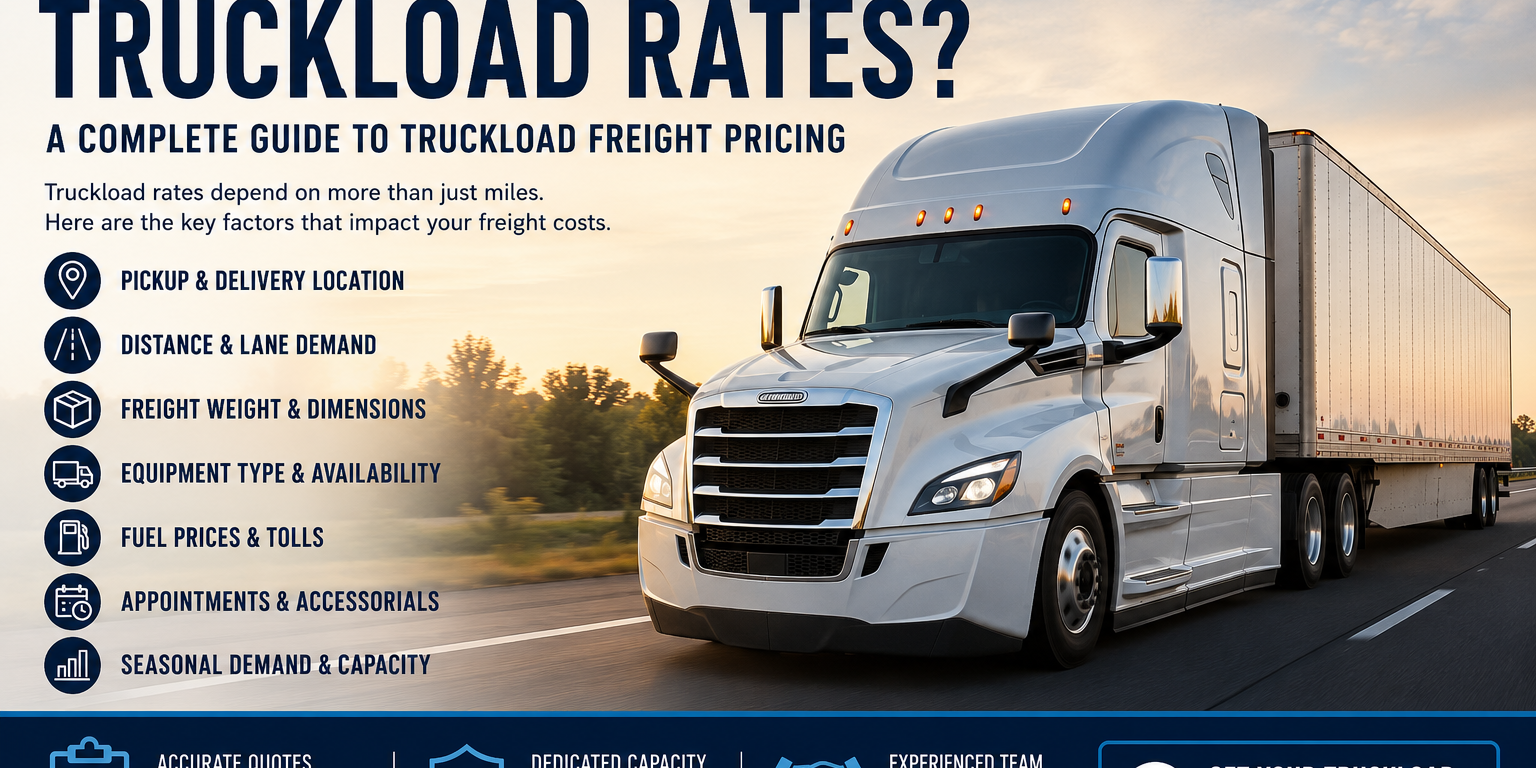
What Determines Truckload Rates? A Complete Guide to Truckload Freight Pricing
When businesses request a truckload freight quote, one of the first questions they ask is:
“How much will it cost?”
The honest answer is that truckload rates depend on many variables. Unlike parcel shipping, where pricing is often based on weight and destination alone, truckload freight rates are influenced by market conditions, equipment availability, shipment characteristics, accessorial services, and operational requirements.
Understanding what affects truckload pricing helps shippers make better transportation decisions, avoid unexpected charges, and obtain more accurate freight quotes.
In this guide, we’ll explain the biggest factors that determine truckload shipping rates and how you can reduce transportation costs without sacrificing service.
-
Pickup and Delivery Locations
One of the largest factors affecting truckload pricing is where the shipment begins and ends.
Some freight lanes have thousands of trucks available every day, while others have limited carrier capacity.
For example, a shipment between two major freight markets may cost less than a shorter shipment into a remote area simply because more trucks are available.
Carriers also consider:
- Deadhead mileage
- Driver availability
- Local regulations
- Traffic conditions
- Toll roads
- Return freight opportunities
Locations with difficult access, heavy congestion, or limited outbound freight often require higher rates.
-
Distance
Mileage plays an important role in truckload pricing, but it is only one piece of the equation.
Longer trips generally cost more overall, but the cost per mile often decreases as mileage increases because fixed costs are spread over a greater distance.
For example:
- 150-mile shipment
- 500-mile shipment
- 1,200-mile shipment
All three require different operating strategies, equipment utilization, and driver planning.
Distance should never be viewed as the only pricing factor.
-
Freight Weight
Truckload trailers have legal weight limitations.
A shipment weighing 12,000 pounds is very different from one weighing 44,000 pounds.
Heavier shipments may:
- Limit available equipment
- Reduce carrier options
- Require special axle placement
- Increase fuel consumption
- Affect loading methods
Always provide the actual shipment weight rather than an estimate whenever possible.
-
Freight Dimensions
Dimensions are just as important as weight.
Two shipments weighing 20,000 pounds can require completely different trailers depending on their size.
Carriers evaluate:
- Length
- Width
- Height
- Pallet count
- Crate dimensions
- Stackability
- Freight overhang
Incorrect dimensions often result in pricing changes after pickup.
-
Equipment Type
Different trailer types have different operating costs.
Examples include:
- 53′ Dry Van
- 48′ Trailer
- Liftgate Trailer
- Flatbed
- Step Deck
- Reefer
- Straight Truck
- Power Only
Specialized equipment is generally more expensive because availability is lower.
-
Market Capacity
Truckload pricing changes daily.
If there are many available trucks and limited freight, rates usually decrease.
If freight demand exceeds available trucks, pricing increases.
Capacity changes because of:
- Seasonal demand
- Produce season
- Holidays
- Severe weather
- Fuel prices
- Driver shortages
- Manufacturing activity
- Port congestion
This is why the same shipment may receive different pricing on different days.
-
Fuel Prices
Diesel fuel is one of the largest operating expenses for trucking companies.
Many carriers include fuel in their quote, while others use a separate fuel surcharge.
Fuel fluctuations can significantly affect truckload pricing throughout the year.
-
Toll Roads
Certain regions require expensive tolls.
Examples include:
- New York City
- Long Island
- New Jersey
- Pennsylvania Turnpike
- Bridges
- Tunnels
Some truckload quotes include tolls, while others list them separately.
Always ask how tolls are handled before booking.
-
Loading and Unloading Time
Truckload pricing assumes a reasonable amount of loading and unloading time.
When trucks are delayed for several hours, detention charges may apply.
Long wait times reduce driver productivity and equipment utilization.
To minimize detention:
- Have freight ready
- Schedule appointments
- Prepare paperwork
- Notify receivers
- Verify dock availability
-
Pickup and Delivery Appointments
Exact appointment times often reduce scheduling flexibility.
Appointments requiring:
- Early morning
- Late evening
- Weekends
- Holidays
may increase transportation costs.
Flexible appointment windows generally improve carrier availability.
-
Number of Stops
Multiple pickups or deliveries require:
- Additional mileage
- Driver time
- Route planning
- Fuel
- Appointment coordination
Each additional stop adds labor and operating costs.
-
Freight Type
Some commodities are easier to transport than others.
Examples include:
- Machinery
- Food
- Electronics
- Medical equipment
- Trade show exhibits
- Furniture
- Steel
- Building materials
Fragile, oversized, hazardous, or high-value freight often requires additional planning.
-
Seasonal Demand
Truckload rates fluctuate throughout the year.
Busy periods include:
- Produce season
- Holiday shipping
- Back-to-school inventory
- Retail peak season
- Construction season
- Trade show season
Booking transportation early during busy seasons often results in better equipment availability.
-
Driver Availability
Even when trucks are available, qualified drivers may not be.
Labor shortages can affect pricing throughout the trucking industry.
-
Specialized Services
Additional services may increase truckload rates.
Examples include:
- Liftgate service
- Driver assist
- Inside delivery
- Residential delivery
- Cross-docking
- Temporary storage
- Trade show deliveries
- Expedited service
- Team drivers
- Drop trailers
- Pallet jack service
- White glove delivery
-
Insurance Requirements
Most carriers provide cargo insurance.
High-value shipments may require increased insurance limits.
Higher cargo values can affect truckload pricing depending on the shipment.
-
Weather
Snowstorms, hurricanes, flooding, wildfires, and other severe weather conditions can reduce truck availability and increase transportation costs.
Weather may also affect:
- Transit times
- Fuel consumption
- Route planning
- Equipment utilization
-
Government Regulations
Federal and state regulations influence trucking costs.
These include:
- Hours of Service
- Weight limits
- Bridge restrictions
- Oversize permits
- Hazmat regulations
- Toll requirements
- Emissions standards
Compliance affects carrier operating expenses.
-
Urban Deliveries
Delivering into congested metropolitan areas often costs more than rural deliveries.
Cities may present challenges such as:
- Heavy traffic
- Limited parking
- Loading restrictions
- Narrow streets
- Dock appointments
- Security procedures
Large metropolitan areas require additional planning and driver time.
-
Supply and Demand
Ultimately, truckload pricing follows basic economics.
When freight demand exceeds truck availability, prices rise.
When truck availability exceeds freight demand, prices typically decrease.
This constant balancing of supply and demand is one of the biggest reasons truckload rates change throughout the year.
How to Get the Most Accurate Truckload Quote
Providing complete shipment information helps carriers calculate accurate pricing.
Be prepared to provide:
- Pickup address
- Delivery address
- Pickup date
- Delivery deadline
- Commodity
- Weight
- Dimensions
- Number of pallets
- Trailer type
- Liftgate requirements
- Appointment information
- Freight photos
- Special handling instructions
Accurate information reduces surprises and helps ensure the correct equipment is assigned.
Tips for Reducing Truckload Shipping Costs
Although some pricing factors cannot be controlled, shippers can often reduce transportation expenses by:
- Booking shipments earlier
- Being flexible with pickup and delivery windows
- Providing accurate dimensions and weights
- Reducing driver wait time
- Consolidating shipments
- Using standard equipment when possible
- Avoiding unnecessary accessorial services
- Planning recurring freight lanes
- Improving loading efficiency
- Working with an experienced transportation provider
Small operational improvements can lead to significant long-term savings.
Conclusion
Truckload freight pricing is based on far more than mileage alone.
Equipment availability, freight characteristics, loading requirements, fuel costs, market conditions, driver availability, and operational complexity all influence the final transportation rate.
By understanding these factors and providing accurate shipment information, businesses can receive more competitive truckload quotes and avoid unexpected charges.
Whether you need a one-time shipment or ongoing transportation support, taking the time to understand what determines truckload rates will help you make smarter shipping decisions.
Frequently Asked Questions
Why do truckload freight rates change every day?
Truckload rates fluctuate because of supply and demand, fuel prices, weather, seasonal shipping patterns, driver availability, and equipment capacity.
Is mileage the biggest factor in truckload pricing?
No. Mileage is important, but freight weight, dimensions, market conditions, equipment type, appointments, and accessorial services also affect pricing.
Why does a shorter shipment sometimes cost more?
A shorter shipment into a difficult market with limited carrier availability or expensive tolls can cost more than a longer shipment between major freight hubs.
What information is needed to receive a truckload quote?
Typically you’ll need the pickup and delivery locations, shipment weight, dimensions, pallet count, commodity, pickup date, trailer type, and any special service requirements.
Does freight weight affect truckload pricing?
Yes. Heavier shipments may limit available equipment, affect fuel consumption, and require additional planning for legal axle weights.
Are liftgate trailers more expensive?
Generally, yes. Liftgate trailers are more specialized than standard dry vans, and equipment availability is often more limited.
What are accessorial charges?
Accessorial charges are additional fees for services beyond standard transportation, such as detention, inside delivery, liftgate service, residential delivery, extra stops, or driver assistance.
Can flexible pickup dates reduce truckload costs?
Often, yes. Flexible scheduling allows carriers to optimize equipment and driver utilization, which may result in more competitive pricing.
How far in advance should I request a truckload quote?
Whenever possible, request a quote several days before your shipment. Early planning generally provides more equipment options and better pricing than last-minute bookings.
Can MO Trucking Inc. help with dedicated truckload shipments?
Yes. MO Trucking Inc. provides dedicated truckload transportation, regional deliveries, cross-docking, final-mile solutions, and nationwide truckload freight coordination based on your shipment requirements.
Contact MO Trucking Inc.
If you need a truckload freight quote, dedicated transportation, cross-docking, final-mile delivery, or help planning your next shipment, our team is ready to assist.
MO Trucking Inc.
Email: Eric@motruckinginc.com
Phone: 631-755-5858
Text or After-Hours: 516-250-4480
Whether you’re shipping a single truckload or managing ongoing freight, we’ll help you find the right transportation solution at a competitive rate.
Request your truckload freight quote today and let our experienced team help you move your freight safely and efficiently.