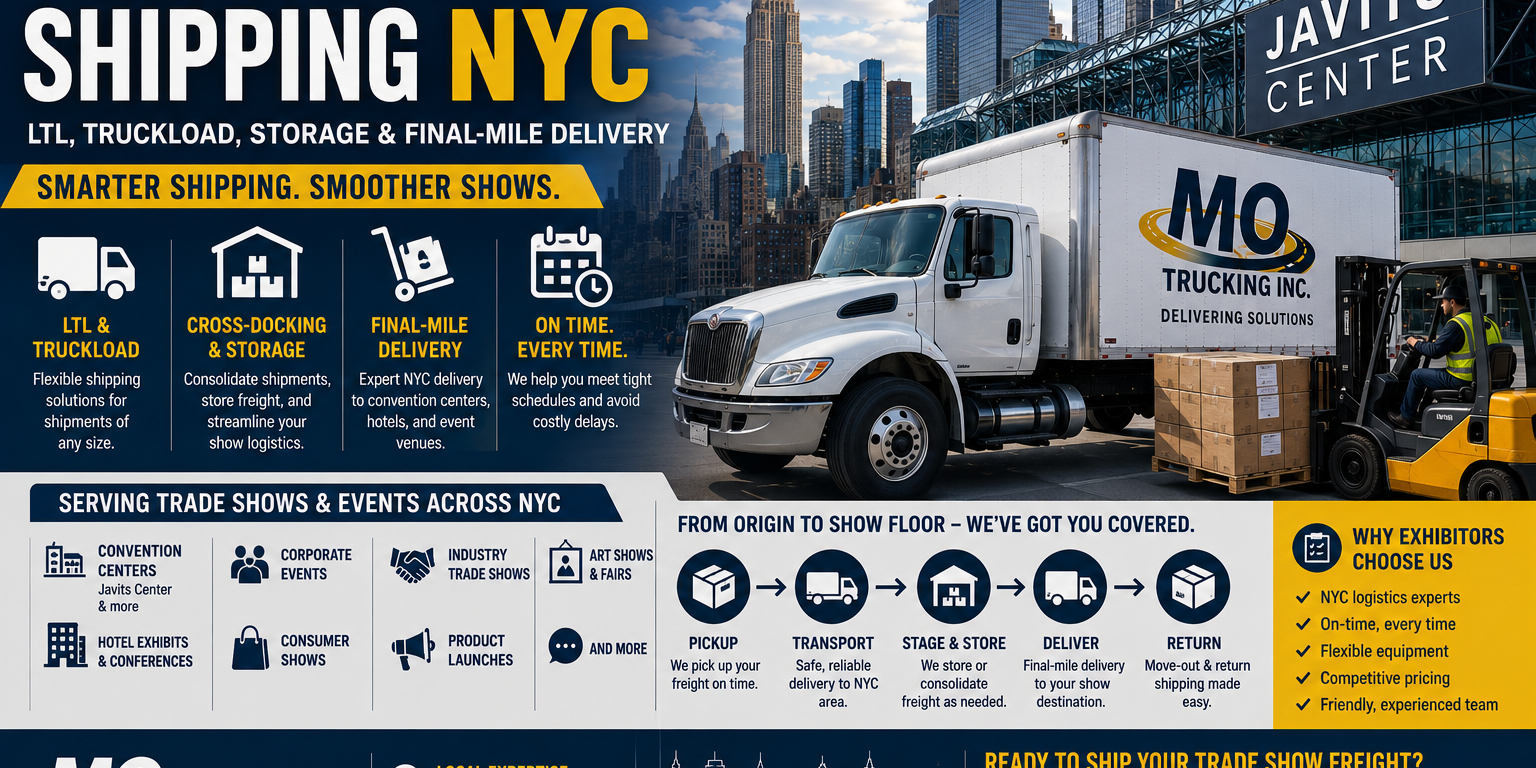
Trade Show Shipping NYC: LTL, Truckload, Storage & Final-Mile Delivery
Trade Show Shipping in New York City Requires More Than Just a Truck
New York City hosts some of the largest trade shows, conventions, exhibitions, conferences, and product marketplaces in the country.
For exhibitors, getting products and booth materials into New York can be almost as important as what happens on the show floor.
A company may spend months designing a booth, preparing product samples, building displays, printing literature, and organizing its sales team.
But none of that matters if the freight does not arrive when it is needed.
Successful Trade Show Shipping NYC requires careful coordination between the shipper, trucking company, warehouse, convention contractor, and exhibitor.
Depending on the shipment, transportation may involve:
- LTL freight
- Full truckload shipping
- Dedicated straight trucks
- Tractor trailers
- Liftgate equipment
- Cross-docking
- Temporary storage
- Consolidation
- Manhattan final-mile delivery
- Expedited transportation
- Return freight after the show
The right strategy depends on where the shipment originates, how much freight is moving, how valuable it is, and exactly when the exhibit needs to receive it.
MO Trucking Inc. helps exhibitors, manufacturers, suppliers, event companies, and vendors coordinate freight transportation throughout the New York metropolitan area.
Why NYC Trade Show Freight Is Different
A convention shipment is not the same as a standard warehouse delivery.
A normal distribution center may receive freight throughout the day.
Trade shows operate around scheduled move-in and move-out periods.
Depending on the event, exhibitors may also need to coordinate:
- General Service Contractor requirements
- Exhibitor freight labels
- Booth numbers
- Driver information
- Delivery schedules
- Marshaling
- Dock assignments
- Material handling
- Freight check-in
- Return shipping
For shows at the Jacob K. Javits Convention Center, for example, contractor and exhibitor freight deliveries or collections are scheduled through the Javits Center’s logistics platform. Drivers and carriers provide shipment and company information before being assigned staging, marshaling, or dock space.
That level of coordination means exhibitors should start planning freight well before the truck arrives in Manhattan.
Shipping to the Javits Center?
Many New York City trade shows take place at the Jacob K. Javits Convention Center.
If that is your destination, read our complete guide:
Javits Center Freight Shipping: Complete Guide for Trade Show Exhibitors
That guide covers Javits-specific freight procedures, delivery planning, cross-docking, warehousing, trucking equipment, show freight, and final-mile considerations.
The Javits Center has extensive convention freight infrastructure, including covered loading docks, a multi-level truck marshaling facility, drive-in ramps servicing exhibit floors, freight handlers, and an advanced logistics management system.
For this article, we will focus more broadly on how exhibitors can plan trade show transportation throughout New York City.
What Types of Freight Are Shipped to NYC Trade Shows?
Almost anything can become trade show freight.
Depending on the industry, exhibitors may transport:
- Booth displays
- Crated exhibits
- Product samples
- Palletized products
- Machinery
- Construction equipment
- Furniture
- Flooring
- Electronics
- Computer equipment
- Retail displays
- Clothing racks
- Textiles
- Cosmetics
- Food products
- Restaurant equipment
- Lighting
- Signs
- Printed materials
- Promotional products
- Tools
- Automotive products
- Packaging
- Laboratory equipment
- HVAC products
- Architectural materials
Some exhibitors need transportation for only one pallet.
Others may need multiple tractor trailers.
The size of the company does not necessarily determine the transportation requirement.
A small exhibitor might have one extremely heavy machine.
A large technology company might have only several crates of valuable electronics.
The trucking solution should match the actual freight.
Start With the Required Delivery Date
One of the biggest mistakes exhibitors make is starting with the pickup date.
Instead, start with the date and time the freight must be available in New York.
Then work backward.
For example:
Required show delivery: Tuesday morning
From there, determine:
- When the freight needs to reach the New York area
- Whether local storage is required
- Whether the shipment needs cross-docking
- How much transit time is needed
- Whether LTL or dedicated service makes sense
- When the original pickup should occur
This approach creates additional protection against delays.
LTL Trade Show Shipping
Less-than-truckload transportation can be an excellent option for smaller exhibits.
LTL may work well when you have:
- One pallet
- Two to five pallets
- Several crates
- Cartons
- Product samples
- Packaged booth materials
- Small displays
Because several customers share the same trailer, the shipper pays for only a portion of the truck.
That can make LTL significantly less expensive than hiring a dedicated vehicle.
However, cost is not the only consideration.
The Challenge With LTL Trade Show Freight
Traditional LTL freight can pass through multiple terminals.
It may also be transferred from one trailer to another before reaching its destination.
That creates additional handling and less control over the precise delivery schedule.
For ordinary commercial freight, this may not be a problem.
For a trade show with a fixed move-in deadline, it can become more important.
If your freight absolutely must be in Manhattan at a particular time, consider adding a buffer.
One strategy is:
Origin → LTL carrier → New York-area warehouse → Dedicated final-mile truck → Trade show
This allows the cost-efficient LTL portion of the move to happen first.
Once the freight reaches the New York region, the final delivery can be handled separately.
Dedicated Trade Show Trucking
Dedicated transportation gives exhibitors more control.
Instead of sharing trailer space with other shipments, the vehicle is assigned specifically to your load.
Dedicated service may make sense when:
- Delivery timing is critical
- Freight is valuable
- Freight is fragile
- Multiple booth components must remain together
- Terminal transfers should be avoided
- The shipment fills most of a trailer
- Freight contains machinery
- The booth cannot open without the shipment
Dedicated transportation can involve different types of equipment.
Cargo Vans and Sprinter Vans
A cargo van or Sprinter can be useful for:
- Emergency shipments
- Small displays
- Replacement booth components
- Printed materials
- Product samples
- Small electronics
- Last-minute promotional materials
These vehicles can be especially useful when something was forgotten at the warehouse or needs to reach the show quickly.
Straight Truck Trade Show Delivery
Straight trucks are one of the most useful equipment types for New York trade show freight.
They can accommodate more freight than a cargo van while remaining easier to maneuver than a full tractor trailer.
Straight trucks may work well for:
- Several pallets
- Crates
- Displays
- Furniture
- Product samples
- Retail fixtures
- Booth equipment
Straight trucks can also be equipped with liftgates when required.
Tractor Trailer Trade Show Shipping
Larger exhibitors may require a dedicated tractor trailer.
A trailer may be appropriate when shipping:
- Large booth displays
- Construction products
- Machinery
- Furniture
- Multiple pallets
- Oversized exhibit components
- Large quantities of products
When booking a trailer into New York City, route planning becomes particularly important.
NYC has designated truck routes, and trucks generally cannot use most parkways. The city distinguishes between Local Truck Routes and Through Truck Routes, and commercial drivers must follow applicable truck-routing rules and posted restrictions.
NYC Truck Routing Matters
A truck can travel 1,000 miles without difficulty and still run into a problem during the final ten miles.
New York City has one of the most complicated commercial trucking environments in the country.
Drivers need to consider:
- Truck routes
- Parkways
- Bridge restrictions
- Tunnel restrictions
- Vehicle height
- Vehicle length
- Vehicle weight
- Manhattan traffic
- Construction
- Loading zones
- Delivery access
NYC DOT specifically advises truck drivers to plan routes in advance, and commercial vehicles are prohibited from most New York City parkways.
For oversized or unusually tall freight, careful route planning is even more important.
Final-Mile Trade Show Delivery in Manhattan
The final portion of a shipment is often where the transportation becomes most complicated.
A long-distance carrier may be excellent at moving freight between major distribution centers.
That does not necessarily mean it is the ideal carrier for a time-sensitive Manhattan convention delivery.
One option is to separate the shipment into two transportation movements.
Movement One
Long-distance carrier transports the freight into the New York metropolitan area.
Movement Two
A local NYC-area trucking company handles the final delivery.
This creates more control over the last portion of the shipment.
Why Local Final-Mile Service Can Help
Using a local carrier may provide several advantages.
A local transportation company can be familiar with:
- Manhattan truck routes
- NYC traffic patterns
- Convention freight procedures
- Local warehouse locations
- Straight truck operations
- Liftgate deliveries
- Time-sensitive deliveries
- Trade show move-in schedules
That familiarity can become especially valuable when a shipment has a narrow delivery window.
Trade Show Cross-Docking
Cross-docking can solve one of the biggest exhibitor problems:
Too many shipments coming from too many locations.
Imagine a company building one booth using five different suppliers.
Supplier A ships the booth structure.
Supplier B ships flooring.
Supplier C ships product samples.
Supplier D ships printed materials.
Supplier E ships furniture.
Trying to coordinate five different carriers directly into Manhattan can become complicated.
Instead, the freight can potentially move to one local cross-dock facility.
There, the shipments can be received, staged, and consolidated.
How Trade Show Cross-Docking Works
A typical cross-dock process may look like this:
- Multiple shipments arrive at the warehouse.
- Freight is identified by exhibitor or booth.
- Pallets and crates are staged.
- Shipments are consolidated.
- Freight is loaded onto final-mile equipment.
- A dedicated truck makes the final NYC delivery.
This can transform five deliveries into one coordinated transportation move.
For exhibitors managing complicated booths, that can significantly simplify logistics.
Trade Show Storage NYC
Sometimes freight arrives before the show is ready for it.
That does not mean the shipment should remain on the truck.
Temporary storage can be useful when:
- Freight arrives early
- A manufacturer needs to ship before move-in
- Multiple vendors are sending products
- Booth materials arrive on different days
- Products need to be consolidated
- The next destination is not ready
- Freight needs to remain in New York after the show
Storage can create a valuable scheduling buffer.
Why Local Staging Helps Long-Distance Shippers
Suppose an exhibitor is shipping from Chicago.
The trade show needs the freight Tuesday morning.
The shipper could try to dispatch a truck so it reaches Manhattan at precisely the right time.
But several things can affect transit:
- Weather
- Traffic
- Loading delays
- Mechanical problems
- Construction
- Driver hours
- Receiving delays
A different strategy is to move the freight into the region earlier.
For example:
Chicago → New York-area warehouse → Storage → Tuesday final-mile delivery
Now the long-distance portion of the shipment is separated from the time-sensitive final delivery.
Javits Center Advance Freight Considerations
This strategy can be especially useful for Javits Center exhibitors.
Javits states that it does not accept advance deliveries before the contracted move-in date. Event deliveries are received by the event’s General Service Contractor, and event-related deliveries are directed through the designated freight process.
That makes local warehouse staging worth considering when long-distance freight is expected to reach New York early.
For additional information, visit our:
Javits Center Freight Shipping Guide
Liftgate Delivery for Trade Show Freight
Liftgate equipment can be valuable when freight must move through a location without dock-level access.
Potential examples include:
- Small warehouses
- Retail locations
- Offices
- Showrooms
- Temporary storage facilities
- Vendor locations
Before dispatching a truck, determine whether the pickup location has:
- Loading dock
- Forklift
- Pallet jack
- Ground-level access
If no dock or forklift is available, a liftgate may be required.
Heavy Trade Show Freight
Not every shipment can be handled like a standard pallet.
Trade shows involving construction, restaurant equipment, manufacturing, furniture, automotive products, and industrial equipment can include extremely heavy products.
Before requesting a quote, provide:
- Length
- Width
- Height
- Weight
- Commodity
- Number of pieces
- Stackability
- Loading method
- Unloading method
Do not estimate dimensions on oversized freight.
Accurate information determines what type of vehicle is required.
Non-Stackable Freight
Trade show freight is often non-stackable.
This matters because transportation pricing is not based only on weight.
Consider ten pallets of boxed merchandise.
If each pallet can be stacked, the freight may occupy considerably less trailer space.
Now consider ten pallets containing fragile displays that cannot have anything placed on top.
Those pallets may consume significantly more trailer capacity.
Always tell the carrier whether freight is stackable.
Crated Trade Show Freight
Wood crates are commonly used for:
- Displays
- Machinery
- Electronics
- Artwork
- Furniture
- Lighting
- Booth structures
Crating provides additional protection, but the trucking company still needs accurate dimensions and weights.
Large crates may require:
- Forklifts
- Liftgates
- Pallet jacks
- Special securement
- Dedicated equipment
Trade Show Material Handling vs. Transportation
One of the most important things exhibitors should understand is the difference between trucking and convention material handling.
The trucking company gets freight to the appropriate receiving point.
The convention’s designated freight handling operation may then unload the truck and move freight inside the facility.
At the Javits Center, freight handlers are responsible for loading and unloading trucks and moving exhibitor freight and machinery between receiving areas and exhibitor booths under the direction of the General Service Contractor.
These are separate parts of the trade show logistics process.
Your Trade Show Freight Budget May Include Several Charges
Depending on the shipment, your total logistics budget may include:
- Origin pickup
- Long-distance transportation
- LTL charges
- Fuel
- Warehouse receiving
- Cross-dock fees
- Storage
- Final-mile trucking
- Liftgate service
- Detention
- Convention material handling
- Return freight
Knowing this before the show makes budgeting easier.
Avoid Detention
Truck detention can become expensive.
Detention occurs when a driver or truck is held beyond the amount of free loading or unloading time included in the transportation rate.
Trade show deliveries can create detention because:
- Docks are busy
- Freight check-in takes time
- Delivery schedules change
- Multiple trucks arrive simultaneously
- Driver paperwork is incomplete
Advance planning helps reduce unnecessary waiting.
Have Your Information Ready Before the Truck Arrives
For trade show freight, the driver should have the necessary shipment information before arriving.
That may include:
- Event name
- Exhibitor name
- Booth number
- Bill of lading
- Delivery address
- Delivery instructions
- Contact information
- Freight labels
- Contractor information
- Appointment information
For Javits Center event freight, carriers should also follow the venue’s freight-booking and driver check-in procedures.
Emergency Trade Show Freight Delivery
No matter how carefully an exhibit is planned, emergencies happen.
Common situations include:
A Booth Component Was Forgotten
Someone arrives in New York and realizes an important display is still sitting in the warehouse.
Equipment Breaks
A replacement piece of equipment has to be shipped immediately.
Product Samples Run Out
A successful show generates more interest than expected, and additional samples are required.
Marketing Materials Are Missing
Additional brochures, catalogs, banners, or promotional items need to reach the event.
A Shipment Was Delayed
An original carrier fails to deliver as expected.
These situations may require expedited transportation.
Expedited Trade Show Shipping
Depending on shipment size and distance, expedited options may include:
- Cargo van
- Sprinter van
- Dedicated straight truck
- Liftgate straight truck
- Dedicated tractor trailer
- Same-day local trucking
- Expedited interstate service
The more urgent the shipment, the more important direct communication becomes.
Same-Day Trade Show Delivery in NYC
Local companies sometimes need same-day delivery to a show.
For example:
A warehouse in Long Island may need to deliver additional display materials into Manhattan.
A supplier in New Jersey may need to send replacement equipment.
A manufacturer in Connecticut may need to send product samples.
Depending on availability and delivery requirements, a dedicated local vehicle can often provide greater control than placing an urgent shipment into a standard LTL network.
Return Freight After the Trade Show
Getting freight into the show is only half of the transportation plan.
Everything that comes in eventually needs to go somewhere.
Before the show opens, determine what happens after move-out.
Will the freight:
- Return to your warehouse?
- Move to another convention?
- Go into temporary storage?
- Ship to a customer?
- Return to several vendors?
- Be consolidated before shipping?
Planning return freight before the show can make move-out significantly easier.
Trade Show Move-Out Can Be Busy
When an exhibition closes, many exhibitors are trying to remove freight at the same time.
Waiting until that moment to arrange transportation can create problems.
Equipment availability may be limited.
Drivers may already be committed.
The desired pickup schedule may not be available.
Arrange outbound transportation early whenever possible.
Post-Show Storage
Not every shipment needs to immediately return home.
Temporary storage may be useful when:
- The next event is several days away
- The home warehouse cannot receive the freight
- Several shipments need to be consolidated
- Equipment must be inspected
- Booth materials need repacking
- The company wants to reduce unnecessary transportation
Freight can potentially move from the convention into a staging warehouse and remain there until the next shipment is ready.
Shipping From One Trade Show to Another
Companies that exhibit frequently may be able to create more efficient transportation plans.
Suppose a booth schedule looks like:
New York → Chicago → Orlando → Las Vegas
Returning the booth to its original warehouse after every show may create unnecessary mileage.
Another option may be:
NYC show → Local warehouse → Next trade show
The booth can be staged, inspected, repaired, repacked, and dispatched to the next event.
Trade Show Freight Consolidation
Consolidation can also work in reverse.
After the show, several pieces of freight can be brought to one warehouse.
From there, they can be divided and sent to:
- Manufacturer
- Marketing company
- Customer
- Corporate office
- Next event
- Storage facility
This can make complicated move-outs easier to coordinate.
Shipping Trade Show Freight From Long Island
Companies on Long Island may need transportation into Manhattan for:
- Javits Center shows
- Hotel exhibitions
- Conferences
- Product launches
- Pop-up events
- Corporate events
Depending on shipment size, equipment could range from a cargo van to a tractor trailer.
For palletized freight, straight truck service can often be an effective local option.
Shipping Trade Show Freight From New Jersey
New Jersey contains a large concentration of:
- Warehouses
- Distribution centers
- Import facilities
- Manufacturers
- Logistics providers
That makes New Jersey one of the most common staging areas for freight entering New York City.
Trade show freight may originate from:
- Newark
- Elizabeth
- Edison
- Secaucus
- Jersey City
- North Bergen
- Carteret
- Woodbridge
- South Plainfield
- Other NJ industrial markets
A dedicated local truck can handle the final movement into Manhattan when appropriate.
Shipping Trade Show Freight From Connecticut
Connecticut exhibitors and warehouses can also use dedicated transportation for NYC conventions.
Depending on shipment size and timing, options may include:
- Cargo van
- Straight truck
- Liftgate truck
- Tractor trailer
For smaller palletized shipments, LTL may also be considered when transit flexibility exists.
Nationwide Freight Into NYC Trade Shows
Trade show shipments frequently originate much farther away.
Common origins may include:
- California
- Texas
- Florida
- Illinois
- Georgia
- Ohio
- Pennsylvania
- Massachusetts
- North Carolina
- Michigan
Long-distance exhibitors have an important decision to make:
Ship directly toward the show or stage freight locally first?
Direct Delivery vs. Local Staging
Direct Delivery May Work When:
- Freight travels on dedicated equipment.
- Origin is relatively close to NYC.
- Pickup timing is predictable.
- Delivery timing is confirmed.
- The carrier is familiar with local procedures.
Local Staging May Work Better When:
- Freight travels a long distance.
- Multiple suppliers are involved.
- LTL transportation is being used.
- Freight might arrive early.
- Products need consolidation.
- The exhibitor wants more control over final delivery.
Neither solution is always correct.
The shipment determines the strategy.
How to Request a Trade Show Freight Quote
The more information you provide, the easier it is to price the shipment accurately.
Pickup Information
Provide:
- Pickup address
- City
- State
- ZIP code
- Pickup date
- Pickup hours
- Dock availability
Freight Information
Provide:
- Pallet count
- Crate count
- Dimensions
- Weight
- Commodity
- Stackable or non-stackable
- Special handling requirements
Delivery Information
Provide:
- Trade show name
- Venue
- Exhibitor name
- Booth number
- Required delivery date
- Delivery schedule
- Official freight instructions
Equipment Information
Tell us if you require:
- Straight truck
- Liftgate
- Tractor trailer
- Dedicated vehicle
- LTL
- Expedited equipment
Trade Show Freight Shipping Checklist
Before shipping your booth freight, confirm:
- Show name
- Venue
- Exhibitor name
- Booth number
- Pickup date
- Delivery schedule
- Pallet count
- Crate count
- Dimensions
- Weight
- Commodity
- Freight labels
- Stackability
- Dock availability
- Liftgate requirements
- Truck type
- Local storage requirements
- Cross-docking requirements
- Final-mile transportation
- Return shipping
- Emergency contact information
Getting these details organized before dispatch helps create a smoother move.
Why Work With a New York-Area Trucking Company?
Trade show freight combines long-distance transportation with local execution.
The final delivery may require knowledge of:
- NYC truck routes
- Manhattan access
- Local traffic
- Warehouse staging
- Cross-docking
- Liftgate service
- Convention scheduling
- Straight truck delivery
- Dedicated transportation
NYC DOT maintains a designated Truck Route Network and requires qualifying trucks to follow applicable Local and Through Truck Routes, while trucks and commercial vehicles are generally prohibited from most parkways.
Using a carrier experienced in the New York market can help exhibitors plan these final miles more effectively.
Trade Show Shipping Services From MO Trucking Inc.
MO Trucking Inc. can help coordinate transportation solutions for exhibitors, vendors, manufacturers, event companies, and suppliers moving freight throughout the New York metropolitan market.
Services may include:
- LTL freight shipping
- Full truckload transportation
- Dedicated trucking
- Straight truck service
- Tractor trailer service
- Liftgate trucking
- Cross-docking
- Short-term storage
- Freight consolidation
- Expedited trucking
- NYC final-mile delivery
- Return freight transportation
Whether you are shipping one pallet of samples or an entire trailer of exhibition equipment, the goal is to match the transportation plan with the freight and delivery requirements.
Choosing the Right Trade Show Freight Strategy
There is no single transportation method that works for every exhibitor.
One or Two Pallets
Consider LTL or a dedicated local straight truck depending on distance and timing.
Several Pallets
Consider LTL into a warehouse with dedicated final-mile delivery.
Large Exhibit
Dedicated straight truck or tractor trailer may provide greater control.
High-Value Equipment
Dedicated transportation may reduce unnecessary freight transfers.
Multiple Vendors
Cross-docking and consolidation can simplify the final delivery.
Early Freight
Temporary storage can provide a buffer.
Last-Minute Freight
Expedited dedicated transportation may be required.
Freight Moving to Another Show
Post-show storage and event-to-event transportation may be more efficient than returning everything to origin.
A Better Approach to NYC Trade Show Logistics
The best trade show transportation plan should answer five questions:
- When does the freight need to arrive?
Start with the required delivery schedule.
- How much freight are you shipping?
Determine pallets, crates, dimensions, and weight.
- How valuable or fragile is the shipment?
This can influence whether LTL or dedicated transportation makes sense.
- Should the freight go directly to the show or through a staging warehouse?
Consider distance, arrival uncertainty, and receiving requirements.
- What happens after the show?
Plan outbound freight before move-out.
Answering these questions early can prevent many common trade show transportation problems.
Need Trade Show Shipping in New York City?
If your company is exhibiting at a New York City convention, exhibition, conference, or trade show, MO Trucking Inc. can help evaluate your transportation requirements.
Our team can assist with freight moving from local or interstate origins and coordinate services such as:
- LTL
- Dedicated trucking
- Straight trucks
- Tractor trailers
- Liftgate service
- Warehouse staging
- Cross-docking
- Temporary storage
- Final-mile delivery
- Expedited transportation
- Return freight
For companies looking for reliable Trade Show Shipping NYC, early planning can help create a smoother transportation experience from origin to show move-in and back again.
If your exhibition is taking place at the Jacob K. Javits Convention Center, also read our complete:
Javits Center Freight Shipping Guide
That pillar guide provides additional information specifically for companies shipping trade show freight into the Javits Center.
Request a Trade Show Freight Quote
MO Trucking Inc.
Email: Eric@motruckinginc.com
Phone: 631-755-5858
Text / After Hours: 516-250-4480
For the fastest quote, send:
Pickup ZIP + Trade Show + Number of Pallets/Crates + Dimensions + Weight + Required Delivery Date
We can evaluate the shipment and help determine whether LTL, a dedicated straight truck, tractor trailer, cross-docking, storage, or another transportation option makes the most sense.
Frequently Asked Questions About NYC Trade Show Shipping
Can I ship only one pallet to a New York trade show?
Yes. Depending on timing, commodity, and delivery requirements, a one-pallet shipment may be suitable for LTL transportation or dedicated local service.
Should trade show freight go directly to the convention center?
Not necessarily. Freight coming from a nearby origin on dedicated equipment may work well as a direct move. Long-distance freight may benefit from arriving at a local staging warehouse first.
Can several suppliers send freight to one warehouse?
Yes. Cross-docking and consolidation can be useful when several vendors are shipping different components of one exhibit.
Can trade show freight be stored before delivery?
Temporary local storage can be useful when freight reaches the New York area before the required final delivery date.
When should I use a dedicated truck instead of LTL?
Dedicated transportation can make sense when timing is critical, freight is valuable or fragile, the shipment is large, or booth components need to remain together.
Can I get a liftgate truck for trade show freight?
Liftgate equipment may be appropriate when the pickup or other handling location does not have dock-level access, depending on freight dimensions and weight.
Can MO Trucking provide Manhattan final-mile delivery?
MO Trucking Inc. provides freight transportation throughout the New York metropolitan area, including NYC final-mile transportation.
Why should I avoid sending a tractor trailer onto a parkway?
NYC DOT states that trucks and commercial vehicles cannot travel on most New York City parkways and directs trucks to the designated city truck-route network.
Does the trucking company take my freight directly to my booth at the Javits Center?
The outside trucking company transports freight into the appropriate Javits receiving process. Javits freight handlers working through the General Service Contractor are responsible for unloading trucks and moving exhibitor freight and machinery to and from booths.
Can freight be sent to the Javits Center before the move-in date?
Javits states that it does not accept advance deliveries before the contracted move-in date, and event deliveries must be received through the event’s General Service Contractor.
Should return transportation be arranged before the show?
Yes. Planning return freight before move-out can improve equipment availability and provide more time to determine whether freight should return to origin, go into storage, or move to another trade show.
Plan Your Next NYC Trade Show Shipment With MO Trucking Inc.
Successful trade show transportation begins before the freight leaves the warehouse.
Know your delivery deadline.
Measure your freight.
Choose the right equipment.
Decide whether local staging makes sense.
Plan the final mile.
Arrange your return transportation.
Whether you need LTL for several pallets, a dedicated straight truck, tractor trailer transportation, liftgate service, cross-docking, temporary storage, or expedited final-mile delivery, MO Trucking Inc. can help coordinate your New York trade show freight.
Email: Eric@motruckinginc.com
Phone: 631-755-5858
Text / After Hours: 516-250-4480