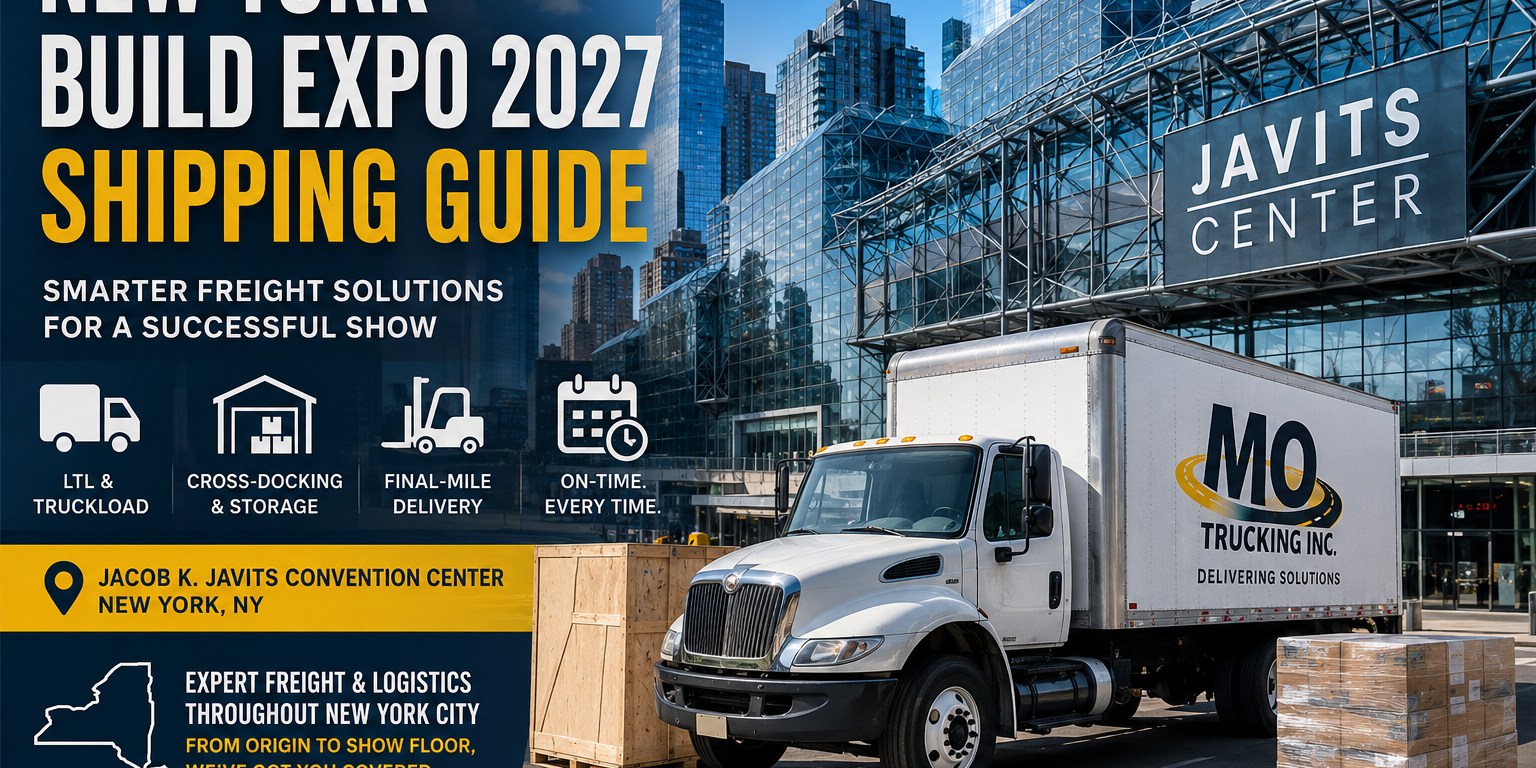
New York Build Expo 2027 Shipping Guide: How to Deliver Exhibitor Freight to the Javits Center
If your company is exhibiting at New York Build Expo 2027, getting your booth displays, construction products, equipment, samples, signage, and promotional materials to Manhattan requires more planning than an ordinary commercial delivery.
New York Build brings together contractors, architects, engineers, developers, manufacturers, suppliers, building-product companies, and construction professionals at the Jacob K. Javits Convention Center in New York City.
For exhibitors, the event represents an opportunity to put products and services in front of thousands of construction-industry professionals.
But before the booth can generate leads, the freight has to arrive.
A successful New York Build Expo Shipping plan should account for long-distance transportation, New York City truck routing, receiving schedules, local staging, short-term storage, cross-docking, final-mile transportation, and return freight after the show.
MO Trucking Inc. helps companies coordinate freight transportation throughout the New York metropolitan area and can provide solutions for exhibitors moving anything from a few pallets of product samples to full trailer loads of booth equipment and construction materials.
Shipping Freight to New York Build Expo 2027
Trade show freight is different from shipping to a normal warehouse.
When a truck delivers to a warehouse or distribution center, there may be a large receiving window and permanent dock staff available to unload freight.
Convention deliveries are different.
Trade shows operate around:
- Move-in schedules
- Freight receiving procedures
- Exhibitor booth numbers
- General service contractor requirements
- Driver check-in procedures
- Freight labels
- Loading dock availability
- Marshaling procedures
- Material handling
- Move-out schedules
That means exhibitors should begin planning transportation well before their freight leaves the origin.
The carrier should know the event name, exhibitor name, booth number, number of pallets or crates, shipment weight, requested delivery date, and any special handling requirements.
Having this information prepared in advance helps reduce delays once the truck reaches New York City.
What Types of Freight Are Shipped to New York Build?
Unlike some trade shows that rely heavily on lightweight displays and printed materials, New York Build exhibitors often showcase physical construction products.
Shipments may contain:
- Doors
- Windows
- Flooring
- Roofing products
- Building materials
- Construction tools
- Machinery
- HVAC equipment
- Lighting products
- Electrical components
- Safety equipment
- Architectural products
- Glass products
- Pumps
- Hardware
- Displays
- Booth structures
- Product samples
- Furniture
- Marketing materials
- Promotional products
Some companies may only have one pallet.
Other exhibitors may have ten, twenty, or more pallets.
Large manufacturers may require a full tractor trailer.
The correct transportation method depends on the size, weight, value, dimensions, and timing requirements of the shipment.
Why Javits Center Freight Delivery Requires Extra Planning
Moving freight into Manhattan presents challenges that do not exist in many other markets.
New York City has:
- Heavy traffic
- Commercial vehicle restrictions
- Limited truck access on certain roads
- Bridge and tunnel considerations
- Busy receiving areas
- Tight delivery schedules
- Limited space for trucks to wait
A truck can travel hundreds of miles without a problem and still encounter complications during the final few miles into Manhattan.
That is why exhibitors should not focus only on the long-distance portion of the shipment.
The final-mile delivery deserves just as much attention.
An experienced local trucking company can help coordinate the transition from interstate transportation to the final delivery movement in New York City.
Do Not Send Freight Too Early Without a Plan
One of the most common trade show shipping mistakes is allowing freight to arrive in New York before it can be received.
If your freight is leaving from states such as:
- Florida
- Texas
- Ohio
- Illinois
- Georgia
- North Carolina
- Pennsylvania
- Michigan
- Massachusetts
- California
you may want the shipment moving several days ahead of the show.
That provides protection against weather, traffic, mechanical problems, and other delays.
However, arriving early creates another problem.
Where will the freight go until it is time for the convention delivery?
This is where local warehouse staging can be valuable.
Use a Local Warehouse Before the Show
A local warehouse can act as a buffer between long-distance freight transportation and the time-sensitive final delivery into Manhattan.
Instead of trying to make a long-haul tractor trailer arrive at exactly the right moment, the freight can move into the New York area ahead of time.
It can then be staged locally until the final delivery is ready to move.
This strategy may be useful for exhibitors who:
- Are shipping from another state
- Expect freight to arrive early
- Have several suppliers
- Need multiple shipments consolidated
- Are using LTL transportation
- Want additional schedule flexibility
- Need temporary storage
- Have booth components arriving on different days
Staging freight locally can give exhibitors more control over the final portion of the shipment.
Cross-Docking for New York Build Exhibitors
Cross-docking can be especially useful for construction-industry exhibitors.
A single booth might involve products from several locations.
For example:
A manufacturer may ship product samples from one facility.
A marketing company may send displays from another warehouse.
A flooring supplier may send booth flooring separately.
Printed brochures may come from a local printer.
Furniture may come from another vendor.
Instead of coordinating several separate final deliveries, the shipments can potentially be received at a local cross-dock facility and consolidated.
The freight can then be staged for a more organized final move.
Cross-docking can help reduce the complexity involved in coordinating multiple vendors.
Short-Term Storage for Trade Show Freight
Temporary storage is another valuable option.
Exhibitors may need storage when:
- Freight arrives before the event receiving period
- A vendor ships early
- Booth equipment arrives before company personnel
- Multiple shipments need to be consolidated
- Return freight cannot immediately leave after the show
Short-term storage gives exhibitors more flexibility.
Instead of leaving freight on a trailer or attempting an early delivery, materials can be held locally until the final delivery is ready.
MO Trucking Inc. can coordinate warehouse, cross-dock, and transportation services for freight moving through the New York metropolitan area.
LTL Shipping for New York Build Exhibitors
Many exhibitors do not need an entire truck.
If you are shipping several pallets, Less-Than-Truckload transportation may provide a cost-effective solution.
LTL shipping can work well for:
- Small booth displays
- Several pallets of samples
- Packaged construction products
- Boxes of promotional materials
- Small equipment
- Furniture
- Printed materials
However, traditional LTL transportation normally involves terminal handling and trailer transfers.
That means transit schedules may be less predictable than a dedicated truck.
For time-sensitive trade show freight, one option is to use LTL transportation to move the freight into a local warehouse and then use a dedicated truck for the final delivery.
This combines the cost advantages of LTL with greater control over the final-mile movement.
Dedicated Truckload Shipping to the Javits Center
Dedicated transportation may be a better choice when timing is critical or when the shipment is large.
A dedicated truck can be useful if:
- Freight fills most of a trailer
- Products are fragile
- Freight is high value
- Multiple pallets must remain together
- Equipment cannot tolerate excessive handling
- Delivery timing is critical
- Freight is unusually large
- Booth components must arrive together
Possible equipment options include:
- Cargo vans
- Sprinter vans
- Straight trucks
- Liftgate straight trucks
- Day cab tractors
- Tractor trailers
- Liftgate trailers
The correct equipment should be chosen based on freight dimensions, weight, loading conditions, and final delivery requirements.
When a Liftgate Truck May Be Needed
Some freight movements require liftgate equipment.
A liftgate may be necessary when the pickup or staging location does not have a loading dock.
It may also be useful for certain final-mile movements where dock-level loading is unavailable.
Before scheduling transportation, confirm whether both the pickup and delivery locations have docks.
Also determine whether the freight can safely be handled using a pallet jack or liftgate.
Very heavy, oversized, or unusually shaped construction products may require additional handling equipment.
NYC Final-Mile Transportation
Final-mile trucking in Manhattan requires careful coordination.
A carrier needs to understand:
- NYC commercial truck routes
- Bridge and tunnel restrictions
- Vehicle height considerations
- Delivery scheduling
- Convention freight procedures
- Traffic conditions
- Truck access points
- Driver check-in requirements
The wrong route or wrong equipment can cause unnecessary delays.
For exhibitors coming from outside the region, separating the long-distance freight movement from the local NYC delivery can provide additional flexibility.
The long-distance truck can deliver to a staging point.
A local truck can then perform the final move.
Why Local Final-Mile Experience Matters
The most expensive part of a transportation problem is not always the mileage.
It can be the delay.
A missed appointment can result in:
- Driver detention
- Rescheduling
- Redelivery
- Extra labor
- Additional handling
- Missed booth setup time
- Emergency replacement transportation
Local knowledge helps reduce these risks.
MO Trucking Inc. serves the New York metropolitan market and can help coordinate the local transportation portion of trade show freight.
Understanding Trade Show Material Handling
Exhibitors should also understand the difference between trucking and convention material handling.
A trucking company transports freight to the designated receiving point.
The company responsible for material handling inside the show may then unload and move the freight to the exhibitor booth.
These can be separate services and separate charges.
Your overall trade show freight budget may include:
- Origin pickup
- Long-distance transportation
- Local warehouse handling
- Storage
- Cross-docking
- Final-mile trucking
- Convention material handling
- Return transportation
Understanding each part of the process can prevent surprises later.
Plan for Emergency Freight
Even a well-planned exhibit can experience unexpected problems.
A crate gets left at the warehouse.
A sample breaks.
A replacement product is needed.
Additional marketing materials must be shipped.
A booth component arrives at the wrong destination.
An exhibitor suddenly needs an additional pallet brought into Manhattan.
When this happens, standard LTL service may not be fast enough.
Depending on the shipment, expedited transportation may involve:
- Cargo van service
- Sprinter van service
- Dedicated straight truck
- Dedicated tractor trailer
- Same-day local trucking
- Expedited interstate trucking
When the show is approaching, speed and communication become extremely important.
Construction Equipment and Oversized Freight
Construction trade shows often involve freight that is heavier or larger than a standard pallet.
Before shipping unusual freight, provide accurate details.
Include:
- Length
- Width
- Height
- Weight
- Commodity description
- Number of pieces
- Whether freight is stackable
- Whether equipment has wheels
- Whether freight requires special securement
- Whether loading equipment is available
Do not estimate dimensions for oversized freight.
Accurate measurements help determine the correct truck and prevent problems at pickup.
Direct Delivery vs. Local Staging
There are situations where direct delivery may work perfectly.
Direct transportation may make sense when:
- The shipment originates near New York City
- Pickup timing is predictable
- Freight is traveling on dedicated equipment
- The receiving schedule is confirmed
- The carrier understands the show requirements
Local staging may make more sense when:
- Freight is traveling a long distance
- Several vendors are shipping products
- Freight may arrive early
- LTL transportation is being used
- Multiple shipments need consolidation
- Temporary storage is required
For some exhibitors, the ideal transportation plan may look like this:
Origin → New York-area warehouse → Cross-dock or storage → Dedicated local truck → Javits Center
This provides a buffer between the long-distance trip and the time-sensitive final delivery.
Build Extra Time Into Your Freight Schedule
Do not build your transportation plan around perfect conditions.
Unexpected delays happen.
Weather can slow freight.
Traffic can delay drivers.
Loading appointments can run behind schedule.
A mechanical problem can occur.
A terminal can delay an LTL shipment.
Trade show deadlines do not move simply because transportation is running late.
Whenever practical, allow extra time.
Moving critical freight into the region before the show can provide additional protection.
Consolidating Multiple Exhibitor Shipments
Large booths frequently involve multiple vendors.
Instead of allowing every supplier to independently arrange transportation to Manhattan, exhibitors may benefit from coordinating freight through one location.
For example:
Supplier A ships product samples.
Supplier B ships booth displays.
Supplier C ships flooring.
Supplier D ships promotional materials.
All four shipments move into a local staging warehouse.
Once everything arrives, the freight can be organized for final transportation.
This approach can reduce the number of separate trucking movements and make the exhibit easier to manage.
Return Freight After New York Build
Do not focus only on getting freight into the show.
You also need to get it out.
Before the event begins, decide:
- What freight is returning
- Where it is going
- How many pallets will return
- Whether freight needs temporary storage
- Whether LTL or dedicated service will be used
- Whether products need to be shipped to multiple locations
- Who will be responsible for coordinating pickup
Creating the outbound plan ahead of time makes move-out much easier.
Post-Show Storage
Sometimes freight cannot immediately return to its origin.
The destination warehouse may not be ready.
Marketing equipment may be needed for another event.
The company may want to reorganize products before shipping them back.
In these cases, temporary local storage can help.
Freight can potentially be staged and then shipped once the next transportation plan is confirmed.
Shipping to Another Trade Show After New York Build
Companies that exhibit nationally may be moving the same booth from one event to another.
Instead of returning everything to the original warehouse after New York Build, it may make more sense to stage the freight locally before shipping to the next trade show.
This can reduce unnecessary transportation miles.
It can also allow the exhibitor to:
- Inspect booth materials
- Replace damaged pieces
- Consolidate freight
- Add new marketing materials
- Repack equipment
- Prepare for the next event
A flexible logistics plan can support an entire trade show schedule rather than a single event.
Information Needed for a Freight Quote
To receive an accurate quote, provide the following information.
Pickup Details
- Pickup company
- Pickup city and state
- Pickup ZIP code
- Pickup date
- Pickup hours
- Dock availability
- Liftgate requirements
Shipment Details
- Number of pallets
- Number of crates
- Dimensions
- Total weight
- Commodity
- Stackable or non-stackable
- Special handling requirements
Delivery Details
- Event name
- Exhibitor name
- Booth number
- Requested delivery date
- Requested delivery time
- Delivery instructions
- Show contractor instructions
Additional Services
Let us know whether you need:
- LTL transportation
- Dedicated truckload
- Straight truck service
- Liftgate equipment
- Tractor trailer service
- Cross-docking
- Temporary storage
- Expedited shipping
- NYC final-mile delivery
- Return transportation
More information allows the carrier to recommend the correct transportation solution.
New York Build Expo Freight Shipping Checklist
Before your freight leaves the origin, confirm:
- Exhibitor name
- Booth number
- Correct shipping instructions
- Required freight labels
- Number of pallets
- Number of crates
- Shipment dimensions
- Total weight
- Commodity description
- Pickup appointment
- Required delivery date
- Delivery instructions
- Dock requirements
- Liftgate requirements
- NYC final-mile plan
- Local storage if required
- Cross-dock plan if required
- Return transportation
- Emergency contact information
Taking care of these details before pickup can help prevent unnecessary problems later.
Why Work With MO Trucking Inc.?
MO Trucking Inc. provides trucking and logistics services throughout the New York metropolitan area.
We help customers coordinate:
- Full truckload transportation
- LTL freight
- Dedicated transportation
- Straight trucks
- Tractor trailers
- Liftgate service
- Cross-docking
- Short-term storage
- Expedited transportation
- Final-mile delivery
- NYC freight transportation
- Return freight
Our location and experience in the New York market can be especially useful for companies shipping freight into the region from another state.
Instead of leaving the entire process to a long-distance carrier unfamiliar with your local requirements, freight can be staged and transitioned to a local transportation solution when appropriate.
A Better Way to Plan New York Build Freight
The best transportation strategy is rarely the one created the day before the show.
Start by working backward from the required delivery date.
Determine when the freight should leave the origin.
Build in enough time for unexpected delays.
Decide whether direct delivery or local staging makes more sense.
Choose the correct equipment.
Confirm your return freight plan before the show begins.
A carefully organized New York Build Expo Shipping strategy can provide exhibitors with greater control over their freight while reducing the risk of last-minute transportation problems.
Need a Freight Quote for New York Build Expo 2027?
If your company will be exhibiting at New York Build Expo 2027 and needs help moving booth displays, construction materials, product samples, machinery, equipment, crates, or palletized freight into the New York area, MO Trucking Inc. can help.
We can coordinate transportation solutions for shipments requiring:
- LTL freight
- Dedicated truckload service
- Straight trucks
- Tractor trailers
- Liftgate equipment
- Cross-docking
- Temporary storage
- Expedited transportation
- Manhattan final-mile delivery
- Return freight
Whether you are shipping one pallet or an entire trailer, planning ahead can help make the move into New York City smoother.
For companies looking for reliable New York Build Expo Shipping, MO Trucking Inc. can help coordinate the transportation, staging, and local delivery portions of the shipment.
Request a Freight Quote
MO Trucking Inc.
Email: Eric@motruckinginc.com
Phone: 631-755-5858
Text / After Hours: 516-250-4480
For the fastest quote, send:
Pickup ZIP + Delivery Date + Number of Pallets + Dimensions + Weight + Commodity
Frequently Asked Questions
Can I ship only a few pallets to New York Build?
Yes. LTL transportation may work well for exhibitors shipping a smaller number of pallets, depending on timing and freight requirements.
Should I send my freight directly to Manhattan?
It depends on the shipment. Direct delivery may work well for nearby dedicated transportation, while freight traveling long distances may benefit from local staging before the final delivery.
Can several vendor shipments be consolidated?
Yes. Cross-docking can be useful when booth materials are arriving from multiple suppliers and need to be organized before final transportation.
Can my freight be stored before the show?
Short-term storage may be available for freight that arrives in the New York area before the required final delivery date.
What kind of truck should I use?
The correct truck depends on shipment dimensions, weight, loading requirements, delivery requirements, and the number of pallets or crates. Options can include straight trucks, liftgate trucks, tractor trailers, and dedicated vehicles.
Can MO Trucking handle final-mile delivery in New York City?
MO Trucking Inc. provides trucking and final-mile transportation services throughout the New York metropolitan area, including Manhattan.
Should I book my return freight before the show?
Yes. Planning outbound transportation before the show begins can reduce stress and help avoid last-minute equipment availability problems.
What information is needed for a quote?
Provide the pickup ZIP code, pickup date, delivery date, number of pallets or crates, dimensions, total weight, commodity, and any special equipment or handling requirements.
If you are exhibiting at New York Build Expo 2027, start planning your transportation before the freight is ready to leave.
MO Trucking Inc. can help coordinate the long-distance, warehouse, cross-dock, storage, and final-mile portions of your trade show logistics.
Email: Eric@motruckinginc.com
Phone: 631-755-5858
Text / After Hours: 516-250-4480