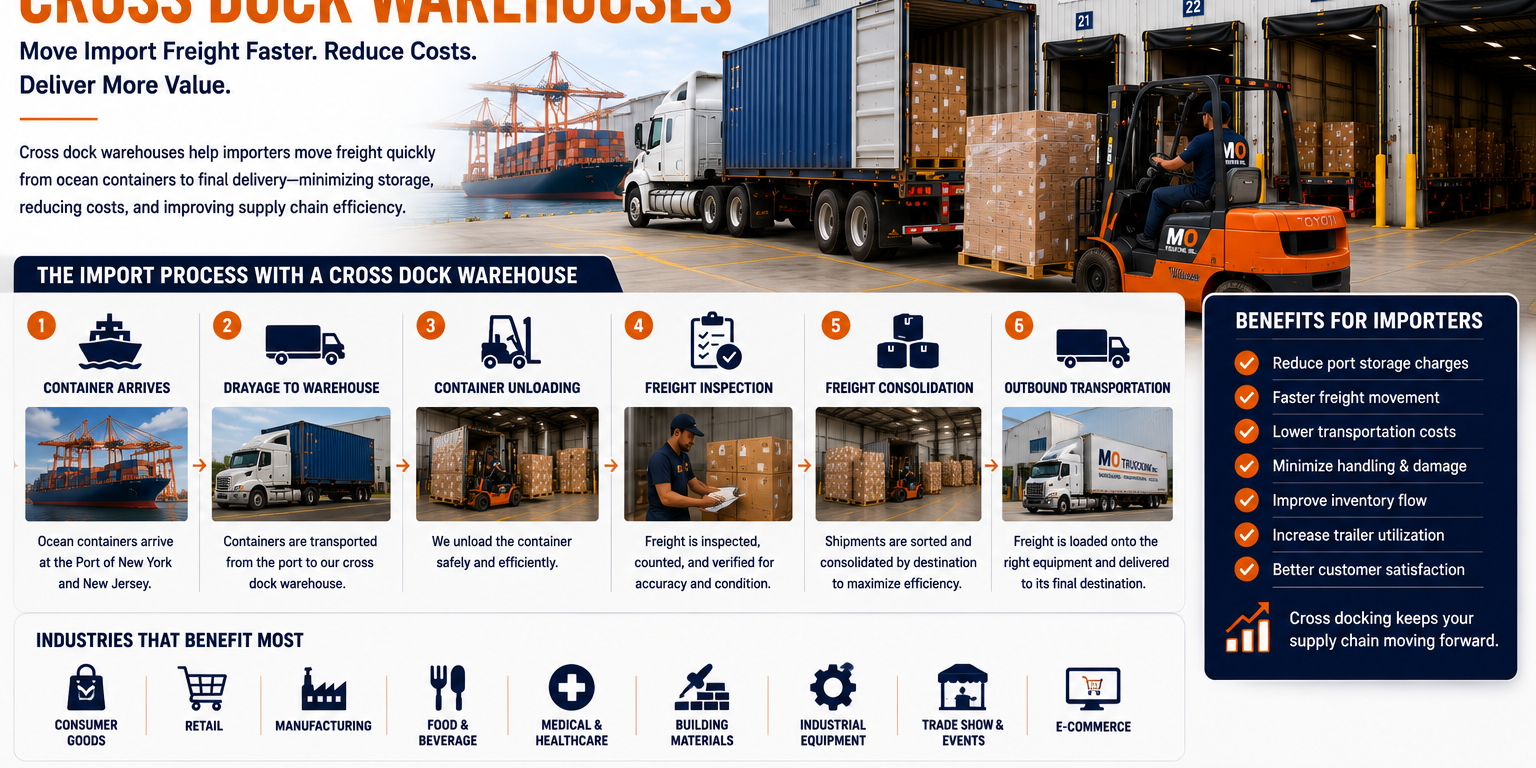
How Importers Use Cross Dock Warehouses
Every day, thousands of shipping containers arrive through the Port of New York and New Jersey carrying products destined for retailers, manufacturers, distributors, and consumers across the United States.
Moving imported freight efficiently is critical to controlling logistics costs. That’s why many importers rely on a Cross Dock Warehouse New York to quickly transfer freight from inbound containers to outbound transportation.
Instead of storing products for extended periods, cross dock warehouses help importers move freight faster while reducing transportation costs and improving supply chain efficiency.
Why Importers Use Cross Dock Warehouses
Importers often work under tight delivery schedules.
Leaving freight sitting at the port or in long-term storage can create unnecessary costs.
Cross docking allows freight to continue moving almost immediately after arrival.
Step 1 – Container Arrives
Ocean containers arrive at the Port of New York and New Jersey.
Depending on the shipment, containers may be:
- 20-foot
- 40-foot
- High cube
- Floor loaded
- Palletized
Step 2 – Drayage to the Warehouse
Containers are transported from the port to the cross dock warehouse.
This keeps the port moving while allowing freight to be processed more efficiently.
Step 3 – Container Unloading
Warehouse personnel unload the container.
Typical services include:
- Manual unloading
- Inventory verification
- Piece counts
- Freight inspection
- Pallet building
- Stretch wrapping
Step 4 – Freight Inspection
Before outbound shipping, freight is checked for:
- Damage
- Labels
- Quantities
- Purchase orders
- Delivery information
This helps reduce shipping errors.
Step 5 – Freight Consolidation
Many importers receive products from multiple suppliers.
Cross dock warehouses allow shipments to be combined before outbound transportation.
This improves trailer utilization while reducing shipping costs.
Step 6 – Outbound Transportation
Once prepared, freight is loaded into:
- Dry van trailers
- Liftgate trailers
- Straight trucks
- Local delivery vehicles
Products immediately continue toward customers.
Benefits for Importers
Cross dock warehouses help importers:
- Reduce port storage charges
- Improve delivery speed
- Lower transportation costs
- Reduce freight handling
- Improve inventory flow
- Increase trailer utilization
- Improve customer satisfaction
Which Importers Benefit Most?
Cross dock warehouses are ideal for importers handling:
- Consumer goods
- Retail merchandise
- Manufacturing materials
- Food products
- Medical equipment
- Building materials
- Trade show exhibits
- Industrial equipment
Frequently Asked Questions
Why do importers use cross dock warehouses?
To reduce port storage charges, improve delivery speed, and lower transportation costs.
Can imported freight be delivered the same day?
Depending on scheduling, many shipments can move immediately after processing.
Do cross dock warehouses store imported freight?
They can, but the primary purpose is moving freight quickly rather than long-term storage.
Can multiple containers be consolidated?
Yes. Freight from multiple containers can be combined into efficient outbound shipments.
Is cross docking better than long-term storage?
For freight that needs immediate distribution, cross docking is often the more efficient and cost-effective solution.
Final Thoughts
Importers face constant pressure to reduce costs while delivering products faster. Cross dock warehouses provide an efficient way to move freight from the port into domestic transportation with minimal delays.
By reducing storage time, improving freight flow, and increasing transportation efficiency, cross docking helps importers create stronger, more responsive supply chains.
Ready to Streamline Your Import Freight?
If you’re looking for a faster and more efficient way to move imported freight, Request a Free Quote and our logistics team will design the right warehouse solution for your operation.
Need help with import freight, container unloading, or cross docking? Contact Our Warehouse Team today to discuss your project.